On March 9, 2026 — a date that fans have long celebrated as "Miku Day" thanks to the phonetic wordplay of "39" sounding like "Miku" in Japanese — YouTube's top page logo changed to a special Hatsune Miku-themed Yoodle for one day only.
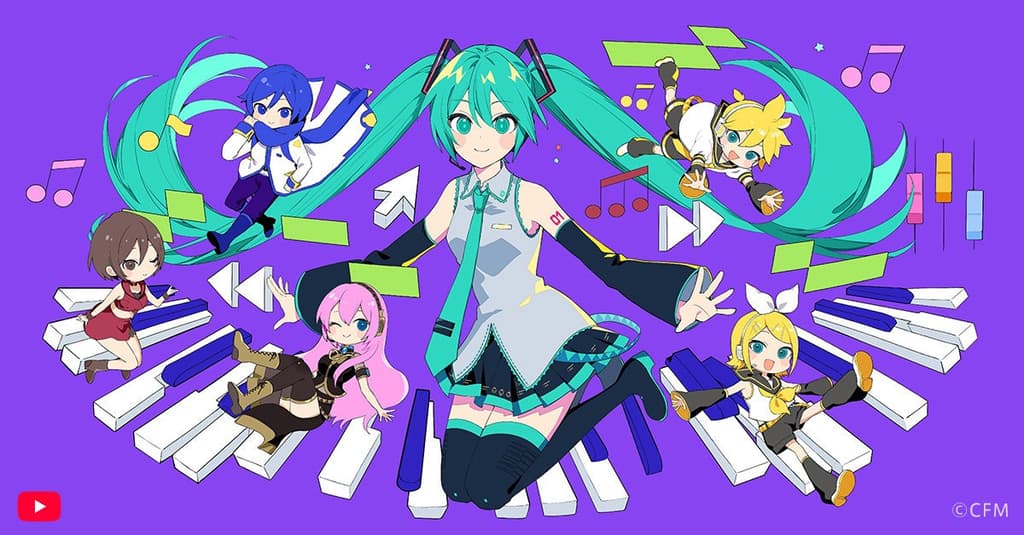
The Yoodle logo and animation were created by illustrator Omutatu, depicting Hatsune Miku as a voice synthesis software coming to life, singing songs crafted by music creators and delivering them to the world. Clicking on the Miku-themed Yoodle on YouTube's top page brought up a specially curated playlist also released on the same day. The illustration of the Piapro Characters — the collective name for Crypton Future Media's virtual singers including Hatsune Miku, Kagamine Rin, Kagamine Len, Megurine Luka, MEIKO, and KAITO — displayed at the top of the playlist was also a newly drawn work by Omutatu.
As part of this initiative, a special program hosted by Hatsune Miku herself, "MIKU TONIGHT!" (https://youtu.be/LeSkX_1w28g), was also published on YouTube. The program features three creators active both in Japan and internationally — Pinocchio-P, SAWTOWNE, and DECO*27 — along with Crypton Future Media CEO Hiroyuki Ito, who is known as "the creator of Hatsune Miku." The program looks back at the co-creation culture that grew into a global movement after Hatsune Miku's debut, now widely recognized as "VOCALOID culture," and offers perspectives on where it is headed.
In a comment posted on the YouTube Official Blog, CEO Hiroyuki Ito reflected on what makes Hatsune Miku unique:
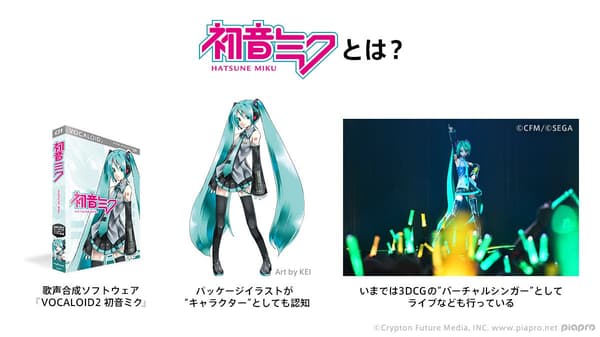
Hatsune Miku has two aspects. One is as a music production software that synthesizes a singing voice when lyrics and a melody are entered. The other is as a character illustrated on the software's packaging. Having both of these aspects at the same time allowed Hatsune Miku to develop into a movement where creative works spanning multiple genres — music, illustration, video, and more — were produced simultaneously and organically.
YouTube has played an important role in supporting this movement. It is not just a place for creators to present their work, but also a place to spread their work, a place for creators and fans to communicate, and even a place for creators to earn compensation for their work. It can be called an ecosystem supporting this creative movement.
I would be very happy if the release of the Yoodle on the special day known among fans as "Miku Day" leads to more attention for Hatsune Miku and the works of her creators.
— Hiroyuki Ito, CEO, Crypton Future Media, Inc.
A "Yoodle" refers to a feature where YouTube's top page logo is temporarily changed to a special design tied to a specific theme for a limited period.
About Hatsune Miku
Hatsune Miku is a voice synthesis software developed by Crypton Future Media in 2007, capable of singing when lyrics and melody are entered. The character depicted on the software's packaging, recognizable by her teal twintails, became a cultural phenomenon as an enormous number of songs created with the software were posted online, sparking a chain of creative works including illustrations, dances, and more. Today Hatsune Miku also performs as a "virtual singer" across a wide range of contexts.
In Japan, the event "Hatsune Miku: Magical Mirai" — which combines a live concert with a creative exhibition — has drawn more than 580,000 visitors cumulatively since 2013, with 2026 performances planned in Osaka, Tokyo, and Hamamatsu. Internationally, the world tour series "HATSUNE MIKU EXPO" has completed more than 120 performances across 50 cities, including a first-ever Asia tour in November 2025. North American and European tours are scheduled for 2026.
About VOCALOID
The term VOCALOID originally refers to a voice synthesis technology and its associated software developed by Yamaha Corporation in 2003, which enables users to produce the vocal part of a song simply by entering lyrics and melody information. Today the term "voca-song" (ボカロ曲) is broadly used to describe music produced using voice synthesis software — including software that does not use the VOCALOID technology — and "VOCALOID" is sometimes used as a genre name in the music scene.
"VOCALOID" and "Vocaloid" are registered trademarks of Yamaha Corporation.