Naoshima New Museum of Art in Kagawa Prefecture, led by Director Akiko Miki, has set "Circulation, Return, Rebirth" (循環・回帰・再生) as its season theme for 2026 and has been rotating part of its displays twice, in spring and winter. Following the spring rotation, the winter rotation opens on Saturday, December 12, 2026, with an exhibition by Kei Imazu and Bagus Pandega.
"Currents without Anchors" (錨なき流れ)
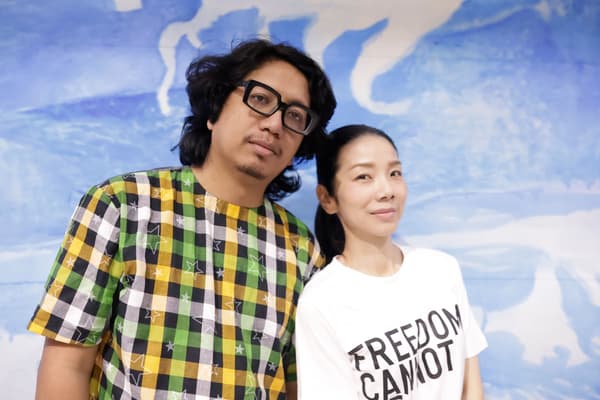
Kei Imazu (born 1980 in Yamaguchi Prefecture) and Bagus Pandega (born 1985 in Jakarta, Indonesia) are both based in Bandung, Indonesia. "Currents without Anchors" is their first full-scale joint exhibition in a museum.
The exhibition grew out of thoughts on the connection between the Seto Inland Sea and Indonesia, both environments made up of islands surrounded by the sea. It aims to visualize the movement of resources across the sea, the expansion of desire, and the memories of disasters and wars that come with them, through concepts such as "current," "purification and preservation," and "destruction and regeneration."
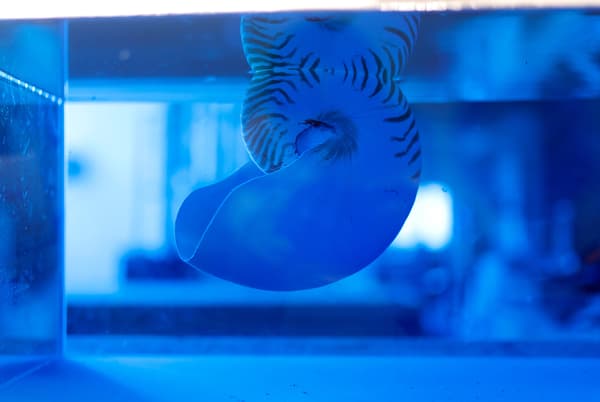
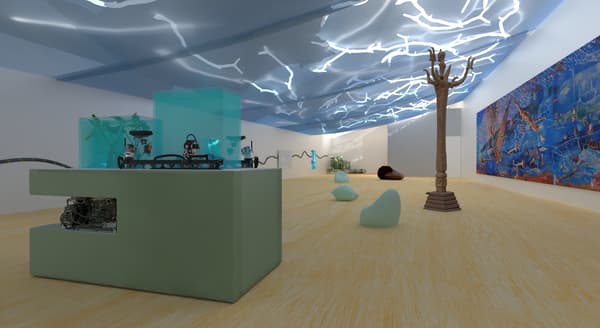
Past, present, and future, and myth and historical fact, cross and overlap in a space that evokes the sea and the forest. Light that changes like waves, a large quantity of driftwood, large-scale paintings, and sculptures that play sounds connect with natural materials. Together they resemble a breathing "giant living organism," and visitors are invited to think deeply about the environment and the state of the world we live in.

Artist Statement
According to the artists, "Currents without Anchors" is an installation in which painting, machines, plants, water, copper, light, and sound react to one another and circulate like a single breathing ecosystem. The word "current" carries several meanings: ocean currents, water currents, electric currents, the flow of information, and the present ("現在") in which we live.
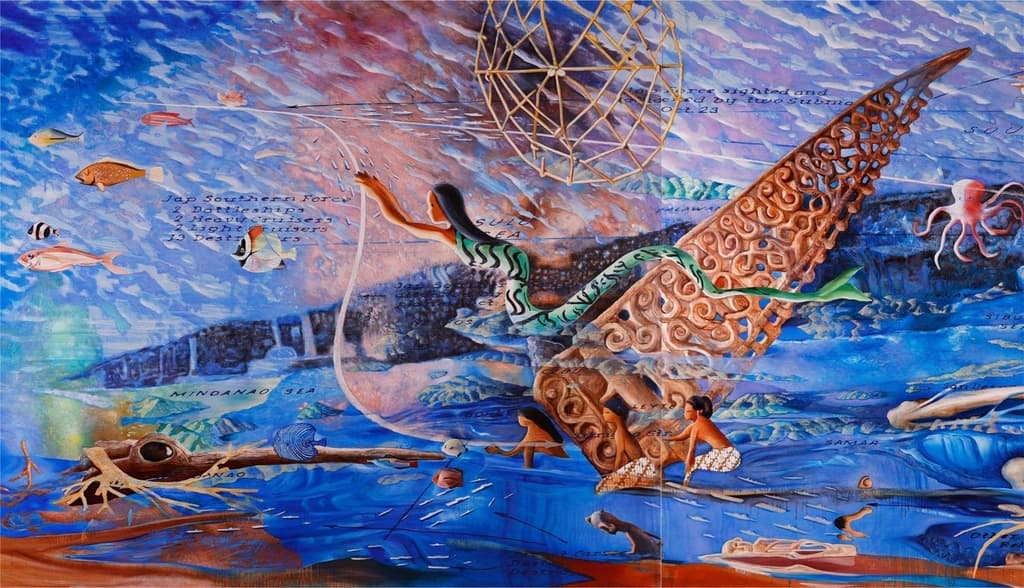
The sunken ships on the seabed painted in Imazu's huge painting were once artifacts used for war and the transport of resources, but they are now ecosystems where coral and fish live, and have become diving spots. At the same time, petroleum fuel, anti-rust copper paint, and metals continue to affect the marine environment as remnants of war. Nature does not erase human history. It takes in its traces and turns them into another ecosystem.
In Pandega's copper plating device, copper, which has long been an industry on Naoshima, keeps moving through electricity, and the reaction is converted into the flickering light of trees floating in the sea overhead. The biosignals of mangroves, which live in brackish water between sea and land, move the sound and images, and the plants themselves become the agents that change the work. Humans can design this system, but they cannot fully control it.
The artists say "current" does not treat humans and nature as opposites. It shows that human history, war, technology, minerals, plants, and the sea all exist within the same huge cycle. On the sea that connects Naoshima and Indonesia, the past never ends and keeps flowing through the present by way of matter and life.
The Artists
Kei Imazu
Born in 1980 in Yamaguchi Prefecture and based in Bandung, Indonesia. Imazu digs up the vast image archives of the internet age and archaeologically reconstructs the fragmented digital space. Based on research, she assembles preliminary drawings with 3D rendering and digital sketches, and while also introducing CGI, Unreal Engine, and 3D printing, she develops paintings rooted in intuition and bodily sense. Since moving to Indonesia in 2018, she has treated archipelagic myths and oral traditions, layered colonial history, and Japan's wartime involvement as layered territories. Recently, through solo exhibitions at Tokyo Opera City Art Gallery and Museum MACAN, she has expanded her expression into video, sculpture, and immersive installations.
Bagus Pandega
Born in 1985 in Jakarta, Indonesia, and based in Bandung, Indonesia. Pandega takes the history and present of resource extraction as his subject, from the 16th-century spice trade to palm oil and nickel for batteries. Using DIY and hacker-style methods, he makes devices that combine familiar technology, plants, rare earth minerals, and musical instruments. He presents installations that run machines and chemical reactions producing sound and movement in response to hyper-local environmental changes such as the presence of people. He holds a master's degree from Bandung Institute of Technology, and has recently held solo exhibitions at Kunsthalle Basel and the Swiss Institute.
Opening Day and Museum Closure
Opening day, Saturday, December 12, 2026
On December 12 (Sat), the museum is closed from 10:00 AM to 12:00 PM, which differs from the usual opening hours, and opens to the general public from 12:00 PM. The following special programs are planned. They are free to join, but a ticket to the museum for the day is required. No registration is needed, and participants can simply gather at the venue.
- 1:00 PM: Opening remarks and exhibition introduction. Venue: Gallery 1 (1st floor).
- 2:00 PM: Talk by Kei Imazu and Bagus Pandega. Venue: multipurpose cafe space "&CAFE." Japanese–English consecutive interpretation is planned.
- 3:00 PM: Talk and reading by Kenjiro Okazaki and ぱくきょんみ. Venue: "&CAFE."
- 4:00 PM: Book sale and signing by Kenjiro Okazaki, and more. Venue: "&CAFE."
The artist talks and other programs at "&CAFE" are hosted by Akiko Miki, Director of the museum, and also include an exchange session.
Closure for the rotation
All areas of the museum, including "&CAFE," are temporarily closed from November 24 (Tue) to 12:00 PM on December 12 (Sat), 2026, and the museum opens to the general public at 12:00 PM on December 12. The cafe service at "&CAFE" starts on December 13 (Sun).
Works that remain on view after the rotation
- N. S. Harsha ("&CAFE," 1st floor)
- Martha Atienza (Gallery 1, 1st floor)
- Do Ho Suh (Gallery 2, 1st basement floor)
- Kenjiro Okazaki, Takashi Murakami, and Makoto Aida (Gallery 3, 2nd basement floor)
- Cai Guo-Qiang (Gallery 4, 2nd basement floor)
- Sanitas Pradittasnee (outdoors)
- Satellite exhibition of Motoyuki Shitamichi's project 瀬戸内「 」資料館 (entrance)
- Indieguerillas (Library Project, 1st basement floor)
The exhibiting artists may change in the future without notice.
Public Programs
Workshops
Flower Casting Workshop
Participants make a flower relief, one of the motifs in Pannaphan Yodmanee's work Aftermath (アフターマス), and look at themselves and the world from a different perspective than usual.
- Date and time: Saturday, October 24, 2026, 1:00 PM–2:30 PM
- Venue: "&CAFE," Naoshima New Museum of Art
- Eligibility: Elementary school students and older. Children in 3rd grade or below must be accompanied by a guardian.
- Fee: Free. A ticket to the museum for the day is required.
- Capacity: 10 people (reservation required, first come, first served)
- Details: https://benesse-artsite.jp/news/20261001-3606.html
Meditation: The Sound of Naoshima
In the stupa SILENCE of Sanitas Pradittasnee's work The Sound of Naoshima, participants take part in a simple meditation, spending a calm time as one with nature while listening to the sound of bells and the wind.
- Dates: Tuesday, November 3 (national holiday), Sunday, November 22, and Sunday, December 20, 2026. All sessions run 9:15 AM–9:45 AM with the same content.
- Venue: The outdoor work The Sound of Naoshima, Naoshima New Museum of Art
- Eligibility: Ages 15 and over who can follow explanations in Japanese
- Fee: Free. Those who enter the museum need to buy a separate ticket.
- Capacity: 5 people per session (reservation required, first come, first served)
- This program is in Japanese only. It may be canceled at the organizer's discretion due to rain or other reasons, and participants will be contacted by the day before.
- Details: https://benesse-artsite.jp/news/20261001-3608.html
Different Together! Collage Workshop
Using the collaborative work by Heri Dono and Indieguerillas, 《人類の自覚:中心への旅》, as a clue, participants experience the fun and difficulty of making something together with others.
- Date and time: Saturday, November 7, 2026, 1:00 PM–2:30 PM
- Venue: "&CAFE," Naoshima New Museum of Art
- Eligibility: Elementary school students and older. Children in 3rd grade or below must be accompanied by a guardian.
- Fee: Free. A ticket to the museum for the day is required.
- Capacity: 10 people (reservation required, first come, first served)
- Details: https://benesse-artsite.jp/news/20261001-3607.html
Tours and Guidance
Gallery Guidance by Staff
A short guidance session to help visitors enjoy the museum more deeply. It is held in Japanese only.
- Date and time: Every Wednesday, 10:15 AM–10:30 AM and 2:00 PM–2:15 PM
- Venue: Naoshima New Museum of Art
- Fee: Free. A ticket to the museum for the day is required.
- Capacity: 10 people per session. No advance reservation is needed.
- Those who wish to join should gather at the reception counter in the museum by the start time.
Kids Gallery Tour
A gallery tour in which children living on Naoshima guide visitors through the works in their own words.
- Period: Scheduled to start in sequence from November onward
- Venue: Naoshima New Museum of Art
- Fee: Free. A ticket to the museum for the day is required.
- Capacity: 10 people. No advance reservation is needed.
- When a tour is held, guidance is provided at the reception counter in the museum.
THE NAOSHIMA MEETING 2026-2028
Organized by Benesse Art Site Naoshima, the symposium "直島会議 / THE NAOSHIMA MEETING" looks at art, architecture, community, the environment, and society from the perspective of a remote island. To mark about 40 years since Benesse Art Site Naoshima began its activities, it will be held as a five-part series, "THE NAOSHIMA MEETING 2026-2028," from November 2026 to 2028. Each session has a different theme and will take various forms, such as talks and symposiums, with experts from Japan and abroad. Details will be announced as they are decided.
The first session features Soichiro Fukutake, who has led the activities of Benesse Art Site Naoshima, and Tadao Ando, who realized ten architectural projects on Naoshima, as they discuss their trajectory of collaboration and joint struggle.
Session 1: "From the Island to the World: Soichiro Fukutake × Tadao Ando – Looking Back on the Trajectory of Collaboration, Joint Struggle, and Challenge" (島から世界へ:福武總一郎×安藤忠雄―協働・共闘・挑戦の軌跡を振り返る)
- Date and time: Saturday, November 14, 2026, 1:30 PM–3:15 PM
- Venue: Benesse House Park Hall
- Speakers: Soichiro Fukutake (Honorary Advisor of Benesse Corporation and Honorary Chairman of the Fukutake Foundation) and Tadao Ando (architect)
- Hosts: Akiko Miki (Director of Naoshima New Museum of Art and International Artistic Director of Benesse Art Site Naoshima) and Ryoji Kasahara (笠原良二, Secretary-General of the Fukutake Foundation)
- Fee: Free
- Capacity: 100 people (reservation required, first come, first served)
- Organizer: Benesse Art Site Naoshima (Benesse Corporation and the Fukutake Foundation)
- Details: https://benesse-artsite.jp/news/20261001-3610.html
About Naoshima New Museum of Art
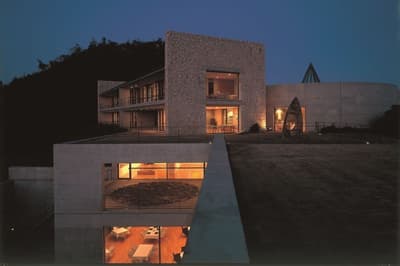
Naoshima New Museum of Art opened in May 2025 on a hill near the Honmura district. It is the 10th art facility designed by Tadao Ando in Benesse Art Site Naoshima. The museum mainly exhibits and collects representative works and commissioned works by artists from across Asia, including Japan. The three-story building has four galleries, a cafe, and an outdoor exhibition area.
While the other museums of Benesse Art Site Naoshima mainly show permanent exhibitions, this museum combines permanent displays with exhibitions that partially change over time, so visitors can encounter new art on each visit. Besides exhibitions, it also holds talks, workshops, and other public programs that create dialogue and exchange among visitors from Japan and abroad.
Visitor Information
- Address: 3299-73 Naoshima-cho, Kagawa-gun, Kagawa Prefecture
- Hours: 10:00 AM–4:30 PM (last entry 4:00 PM)
- Closed: Mondays (open if Monday is a national holiday, and closed the next day). Irregular closures may occur, and the opening calendar on the Benesse Art Site Naoshima website is updated as needed.
- Parking: 20 spaces for regular vehicles and about 15 for bicycles, both free
- Official website: https://benesse-artsite.jp/art/nnmoa.html
Tickets
- Admission: Online purchase (date specified) ¥1,500 / window purchase ¥1,700 / free for ages 15 and under
- Online tickets for December 12 (Sat) and later, when the new exhibition can be seen, go on sale on Friday, October 9, 2026, at 10:00 AM.
- Ticket sales: On the Benesse Art Site Naoshima museum reservation site: https://benesse-artsite.jp/general-information.html