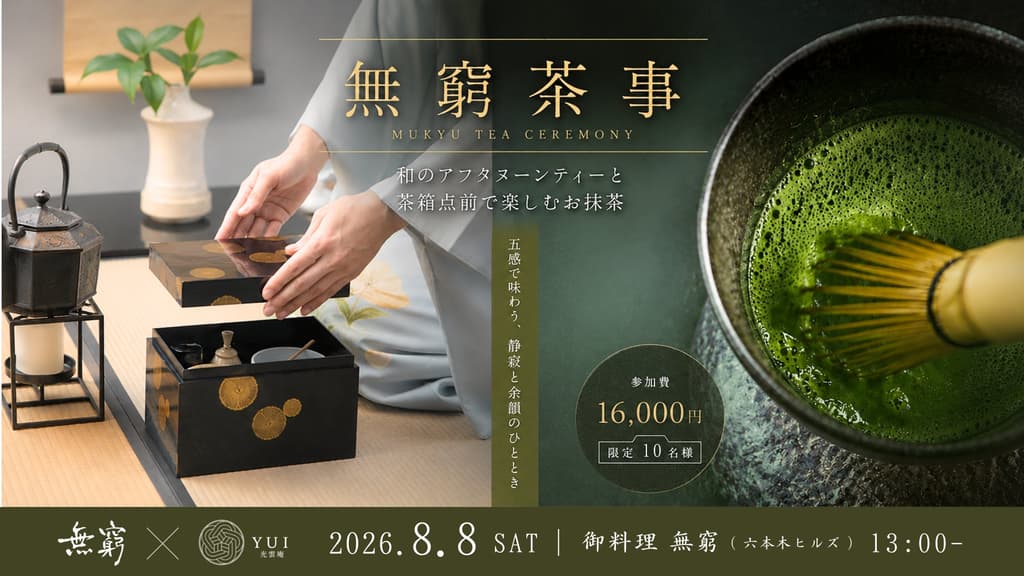
Goryori Mukyu, a kappo-style Japanese restaurant in Roppongi Hills, is holding a one-day collaboration event called "Mukyu Chaji" on Saturday, August 8, 2026, limited to 10 guests. The event is presented together with Kyoko Ishikawa, an Urasenke tea ceremony instructor who runs the tea room Koun-an in Ebisu, Tokyo.
Bringing Japanese Cuisine and Tradition Together at Goryori Mukyu
At Goryori Mukyu, Japanese cuisine is treated as more than just a meal. The restaurant aims to deliver a full Japanese-culture experience, one that takes in an appreciation for the seasons, tableware and table settings, manners, and the spirit of hospitality.
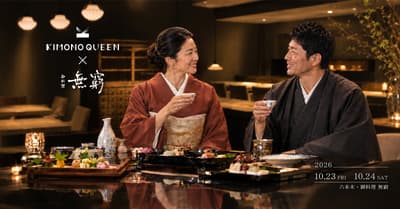
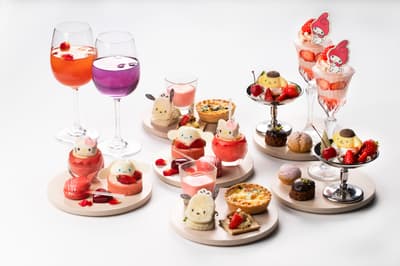
As part of that approach, Mukyu has continued to hold events pairing Japanese food and culture, including past themes such as "kimono and Japanese cuisine" and "table tea ceremony and Japanese assiette desserts," offering guests ways to enjoy Japanese culture through both attire and food.
This time, the restaurant resonates deeply with Kyoko Ishikawa, who runs the tea room Koun-an in Ebisu, Tokyo, bringing together the shared aesthetic worlds of Japanese cuisine and tea ceremony as a single experience.
Kimono, tea ceremony, and Japanese cuisine are all traditions passed down over a long history, yet their formality and etiquette can feel like a high barrier for those experiencing them for the first time. Through a Japanese afternoon tea, a chabako tea ceremony, and an explanation of how to enjoy matcha, this event offers an approachable way to experience the essence of a tea gathering and the aesthetic sensibility at its heart.
Goryori Mukyu plans to continue pairing Japanese cuisine with a range of traditional arts, introducing new facets of Japanese culture to visitors from Japan and abroad.
A Japanese Afternoon Tea Paired With a Chabako Tea Ceremony
On the day, guests will first enjoy a colorful, one-of-a-kind Japanese afternoon tea created especially for the event by owner-chef Shotaro Igarashi. Afterward, Kyoko Ishikawa will perform a formal chabako temae — a tea ceremony procedure using a compact tea box — to serve guests matcha.
August 8 also happens to be the day of the Jingu Gaien Fireworks Festival, so guests are welcome to attend in yukata. While honoring the essence of a traditional tea gathering, the event is designed to feel approachable for everyday life today, giving guests with no tea ceremony background a chance to encounter its spirit and beauty.
A One-Day-Only Japanese Afternoon Tea, Created by the Owner-Chef
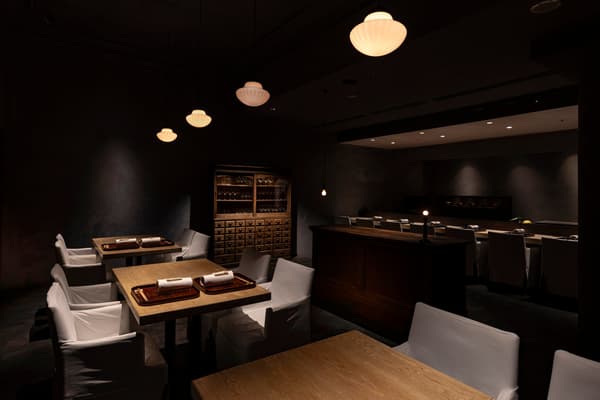
Drawing on the techniques and sensibility of Japanese cuisine, Igarashi has created a one-day-only Japanese afternoon tea featuring seasonal sweets and light dishes. Each course comes paired with a tea suited to its flavor, in a seating that reflects Goryori Mukyu's own style.
Note: The lineup on the day may change depending on available ingredients and the season.
A Signature Live Performance: Freshly Kneaded, Freshly Wrapped Daifuku
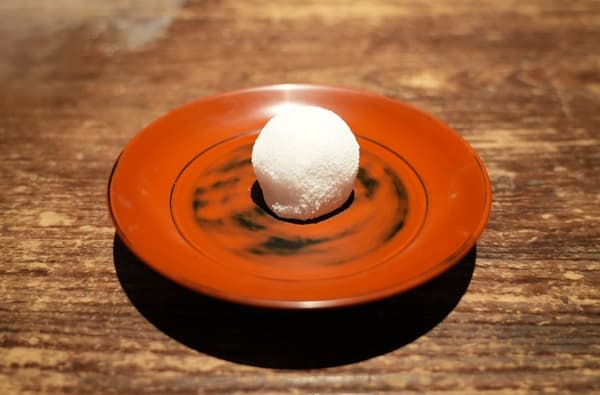
The afternoon tea closes with Mukyu's signature daifuku, a favorite since the restaurant's opening. Guests watch as the mochi is kneaded and filled with bean paste right in front of them, each piece finished individually. Freshly kneaded and freshly wrapped, the daifuku offers a soft texture and delicate melt-in-the-mouth finish that comes only from being made to order.
A Chabako Tea Ceremony From Kyoko Ishikawa
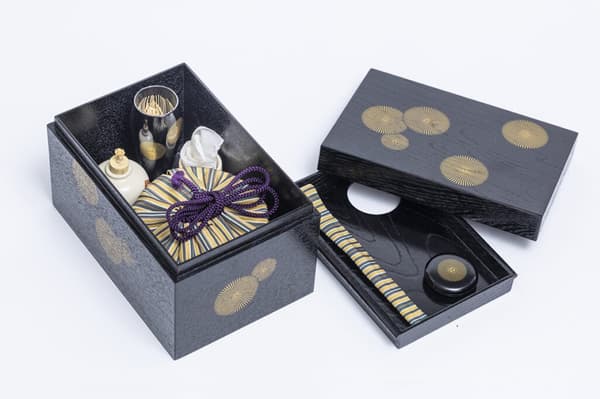
After the afternoon tea, guests move into a formal tea gathering led by Ishikawa. True to her belief that any favorite spot can become a tea room, she performs a beautiful chabako temae, using a tea box to set the stage for the ceremony.
Opening the chabako and drawing out the tools needed to prepare a bowl of tea within that limited space, Ishikawa performs an elegant, precise temae. Alongside her explanation of how to enjoy matcha and the basic etiquette involved, guests are served a bowl of tea, prepared one at a time with care.
What Is a Chabako? A Hospitality Space That Opens the Moment the Lid Comes Off
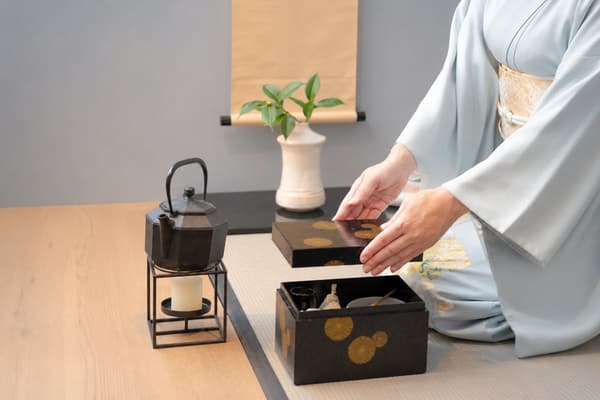
One highlight of this event is the chabako temae itself. A chabako is a compact box that holds the tools needed to prepare matcha — the tea bowl, whisk, and other utensils — and has been used since the time of tea master Sen no Rikyu as a portable set for enjoying tea while traveling.
The chabako temae follows the same etiquette as a standard Urasenke tea ceremony and is recognized as a distinct procedure in its own right. Even without a dedicated tea room, opening the chabako, taking out the tools, and preparing tea creates a special space for a single bowl of tea, wherever it takes place. Part of the appeal of chabako temae is that the surrounding air and scenery become part of the tea experience itself.
Ishikawa has also supervised chabako design for Gato Mikio Shoten, a long-established Yamanaka lacquerware maker. Guests are invited to enjoy her chabako temae at this event.
Event Overview: Mukyu Chaji — Matcha Enjoyed Through Japanese Afternoon Tea and Chabako Temae
Date: Saturday, August 8, 2026
Time: 1:00 PM to 3:00 PM (check-in begins at 12:30 PM)
Venue: Goryori Mukyu (3F, Roppongi Hills Residence B, 6-12-2 Roppongi, Minato-ku, Tokyo)
Capacity: 10 guests (advance reservation required, first come, first served)
Price: ¥16,000 (tax included) per person, paid in advance by bank transfer
Attire: Regular clothing is welcome, and since the day coincides with the Jingu Gaien Fireworks Festival, guests are also welcome to come in yukata. No need to bring anything — just come as you are.
Application deadline: Once capacity is reached
Application: https://forms.gle/6H5mEKsAsUw3Thuc9
Kyoko Ishikawa — Head of the Tea Room Koun-an, Urasenke Tea Ceremony Instructor
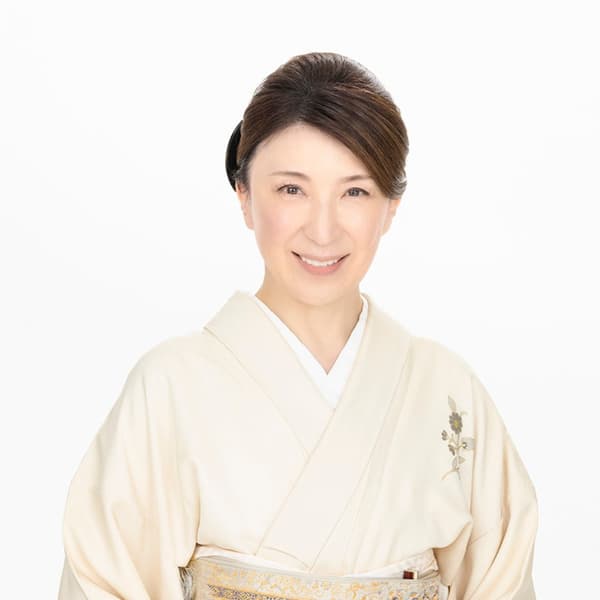
Kyoko Ishikawa (tea name: Sokyo) is a jun-kyoju, or assistant instructor, of the Urasenke school, with 35 years of experience in tea ceremony. She runs the tea room Koun-an in Ebisu, Tokyo, where she leads a referral-only Urasenke tea ceremony class and private tea gatherings. At department store tea ceremony classes, she teaches ryurei (chair-based) and chabako lessons.
She is active across a wide range of fields, including tea ceremony supervision, product development, and events, working to bring traditional culture into modern life and offering ways to enjoy everyday living more fully.
Official website: https://xn--54q004a937b.tokyo/
Shotaro Igarashi — Owner-Chef, Goryori Mukyu
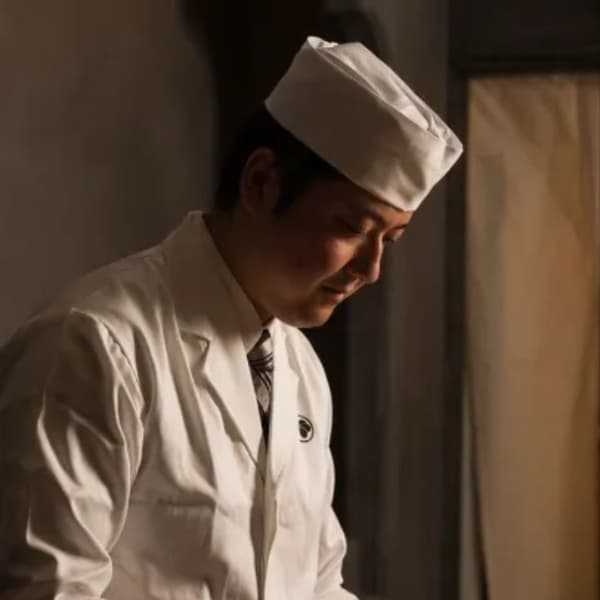
A native of Fukushima Prefecture, Igarashi began his culinary career at the Michelin three-star restaurant Mizai in Kyoto, where he learned that culinary training never truly ends and developed the discipline and aesthetic sensibility needed to engage fully with the essence of kaiseki cuisine.
After returning to Tokyo, he served as sous chef at the Michelin two-star restaurant Goryori Miyasaka in Minami-Aoyama, then as executive chef at Saryo Miyasaka in Roppongi Hills, before opening Goryori Mukyu in 2025. That same year, the restaurant was named to the "100 Notable Japanese Restaurants in Tokyo 2025" (日本料理 TOKYO 百名店 2025) list.
"Still yet to be" — with the belief that there is no such thing as true completion, Igarashi continues an endless journey to carry the spirit of Japanese cuisine forward, and out into the world.
Official website: https://gf-restaurant.jp/mukyu