Most visitors to Kansai treat Nara as an add-on -- a few hours with the deer, a quick look at the Great Buddha, then back on the train to Osaka or Kyoto. That approach works, but it undersells the place. Nara was Japan's capital before Kyoto even existed, and the city packed a remarkable number of temples, shrines, and cultural sites into a compact area that rewards a slower pace.
This guide lays out two itineraries: a focused one-day plan that covers the highlights without rushing, and a two-day version for travelers who want to go deeper. Both routes are designed around walking -- Nara's main sights cluster within a few kilometers of each other, so you rarely need a bus.
Getting to Nara from Osaka and Kyoto
Nara sits roughly between Osaka and Kyoto, making it easy to reach from either city. Two rail companies serve the route: Kintetsu and JR West.
Kintetsu Nara Station is the better arrival point for sightseeing. It sits at the edge of Nara Park, putting you within a 10-minute walk of the first stops on this itinerary. JR Nara Station works too, but it adds about 15 minutes of extra walking.
From Osaka (Namba):
Kintetsu rapid express from Osaka-Namba to Kintetsu Nara takes about 40 minutes and costs around 680 yen. No reservation needed -- just tap your IC card and board.
From Osaka (Tennoji):
JR Yamatoji Line from Tennoji to JR Nara takes about 33 minutes, around 510 yen. Covered by the Japan Rail Pass.
From Kyoto:
Kintetsu limited express from Kyoto Station to Kintetsu Nara runs about 35 minutes, around 1,280 yen (includes limited express surcharge). The regular express takes about 45 minutes for around 760 yen with no surcharge. JR Nara Line's Miyakoji Rapid takes about 45 minutes, around 720 yen, and is covered by the Japan Rail Pass.
For a deeper look at things to do in Nara beyond the itinerary stops, check out our full guide:
One-Day Nara Itinerary
This route covers Nara's core sights in a comfortable loop that starts and ends near Kintetsu Nara Station. Plan to arrive by 9:00 and budget about 7 to 8 hours including lunch.
Morning: Kofuku-ji and Nara Park (9:00 to 10:00)
Start at Kofuku-ji, a 5-minute walk east from Kintetsu Nara Station. The temple's five-story pagoda is normally one of Nara's most recognizable landmarks at 50 meters tall, but it is currently enclosed for a major restoration project that began in 2023 and is expected to continue through 2033. You can still visit the temple grounds and other halls during this period. The National Treasure Hall houses a famous three-faced, six-armed statue of Ashura that draws visitors from across the country.
- Kofuku-ji National Treasure Hall: 9:00 to 17:00, last entry 16:45. Adults 700 yen, children 300 yen.
- Central Golden Hall: 9:00 to 17:00. Adults 500 yen.
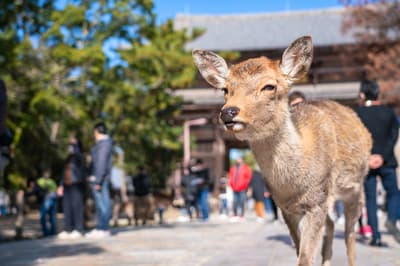
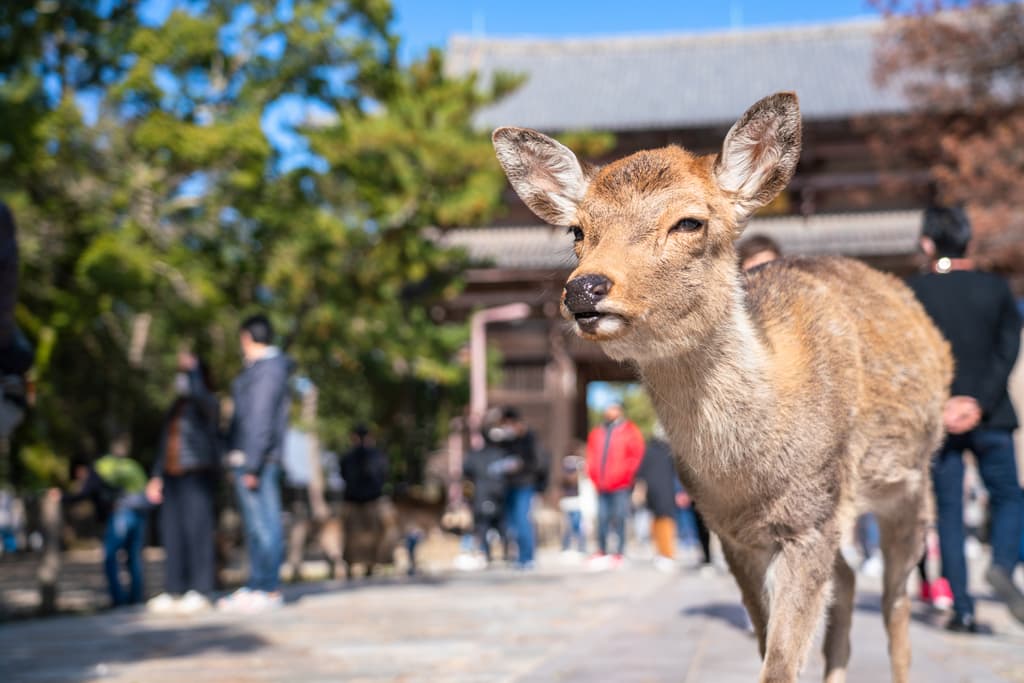
From Kofuku-ji, walk east into Nara Park. The deer start appearing almost immediately. There are over 1,000 sika deer here, and they roam freely across the park grounds. You can buy shika senbei (deer crackers) from vendors around the park for 200 yen per bundle -- these are the only food you should offer them. Bow to a deer before offering a cracker and it will often bow back, though they can get pushy if they see food.
Late Morning: Todai-ji and Nigatsu-do (10:00 to 12:00)
Walk north through the park toward Todai-ji. The approach takes you through the Nandaimon Gate, a 25-meter-tall wooden gate guarded by two fierce Nio statues carved in the 13th century. Past the gate, the Great Buddha Hall appears.
Todai-ji's Daibutsuden (Great Buddha Hall) is one of the largest wooden buildings in the world, and the bronze Buddha inside stands about 15 meters tall. The hall dates from 752, though the current structure is an 18th-century reconstruction that is actually smaller than the original. Walk around the back of the Buddha to find a pillar with a hole cut through its base -- squeezing through it is said to bring good luck.
- Great Buddha Hall: April to October 7:30 to 17:30, November to March 8:00 to 17:00. Adults 800 yen, children (6 to 12) 400 yen.
- Joint ticket (Hall + Museum): Adults 1,200 yen, children 600 yen.
After Todai-ji, climb the stone steps behind the hall to reach Nigatsu-do (Second Month Hall). This smaller hall sits on a hillside and offers one of the best views in Nara -- you can see across the park rooftops all the way to the western mountains. Entry is free. The wooden balcony is a good place to catch your breath before heading to the next stop.
Lunch Break (12:00 to 13:00)
Head back toward the center of Nara Park for lunch. The area around Kintetsu Nara Station and the Higashimuki shopping arcade has plenty of options. For something local, look for kakinoha-zushi -- pressed sushi wrapped in persimmon leaves, a Nara specialty. Hiraso near Kintetsu Nara Station has been making it since 1861. Alternatively, try kuzu mochi (arrowroot starch cake) or chagayu (tea porridge) at a Naramachi restaurant if you want to skip ahead to that neighborhood.
Afternoon: Kasuga Taisha (13:00 to 14:30)
Walk southeast through the park to reach Kasuga Taisha, Nara's most important Shinto shrine. The approach is lined with roughly 3,000 stone and bronze lanterns -- donations accumulated over centuries from worshippers. Twice a year, during the Mantoro festivals in February and August, all of these lanterns are lit simultaneously.
The shrine grounds are free to enter. The inner sanctuary requires a separate ticket and is worth visiting for the vermilion corridors and hanging lanterns.
- Shrine grounds: March to October 6:30 to 17:30, November to February 7:00 to 17:00. Free.
- Inner sanctuary (special worship): 9:00 to 16:00. Adults 700 yen.
- Kasuga Taisha Museum: 10:00 to 17:00, last entry 16:30. Adults 700 yen.
Afternoon: Mount Wakakusa (14:30 to 16:00) -- Optional
If the weather is clear and you have the energy, take a detour to Mount Wakakusa (Wakakusayama), a grassy hill east of Kasuga Taisha. The climb to the first plateau takes about 20 minutes and rewards you with a wide-open view of Nara's rooftops and the mountains beyond. Deer graze on the slopes here too, usually with fewer tourists around.
Mount Wakakusa is open from the third Saturday of March through the second Sunday of December. In 2026, that means March 21 to December 13.
- Admission: 150 yen for adults, 80 yen for elementary students.
If you skip Wakakusayama, head directly to Naramachi from Kasuga Taisha -- it is about a 15-minute walk south.
Late Afternoon: Naramachi (16:00 to 17:30)
Naramachi is the old merchant district south of Nara Park. The narrow lanes are lined with restored machiya (traditional wooden townhouses), many converted into cafes, craft shops, and small museums. The area has a quiet, lived-in feel that contrasts with the temple grandeur elsewhere in the city.
A few spots to look for:
- Naramachi Koshi-no-Ie: A preserved merchant house open to the public for free. The long, narrow layout shows how machiya were designed to minimize street frontage (which was taxed) while maximizing interior space.
- Gangoji: A Nara-period temple tucked into the neighborhood streets. Less visited than the big temples, but the roof tiles on the main hall date to the 6th century -- some of the oldest original building materials in Japan.
- Sarusawa Pond: A good final stop on the way back to the station. The pond is known for reflecting Kofuku-ji's pagoda, though the pagoda is currently hidden behind scaffolding during the ongoing restoration (through 2033). The pond and surrounding area are still a pleasant spot, especially in the late afternoon light.
Wrap up and walk back to Kintetsu Nara Station, about 15 minutes from the heart of Naramachi.
Two-Day Nara Itinerary
If you can spare a second day, Nara opens up considerably. Day 1 follows the same route as the one-day plan above, but at a more relaxed pace -- you can spend more time at Todai-ji, sit with the deer instead of rushing past them, and linger in Naramachi for dinner. Day 2 adds sites that most visitors miss entirely.
Day 2 Morning: Isuien Garden and Yoshiki-en (9:30 to 11:30)
Start your second day at Isuien Garden, a traditional Japanese stroll garden with two distinct sections: the front garden dates from the 17th century and features a pond with stepping stones and a tea house, while the back garden was added in the Meiji era and uses Todai-ji's Nandaimon Gate and Mount Wakakusa as borrowed scenery -- a design technique called shakkei where distant landmarks are framed as part of the garden composition.
- Isuien Garden: 9:30 to 16:30, last entry 16:00. Closed Tuesdays (except holidays). Adults 1,200 yen, university and high school students 500 yen.
Right next door, Yoshiki-en is a smaller garden that is free for foreign tourists (bring your passport). It has three distinct sections: a pond garden, a moss garden, and a tea ceremony garden. It is less manicured than Isuien but feels more natural.
Day 2 Late Morning: Shin-Yakushi-ji (11:30 to 12:30)
Walk south for about 20 minutes to reach Shin-Yakushi-ji, a quiet temple known for its ring of twelve clay guardian statues. These figures, called the Twelve Divine Generals, date to the 8th century and are remarkably expressive -- each one shows a different pose and facial expression. The main hall itself is an original Nara-period building.
- Shin-Yakushi-ji: 9:00 to 17:00. Adults 700 yen.
Day 2 Afternoon: Deeper Naramachi and Sake (13:00 to 14:30)
After lunch, spend the afternoon exploring parts of Naramachi you skipped on Day 1. Nara has a long sake-brewing tradition, and several breweries and sake bars operate in the old town area.
Harushika Sake Brewery offers tastings in a converted storehouse and has been brewing since 1884. The brewery sits a short walk south of Kasuga Taisha. If you prefer a more structured tasting, several sake shops and bars in the Naramachi area offer curated tasting sets with English menus.
For something sweet, look for Nakatanidou near Kintetsu Nara Station. The shop makes yomogi mochi (mugwort rice cakes) by hand, pounding the dough with dramatic speed that usually draws a crowd.
Day 2 Mid-Afternoon: Heijo Palace Site (14:30 to 16:00)
If you still have energy, take a bus or walk west to the Heijo Palace Site (Heijokyo-seki), the remains of Nara's imperial palace from 710 to 784. The site is vast -- about 120 hectares -- and mostly open grassland, but the reconstructed Suzaku Gate and the Former Imperial Audience Hall give a sense of the scale. The site is free to enter and makes for a peaceful end to the day, especially near sunset.
A bus from Kintetsu Nara Station to the Heijokyo-seki stop takes about 15 minutes.
Visiting Nara in Cherry Blossom Season
Nara's cherry blossoms typically peak from late March through early April, roughly the same timing as Kyoto and Osaka. The combination of sakura and deer is one of the most photogenic scenes in Japan, and Nara is generally less crowded than Kyoto's popular hanami spots.
The best sakura spots in and around the itinerary route:
- Nara Park: The open lawns near Todai-ji become a natural hanami ground. Deer resting under cherry trees is the signature Nara spring photo.
- Mount Wakakusa: The grassy hillside offers wide views of blossoming trees across the park below. Fewer people make it up here compared to the main park area.
- Sarusawa Pond: Cherry trees ring the pond, and the reflections make for good photos, particularly in the early morning.
- Himuro Shrine: A small shrine near Kintetsu Nara Station with a dense cluster of cherry trees and an ice-related history. It held a spring festival connected to the ancient practice of storing ice for the imperial court.
If you are planning a spring trip to Kansai, Nara works well combined with Kyoto's cherry blossom highlights:
Practical Tips
How long to spend: One full day covers the main sights comfortably. Two days lets you see everything at a slower pace and explore areas most tourists skip.
Best time to arrive: Get to Nara by 9:00 or earlier. The deer in the early morning are calm, Todai-ji has shorter lines, and the light through the Kasuga Taisha lantern corridors is best before noon.
Walking distance: The one-day itinerary covers roughly 6 to 7 km on foot. Wear comfortable shoes -- the paths through Nara Park are a mix of paved walkways and packed earth.
Luggage storage: Both Kintetsu Nara Station and JR Nara Station have coin lockers. Sizes vary, but large lockers for suitcases tend to fill up by mid-morning on busy days. Consider using a luggage delivery service from your hotel if you are traveling with heavy bags.
IC cards: Suica, ICOCA, and other major IC cards work on both JR and Kintetsu trains to Nara, as well as city buses.
Budget estimate: A one-day visit costs roughly 3,000 to 5,000 yen per person for transport and admissions, depending on how many paid sites you enter and whether you take the Kintetsu limited express from Kyoto.
Combining Nara with Kyoto and Osaka
Nara's location between Kyoto and Osaka makes it a natural stop on any Kansai trip. A few approaches work well:
Day trip from Osaka: Take the Kintetsu rapid express from Namba in the morning, follow the one-day itinerary, and return to Osaka for dinner. The last trains run until around 23:00, so there is no rush. For ideas on what else to do in Osaka, see our guide:
Day trip from Kyoto: Same approach from Kyoto Station. The Kintetsu regular express runs frequently and the ride is under an hour. You can also stop at Fushimi Inari on the JR Nara Line on your way back to Kyoto -- Inari Station is just two stops from Kyoto Station.
Nara as a transit stop: If you are traveling between Osaka and Kyoto, consider stopping in Nara along the way. Drop your bags at the station lockers, spend the day exploring, then continue to your next city in the evening. The rail connections make this straightforward.
Multi-day Kansai plan: For a longer trip, spend two or three days in Kyoto, one full day in Nara, and two days in Osaka. This gives you enough time to see each city properly without trying to cram everything into day trips.