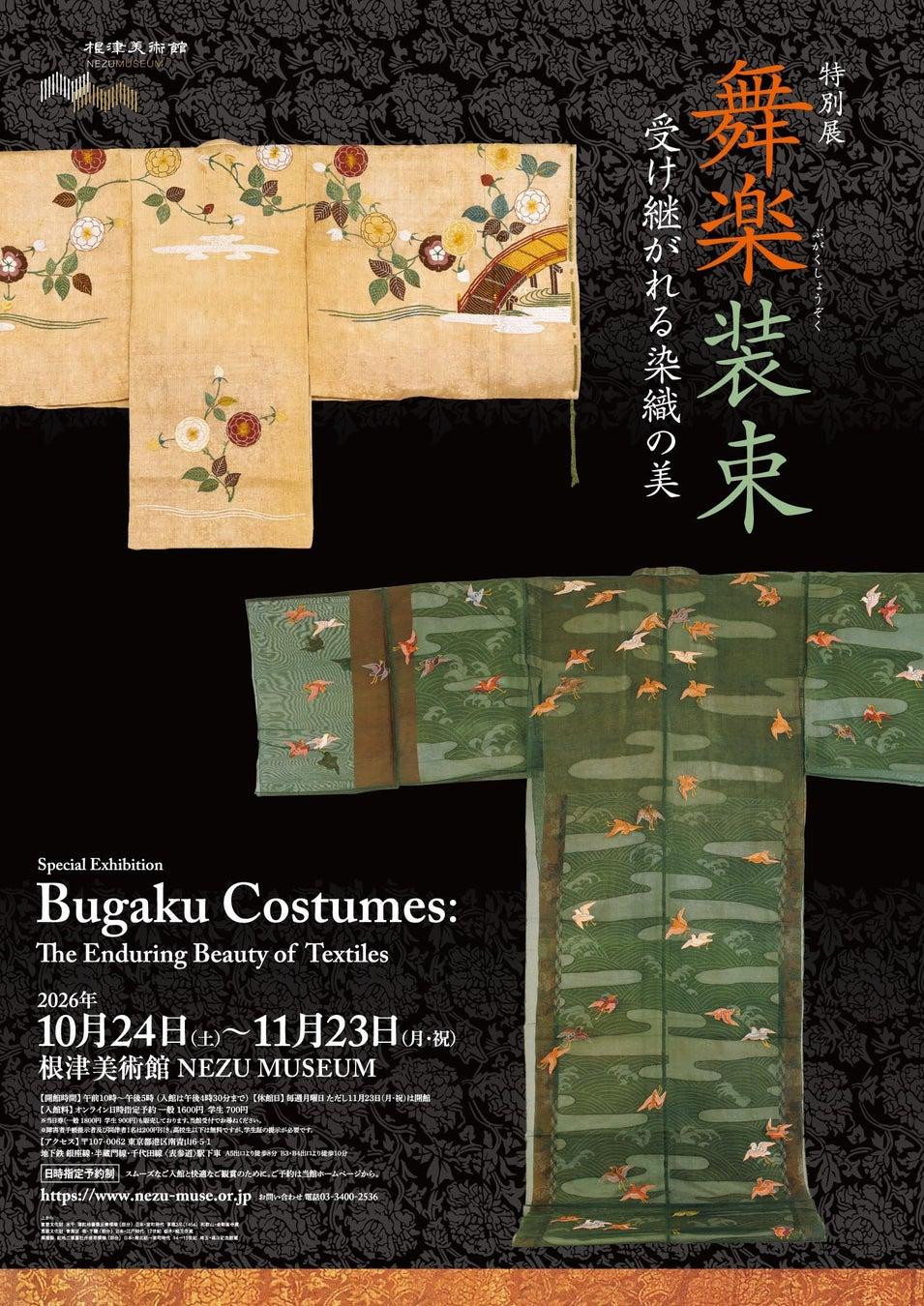
The Nezu Museum in Minami-Aoyama, Tokyo, will hold the special exhibition "Bugaku Costumes The Enduring Beauty of Textiles" from Saturday, October 24 to Monday, November 23 (a national holiday), 2026. The exhibition displays about 50 bugaku costumes and related materials, including many National Treasures and Important Cultural Properties.
What Is Bugaku?
Gagaku is Japan's classical performing art, which developed in its own way while absorbing music and dance that began arriving from abroad in the 5th century. Bugaku is the part of gagaku that is accompanied by dance. Its costumes are colorful adaptations of the uniforms worn by court military officers, who were the dancers. Depending on the origin of each piece, those of Chinese origin are called "left" (sahō) and those from the Korean Peninsula are called "right" (uhō), and red and blue were used as the base colors of their costumes, respectively.
Bugaku was performed not only at the imperial court but also at influential temples and shrines. Costumes handed down at Amano Shrine (now Niutsuhime Shrine), the tutelary shrine of Mount Koya, include designs that make full use of 14th- to 15th-century textile techniques.
The Onin War (1467–77) and the turmoil of the warring states period that followed dealt a heavy blow to gagaku. It was revived by the imperial court and those in power, and eventually came under regulation. Along with this, costumes at the court and at the major temples and shrines of eastern and western Japan converged on highly similar designs. The exhibition shows this change through the costumes of Shitennoji Temple in Osaka, said to have been founded by Prince Shotoku and still carrying on a long bugaku tradition, and those of Rinnoji Temple in Tochigi, which has ties to the Tokugawa shogun family and whose costumes will be shown to the public for the first time in 45 years.
Exhibition Structure
Prologue
This "mai-e" (dance painting) offers a glimpse of what bugaku, introduced to Japan from overseas in ancient times, was like. It shows the prototype of the bugaku costume, which later developed in connection with the uniforms of court military officers.
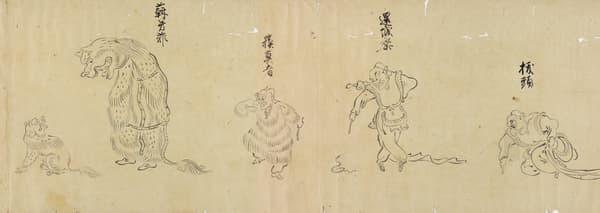
Mai-e (detail), 1 handscroll, ink on paper, Japan, Muromachi period, 14th–15th century, Yomei Bunko, Kyoto
1. Bugaku Costumes of Amano Shrine on Mount Koya: The Finest of Medieval Textiles
Amano Shrine (Niutsuhime Shrine) has long been closely tied to Kongobuji Temple. Kobo Daishi Kukai is said to have donated the shrine's lands when he built the temple. Because music and dance were banned on Mount Koya as a hindrance to study, Buddhist services accompanied by bugaku offerings were held regularly at Amano Shrine instead. This section introduces costumes used for the Issaikyo-e Buddhist service held from the 13th to the 15th century.
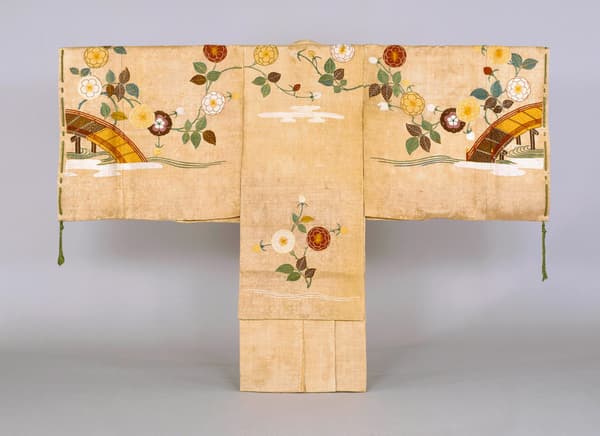
Important Cultural Property: Suikan (jacket) with rose and arched bridge pattern on a pale pink ground, 1 piece, hemp, embroidery, Japan, Muromachi period, Kyotoku 3 (1454), Kongobuji Temple, Wakayama
The Finest of Medieval Textile Techniques
This child's suikan (warawa suikan) is made from a single width of fabric, with climbing roses and arched bridges embroidered on a pale pink ground. Curving rose vines grace the back, and arched bridges appear on both sleeves, all worked in a variety of colored threads and embroidery techniques. Among them is "watashi-nui," a technique that fills a surface by running the thread back and forth on the front side only. It was widely used on kosode of the Momoyama period, and this piece is noted as a pioneering example.
Court Dance Paintings: A Rare Medieval Bugaku Scroll
The "Bugaku Zukan" (1 handscroll, color on paper, Muromachi period, Oei 15 [1408]) in the Asian Art Museum of San Francisco is one of the few bugaku picture scrolls known to date back to the medieval period, based on the dated inscription at the end. It is presumed to be one of three scrolls of dance paintings owned by Prince Gi'nin of Toganoo-no-miya (栂尾宮義仁法親王), which the court musician Abe no Suehide (安倍季英) was asked to copy. These appear in "Noritoki-kyoki," the diary of the court noble Yamashina Noritoki (1328–1411). Its detailed colored depictions show concretely how bugaku costumes were worn in the Middle Ages.
The Oldest Surviving Kinran Ryoto and the Mysterious Ryoto-gire
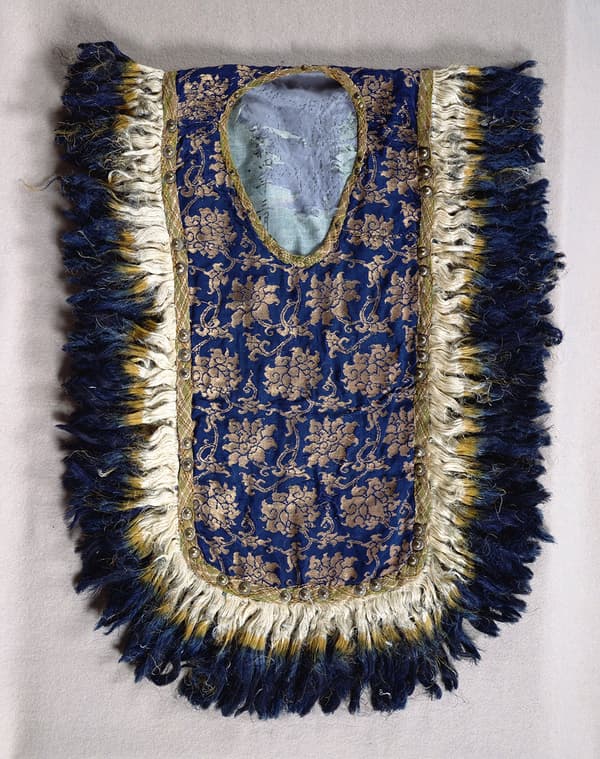
Important Cultural Property: Ryoto (chest garment) with double-vine peony arabesque pattern on a dark blue ground, 1 piece, silk, Japan, Nanbokucho period, inscribed Eiwa 4 (1378), Tokyo National Museum. Image: TMN Image Archives
An ink inscription on the lining shows that this ryoto, which has a fur edging (kebori), was donated in Eiwa 4 (1378) to the "Niu Shrine on Mount Koya" (Amano Shrine). It keeps the complete form of a costume that makes lavish use of imported gold brocade (kinran), and it is an important reference piece.
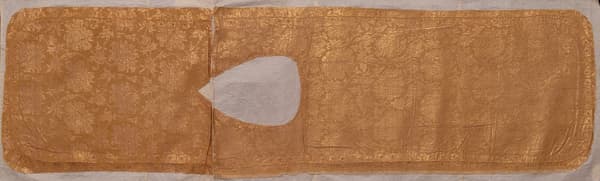
Ryoto-gire (ryoto fragment) with double-vine peony arabesque pattern on a red ground, 1 piece, silk, Japan, Nanbokucho to Muromachi period, 14th–15th century, Toyama Memorial Museum, Saitama
This piece has since been taken apart and its original form is unknown. However, a photograph in a 1936 auction catalog shows that it was once a ryoto with fur edging. Its inverted-teardrop neckline and the pattern of its gold brocade resemble those of the Tokyo National Museum ryoto above, suggesting the two may date from a similar period.
The Dance of a Beautiful Foreign King
The bugaku piece "Ryoo" (陵王; also called "Ranryoo" or "Raryoo") is a leading example of "hashiri-mai," or fast-moving running dances, and has often been depicted in paintings. This section focuses on the types of costume pieces used in "Ryoo" and shows how they correspond to the dancer in a painting, so visitors can see how the costume looks when worn.
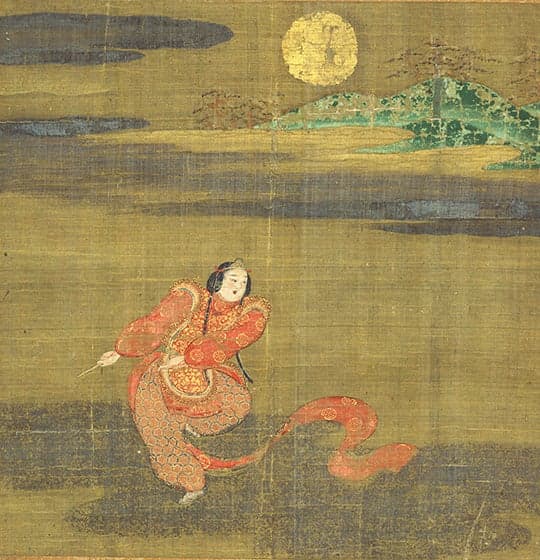
Raryoo-zu (Painting of Raryoo), attributed to Tosa Yukihide, 1 hanging scroll, color on paper, Japan, Muromachi period, 15th century, Nezu Museum, gift of Mr. Uemura Wadō
2. Bugaku Costumes of Shitennoji Temple in Osaka and Rinnoji Temple in Tochigi: The Splendor of the Early Modern Period
Gagaku flourished as a court art in the Heian period and was also practiced among samurai families, and its tradition was kept relatively well until the early Muromachi period. However, the outbreak of the Onin War (1467–77) and the prolonged fighting that followed devastated the court's gagaku culture, scattering musicians and dispersing their instruments and equipment.
In the second half of the 16th century, gagaku regained its splendor with the support of the emperor and those in power, including the Toyotomi family. When the center of politics moved to Edo in the 17th century, new temples and shrines were built, and a foundation for large-scale bugaku performances was laid in the Kanto region as well.
Shitennoji Temple, Osaka: A Cultural Project of the Toyotomi Family After Unifying the Country
At Shitennoji Temple in Osaka, said to have been founded by Prince Shotoku, bugaku has been performed since ancient times to add solemnity to Buddhist services. The temple burned in a war fire in Tensho 4 (1576) and its bugaku equipment was lost, but it was rebuilt with donations from the Toyotomi family. The costumes have been repaired repeatedly and carefully used ever since, and were designated Important Cultural Properties in 1966.
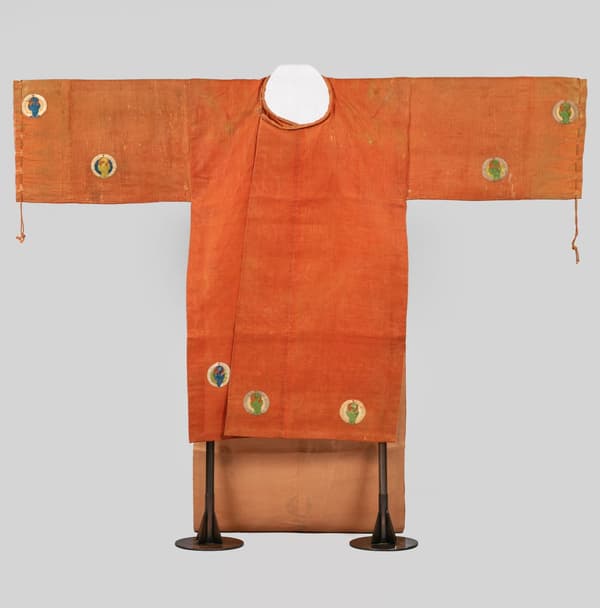
Important Cultural Property: Ho (outer robe) from a Taiheiraku costume set, silk, Japan, Momoyama to Edo period, 16th–17th century, Shitennoji Temple, Osaka
"Taiheiraku," a Dance to Console the Spirit of Prince Shotoku
These are the costumes for "Taiheiraku," a dance that is essential for marking the end of the Buddhist service portion of the "Shoryoe," a memorial service that consoles the spirit of Prince Shotoku. The exhibition shows 11 items from the full set, including armor and weapons.
Rinnoji Temple, Tochigi: The Pinnacle of Early Modern Bugaku Costumes
The bugaku costumes of Nikkozan Rinnoji Temple in Tochigi were commissioned by the third shogun, Tokugawa Iemitsu, in Kan'ei 13 (1636), to coincide with the great reconstruction of Nikko Toshogu Shrine and the 21st anniversary memorial ceremony for Tokugawa Ieyasu. The collection is a large set of more than 800 costumes, enough to cover every bugaku piece, and it is also valued for the outstanding craftsmanship in every detail. It was designated an Important Cultural Property as a whole in 1983.
Rare Two-Color Ho
The costumes made exclusively for "Karyobin," a bugaku piece danced by children, stand out for their neat embroidery of small birds and flowers. Because this is a left-side dance, a red ho is normally worn, but Rinnoji has preserved ho in both red and blue, which is rare.
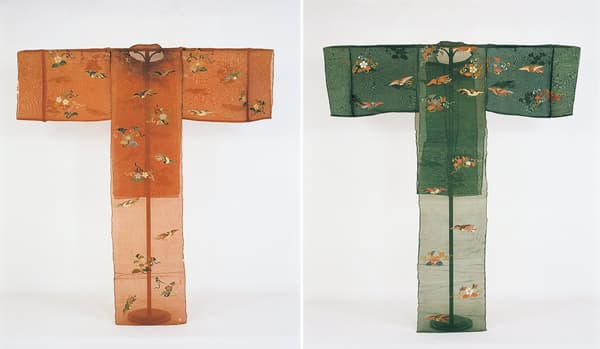
Important Cultural Property: Karyobin ho (outer robe) with small bird and flower pattern on a red ground (left) and a moegi (yellow-green) ground (right), silk, Japan, Edo period, 17th century, Rinnoji Temple, Tochigi
Epilogue
Bugaku costumes, made with various techniques such as dyeing, weaving and embroidery, are completed when a person wears them and dances. The exhibition closes with a large folding screen, richly decorated and painted in the tradition of bugaku paintings. Visitors can reflect on the changes in costume style they have seen while enjoying the beauty that emerges with the movement of the dance.
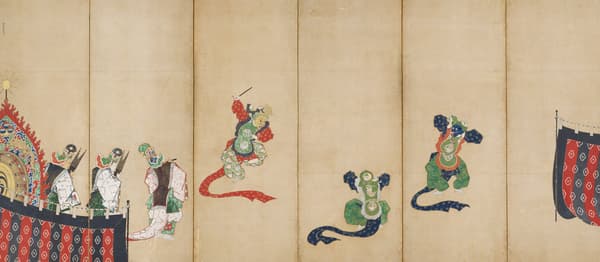
Bugaku-zu Byobu (Bugaku Folding Screens), left screen, by Kusumi Morikage, pair of six-panel screens, color on paper, Japan, Edo period, 17th century, Nezu Museum
Related Events
For the related events, applications are accepted from 1:00 PM on Tuesday, October 13 through the application form under "Event Information" on the Nezu Museum website. Applications close once capacity is reached.
Lecture 1: "Elegant Dance Attire: Bugaku Costumes Adorning Amano Shrine"
- Date and time: Saturday, October 31, 2026, 2:00 PM to 3:30 PM
- Speaker: Shigeki Kawakami (Professor, Osaka Gakuin University)
- Venue: Nezu Museum, Auditorium
Lecture 2: "Bugaku Pieces and Costumes"
- Date and time: Sunday, November 15, 2026, 2:00 PM to 3:30 PM
- Speaker: Toru Endo (Professor, Tokyo Gakugei University)
- Venue: Nezu Museum, Auditorium
Slide Lecture: "Bugaku Costumes The Enduring Beauty of Textiles"
- Date and time: Friday, October 30 and Friday, November 6, 2026, both from 11:30 AM to 12:15 PM (the two sessions have the same content)
- Venue: Nezu Museum, Auditorium
The curator in charge gives an explanation of the exhibition using slides. Participation is free, but museum admission is required.
Special Event: Bugaku "Ryoo" Demonstration of Costume Dressing and Performance (paid event)
- Date and time: Sunday, November 8, 2026, 2:00 PM to 3:00 PM
- Performers: Lecturers and graduates of the Gagaku major, Department of Japanese Traditional Music, Tokyo University of the Arts
- Venue: Nezu Museum, Auditorium
After a demonstration of how the "Ryoo" costume is put on, guests can see an actual performance and dance. Please check the details on the in-museum flyers or the "Events" section of the museum website, and buy a participation ticket (¥2,000) in advance. Tickets cannot be canceled or refunded. Participation tickets are sold only on the museum website, and museum admission is also required on the day of the event.
Concurrent Exhibitions
Gallery 5: "The Beauty of Hakubyo"
Hakubyo is a style of painting that mainly uses fine ink lines. The exhibition presents the quiet monochrome beauty of the style, from Buddhist iconography and preparatory drawings for picture scrolls of the medieval period and earlier, to Yamato-e of the early modern period and paintings of the modern era.
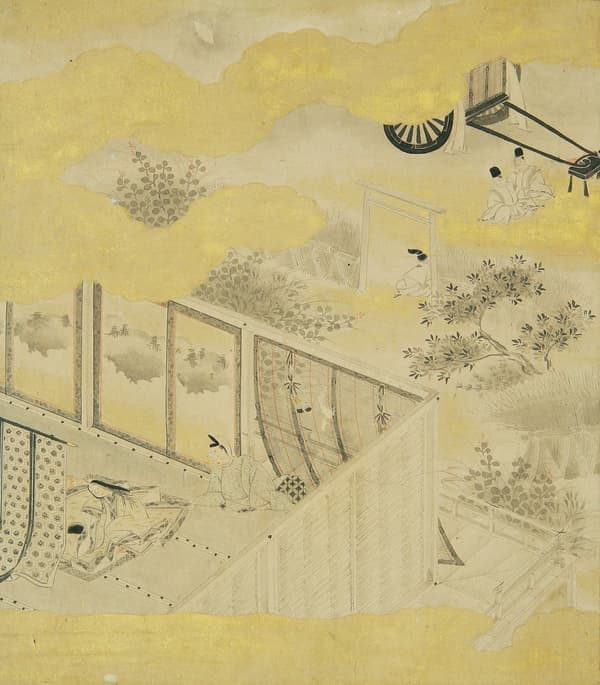
Genji Monogatari Gajo (Tale of Genji album) "Sakaki," attributed to Sumiyoshi Gukei, 1 album, ink and light color on paper, Japan, Edo period, 17th century, Nezu Museum
In this scene, Hikaru Genji visits Rokujo no Miyasundokoro in Saga and regrets their parting. Early modern hakubyo expanded its range of expression by introducing variations in ink tone, lines with changing strength, and even gold.
Gallery 6: "Kairo, Welcoming Winter"
In November, the hearth is opened in the tea room and the room is refreshed to welcome winter. Tea utensils of high standing, suited to a celebratory tea gathering that marks a turning point in the year, are put together.
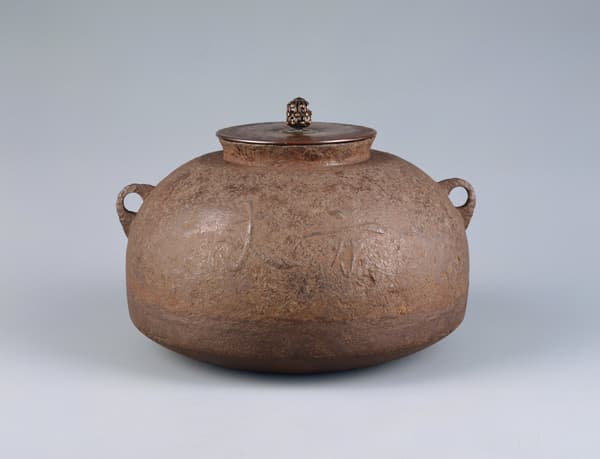
Juo-guchi kama (kettle), Tenmyo, 1 piece, iron, Japan, Muromachi period, 16th century, Nezu Museum
Tenmyo kettles (from what is now Sano, Tochigi) are characterized by free shapes and a wabi-like texture. This piece is called "Juo-guchi" because its outward-flaring rim resembles the crowns of the Ten Kings, including King Enma.
Exhibition Information
- Exhibition name: Special Exhibition "Bugaku Costumes The Enduring Beauty of Textiles"
- Organizer: Nezu Museum
- Dates: Saturday, October 24 to Monday, November 23 (national holiday), 2026
- Hours: 10:00 AM to 5:00 PM (last admission 4:30 PM)
- Closed: Every Monday, except Monday, November 23, when the museum is open. On closed days, the entire museum is closed, including the garden and NEZUCAFE.
- Admission:
- Online date-and-time reserved tickets: General ¥1,600, Students ¥700
- Same-day tickets: General ¥1,800, Students ¥900
- Holders of a disability certificate and one accompanying person: ¥200 off
- High school students and younger: Free
- Admission notes:
- A student ID must be shown at entry to receive the student rate or free admission for high school students and younger.
- Guests with reservations are guided first, and holders of same-day tickets may have to wait. Depending on how crowded the museum is, same-day tickets may not be sold.
- Reservations are limited to 10 people per group.
- The admission fee covers all exhibitions in the museum and the garden.
- Address: 6-5-1 Minami-Aoyama, Minato-ku, Tokyo 107-0062
- Access: From Omotesando Station on the subway Ginza, Hanzomon and Chiyoda lines, an 8-minute walk from Exit A5 (stairs), a 10-minute walk from Exit B4 (stairs and escalator), or a 10-minute walk from Exit B3 (elevator or escalator)
- Phone: 03-3400-2536 (main line)
- Website: https://www.nezu-muse.or.jp