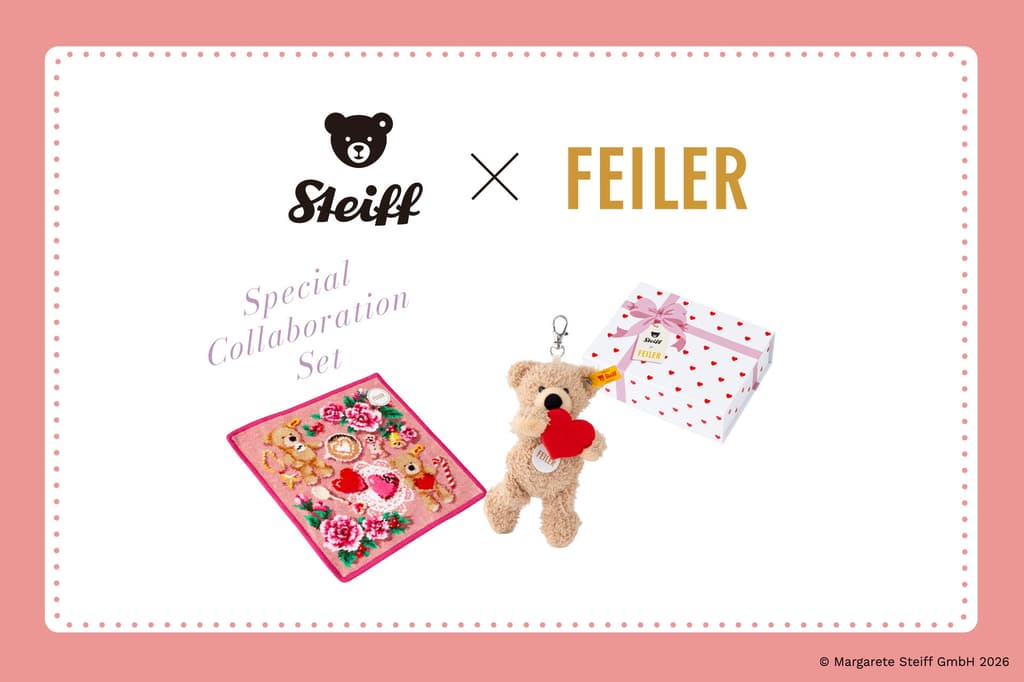
Steiff, the German plush brand founded in 1880 that made the world's first teddy bear, has teamed up with Feiler, a German brand of chenille-woven goods, on a special collaboration set. The set will be sold at the "Teddy Bear 125th Anniversary: Big Steiff Exhibition" (テディベア誕生125周年記念 大シュタイフ展) at Nihonbashi Mitsukoshi Main Store in Tokyo.
Where and When
- Event: Teddy Bear 125th Anniversary: Big Steiff Exhibition (テディベア誕生125周年記念 大シュタイフ展)
- Dates: December 2, 2026 (Wed) to December 8, 2026 (Tue)
- Hours: 10:00 AM to 7:30 PM
- Venue: Nihonbashi Mitsukoshi Main Store (日本橋三越本店), Main Building 1F Central Hall
- Event details: https://www.mistore.jp/store/nihombashi/shops/living/living_stationery/shopnews_list/steiff.html
How to Buy
The set is first offered through online advance reservation on a first-come, first-served basis, with pickup in the store.
- Reservation page opens: November 18, 2026 (Wed), 10:00 AM
- Reservation period: November 23, 2026 (Mon, holiday), 12:00 PM to November 29, 2026 (Sun), 11:59 PM
- Reservation page: https://www.mistore.jp/shopping/product/900000000000000003846395.html
During the event, from December 2 to 8, general sales at the venue are planned depending on stock. If the set sells out in the online advance reservation, it will not be sold at the venue.
Purchase Limit
- One set per person
- The limit may be lifted without notice after a certain period.
- Please refrain from buying for resale. If a purchase for resale or any other improper conduct is found, future sales to that customer will be refused.
About the Set
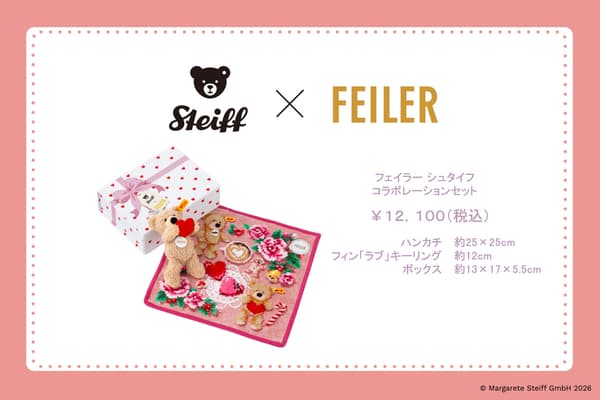
- Item number: 112669-1
- Name: Feiler Steiff Collaboration Set (フェイラー シュタイフコラボレーションセット)
- Price: ¥12,100 (¥11,000 before tax)
- Materials: Polyester (key ring) / cotton (handkerchief)
The set combines a soft key ring teddy bear, Finn "Love" (フィン「ラブ」), with a handkerchief. The chenille handkerchief, woven with motifs such as Finn holding a heart, roses, a café latte, and gingerbread, and the chest tag of the soft key ring teddy bear Finn "Love" both carry the FEILER logo.
The set is not sold at Feiler shops.
This product is an interior decoration item for adults, not a toy for children, and has not undergone food inspection. In households with children, please handle it under the supervision of a parent or guardian.
About Feiler
Feiler (Hohenberg, Germany, founded in 1948) is a lifestyle brand centered on chenille weaving, a traditional craft textile from the Bavaria region of Germany. Its range includes handkerchiefs, interior cloths, pouches, and bags with beautiful colors and patterns and a soft texture. Feiler products are handed down in families and given as gifts across generations, and its handkerchiefs come in more than 200 colorful designs.
- Feiler brand site: https://www.feiler-jp.com/
- Feiler official online shop: https://feiler.jp
- Instagram / X: @feiler_jp
History of Steiff
Steiff and Its Founder, Margarete Steiff
"When you think of teddy bears, you think of Steiff." The founder of this world-famous plush brand was Margarete Steiff (1847 to 1909), born in 1847 in the small town of Giengen (キンゲン) in southern Germany. At the age of one she caught polio, which left her right hand and both legs impaired, and she spent her whole life in a wheelchair.
Margarete's parents sent her to school and had her master sewing so that she could be independent despite her disability. In her twenties she founded the "Felt Mail Order Company" (フェルト・メール・オーダーカンパニー), the predecessor of Steiff, and sold women's and children's clothing. In December 1880, Margarete came up with the idea of giving her nieces and nephews elephant-shaped toys as Christmas presents. Eight soft elephants were made from felt and stuffed with the finest wool. Given as toys to the children and as pincushions to the adult women, they were well received. This was the birth of the world's first plush toy. The year 1880, when plush making began, is regarded as the year Steiff was founded.
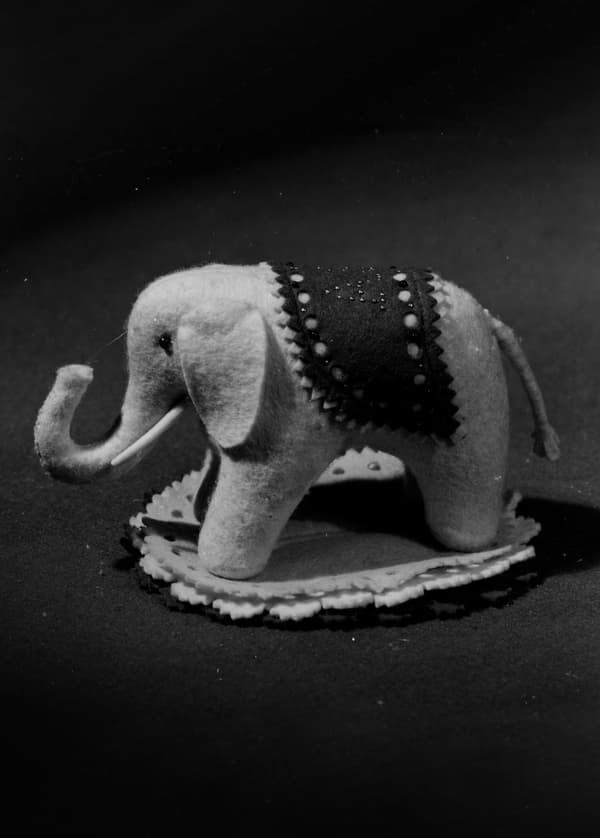
The world's first plush toy, the "elephant pincushion," made in 1880
Margarete's nephew Richard, who had helped with the business since 1897, suggested that she make a "lifelike bear plush." This became the "55PB," called the world's first teddy bear. It was a refined plush with a movable head and limbs, made with materials of the highest grade. The 55PB caught the eye of an American buyer at a trade fair and, after further improvements, went into mass production.
Around the same time in the United States, bear plush toys were growing in popularity along with the nickname "Teddy" of President Theodore Roosevelt, but counterfeits and inferior products also began to appear. The idea that emerged was to attach a button to the left ear to certify a Steiff product. This was the start of the "Button in Ear" (ボタン・イン・イヤー), the world's oldest trademark, which continues today as a mark of top quality.
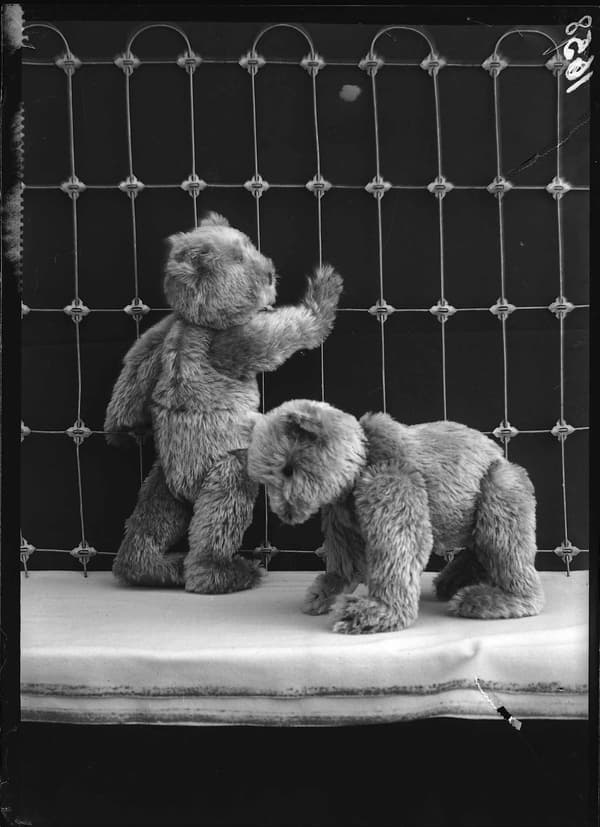
The first teddy bear, "55PB," invented in 1902
The World's Oldest Trademark: "Button in Ear"
Friends
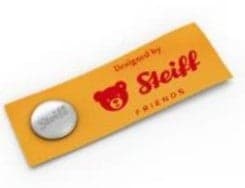
Attached to simple, child-oriented designs among the standard products.
Collectors
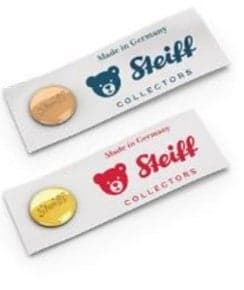
Collector's items for adults.
- White tag with blue text: attached to standard mohair-type products
- White tag with red text: attached to limited-edition pieces
Originals
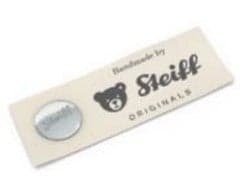
Unlike Friends, attached to products with realistic, finely made animal designs that use joints.
Replica

Attached to replicas that reproduce Steiff products from the early 1900s. In addition to the item number, the tag shows the year of production and a serial number. The ear carries a tag that reproduces the one used at the time, while the tag in the image is attached to the body and elsewhere.
Due to a specification change, the new tag designs above are being introduced gradually, starting with products shipped in 2024.
Teddy Bears in Europe
In Europe, it is customary to give a teddy bear as a gift when a baby is born. Receiving a durable, "genuine" teddy bear that can be treasured not only in childhood but as a lifelong friend is itself considered a mark of status. Steiff is so popular in Europe and the United States that people say "for a baby gift, Steiff."
Born in Germany in 1880 and the maker of the world's first teddy bear, Steiff has grown into a historic top brand that cannot be left out when talking about teddy bears.