The full lineup of artworks has been revealed for teamLab: Hama-rikyu Gardens, a night outdoor art exhibition at Hama-rikyu Gardens in Tokyo. It runs from Wednesday, November 25, to Thursday, December 24, 2026.
Hama-rikyu Gardens is a leading daimyo garden of the Edo period, designated as a Special Place of Scenic Beauty and Special Historic Site of Japan under the name 旧浜離宮庭園 (Former Hama-rikyu Gardens). In this exhibition, the garden, with its long history, becomes the artwork space as it is. Influenced by wind, rain, and the shifting forest, it is transformed by the presence of the people living today.
The exhibition is held as a special program of ARTE TOKYO (東京国際文化芸術祭), which is organized by the Tokyo Metropolitan Government (東京都) and the 東京国際文化芸術祭実行委員会. It is produced by 杉山央 of 新領域株式会社.
Highlight Video: teamLab: Hama-rikyu Gardens, Tokyo © teamLab. Shot in real space. No AI or CGI.
Artworks
Pillars of Constant Flux
Pillars of Constant Flux (2026–) is part of the series Pillars that Dance with the Wind (2023–).
All life exists within flow, and the flow itself creates and sustains structure.
This is fundamentally different from objects such as stones, iron, and the things humans have made so far, which have independent, static, and stable structures of their own.
The work does not stand because air is sealed inside it and pressure holds it up. Its entrance and exit are the same size, and air flows continuously through the interior. Through that flow itself, the work maintains its structure and existence. If the flow stops, its existence as an artwork disappears.
Here, objects are not moved by the flow. The flow itself creates structure and brings existence into being.
The work is strongly affected by the environment, including wind, rain, and humidity, and its movement and height change greatly. Even so, as long as the environment that gives rise to its existence is maintained and the flow continues, its existence is maintained while its form keeps changing.
Autonomous Resonating Life
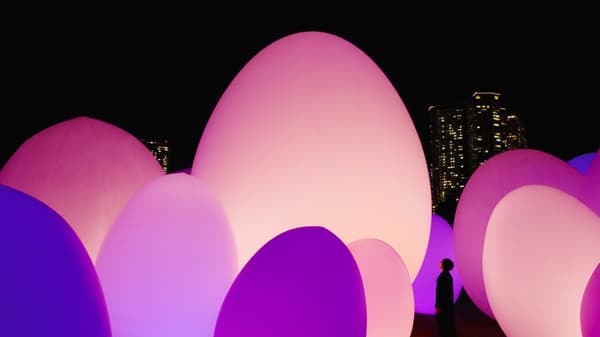
teamLab, Autonomous Resonating Life, 2017– © teamLab. Shot in real space. No AI or CGI.
When pushed by a person or a wild animal, or knocked over by strong rain or wind, each Ovoid stands back up on its own, shining brightly and sounding a tone. Neighboring Ovoids respond one after another, continuing the light and tones.
The light and tones of the Ovoids also spread to the neighboring artwork Resonating Trees and continue on. The artwork space is transformed by people's behavior, the environment, and the surrounding artworks, making people and the environment part of the work.
This work belongs to the series Resonant Collective Sculpture (2009–). Each sculpture is an autonomous physical existence, yet the sculptures respond to one another and form a single continuous field as a colony.
In this series, pushing with the body, being moved by others, environmental effects such as wind and rain outdoors, the behavior of wild animals, neighboring sculptures within the same group, and other nearby artworks all become triggers for response. The light, sound, or movement that arises in one sculpture does not stay within that individual. It spreads to nearby sculptures, then to the surrounding artworks and space, and continues through the whole.
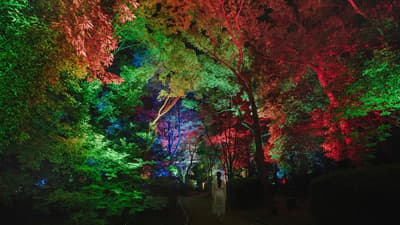
Resonating Trees
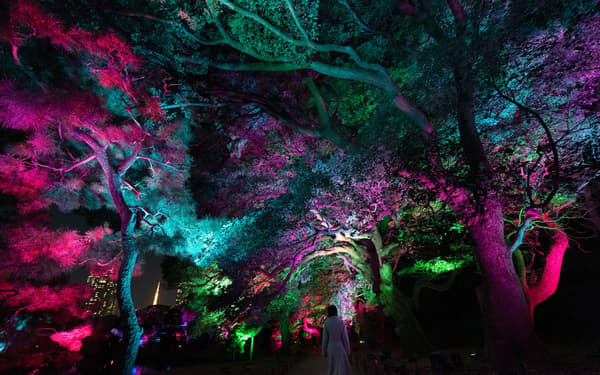
teamLab, Resonating Trees, 2014– © teamLab. Shot in real space. No AI or CGI.
The trees respond to neighboring trees and to the neighboring artworks Autonomous Resonating Life and Resonating Microcosms - Solidified Light, continuing the light and tones.
When light rushes in from deep among the trees, it means that a person or a wild animal is over there. The artwork space is transformed by the behavior of bodies, other people, and wild animals, and by the surrounding artworks, making people and the environment part of the work.
This work is part of Digitized Nature (2002–). Digitized Nature is an attempt to let nature become art as nature, without destroying it.
The form, texture, and changes of the forest's trees themselves contain long spans of time, the continuity of life, and relationships with the ecosystem. A tree is part of an ecosystem, yet its surface and interior also host life and form an ecosystem of their own. Unlike objects made by humans, the outline of its existence is ambiguous.
Resonating Microcosms - Solidified Light
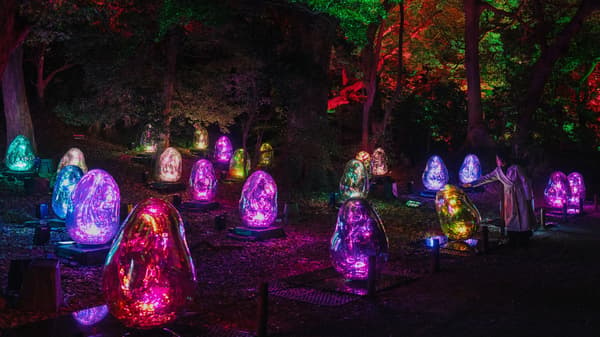
teamLab, Resonating Microcosms - Solidified Light, 2022–, from the series teamLabBall, 2009– © teamLab. Shot in real space. No AI or CGI.
When pushed over by a person, each Ovoid stands back up on its own, shining brightly and sounding a tone. The surrounding Ovoids also respond one after another, continuing the same light and tones. The light and tones of the Ovoids also spread to the nearby artwork Resonating Trees and continue on. The artwork space is transformed by people's behavior, the environment, and the surrounding artworks, making people and the environment part of the work.
The patterns of color that appear inside exist as infinite possibilities until they are seen. At the moment they are viewed, they are fixed as a single form from that person's viewpoint. The form then keeps changing in response to the viewer's moving body, the wavering of the sculpture itself, and the surrounding environment.
Continuous Life and Death at the Now of an Ancient Tree
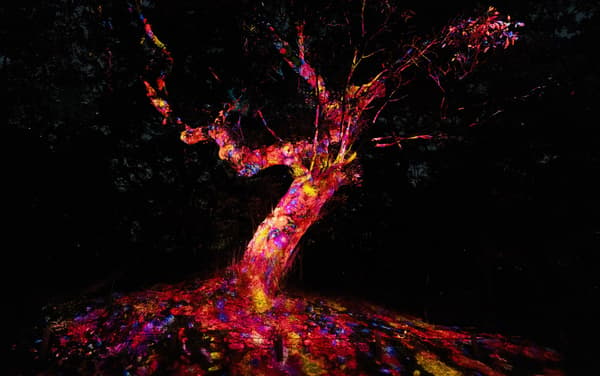
teamLab, Continuous Life and Death at the Now of an Ancient Tree, 2026, from the series Ever Blossoming Life Tree - Giant Taro Cedar, 2021– © teamLab. Shot in real space. No AI or CGI.
A giant tree standing in the forest roots itself in the earth, thickens its trunk, and spreads its branches, shaping its present form over a long span of years.
People usually cannot grasp a span of time far longer than the time they have lived, nor that this time is continuous with the "now." But when facing a giant tree, they notice that an enormous amount of accumulated time is contained within its imposing form and texture.
teamLab calls this vast presence shaped by long time Time-Sculpted Existence (2015–).
Within this vast presence, flowers repeat birth and death, the time of continuous life flows, and it is transformed by the presence of the people living today.
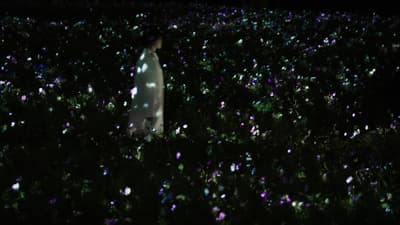
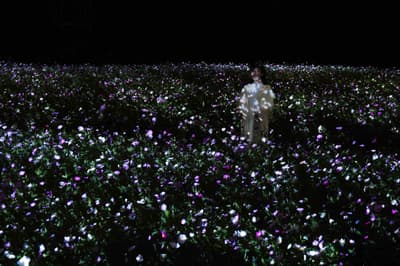
Ethereal Flowers
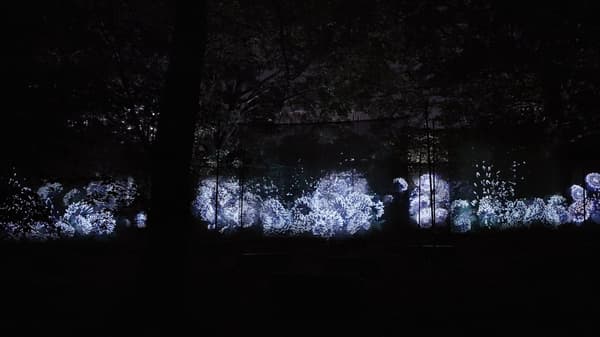
teamLab, Ethereal Flowers, 2026, from the series Flowers in Layered Ultrasubjective Space, 2018– © teamLab. Shot in real space. No AI or CGI.
Clusters of Edo chrysanthemums (江戸菊) appear in the garden's forest. The flowers sway and overlap, becoming one with the forest and its patina of age.
Each flower is born, blooms, and eventually scatters and disappears. Through the repeated life and death of the flowers, the cluster continues to exist.
The garden of Hama-rikyu was shaped into the form that continues to the present from the middle to late Edo period (from the early 18th to the early 19th century). Giant trees that have lived for more than 300 years also remain in the garden.
Edo chrysanthemums, which were cultivated in the Edo period, have also been passed down in the form of their old flowers of that time through division and cuttings. Even as individual flowers scatter and disappear, their form is fixed as something formless within life and has been preserved across time.
That living memory overlaps with the long time of the forest.
Where does eternity reside?
Concrete and Abstract
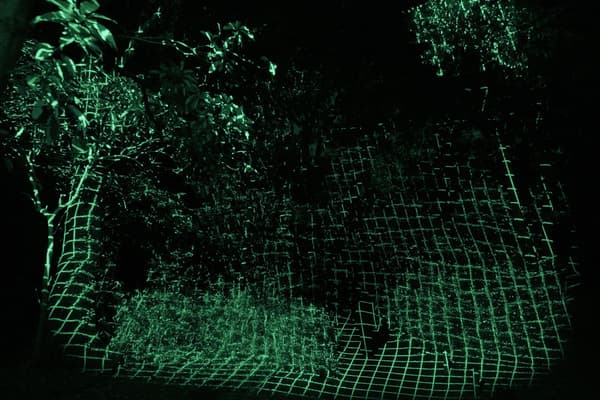
teamLab, Concrete and Abstract, 2024–, from the series Concrete and Abstract - Sacred Tree Forest Entrance, 2018– © teamLab. Shot in real space. No AI or CGI.
The forest appears as many layers of planes while keeping its complexity.
When people enter the work and stand still for a while, distortion arises and spreads.
Traces of the Forest
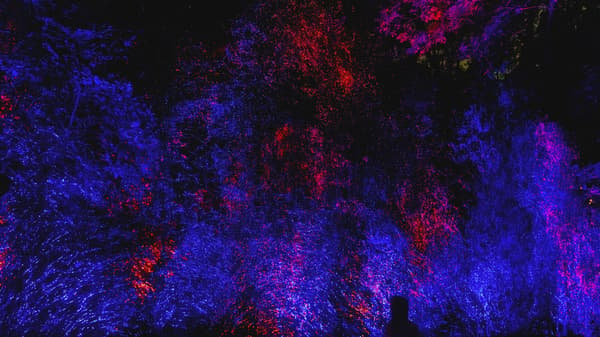
teamLab, Traces of the Forest, 2026, from the series Strata of Traces, 2025– © teamLab. Shot in real space. No AI or CGI.
Darkness lies in the foreground, and light exists in its depths.
Substance and perception become ambiguous, and material boundaries disappear.
Countless layered, ghostly traces of the forest stand as one with the forest of the garden.
Cognitive Solidified Spark
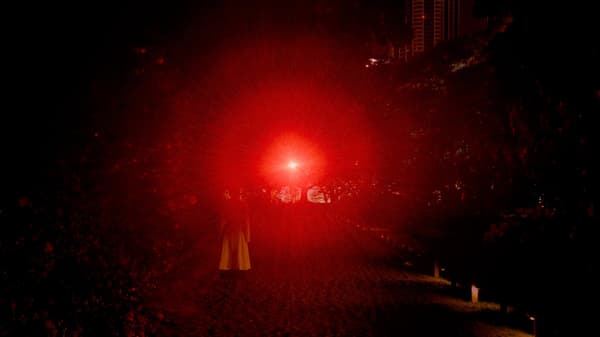
teamLab, Cognitive Solidified Spark, 2022– © teamLab. Shot in real space. No AI or CGI.
People do not recognize the world they are seeing. They see the world they recognize.
Countless thin red lines of light spread radially from a center, forming a bright red, sea-urchin-like sphere. The light source does not move, but the countless lines keep writhing.
This sphere is made of light alone. Yet at the place where it can be seen, there is no collection of solidified lines of light.
It is a sculpture that appears only in the human cognitive world, a Cognitive Sculpture. The form of the sculpture is not determined by a material outline. The subject that shapes it is the viewer's own body and cognition.
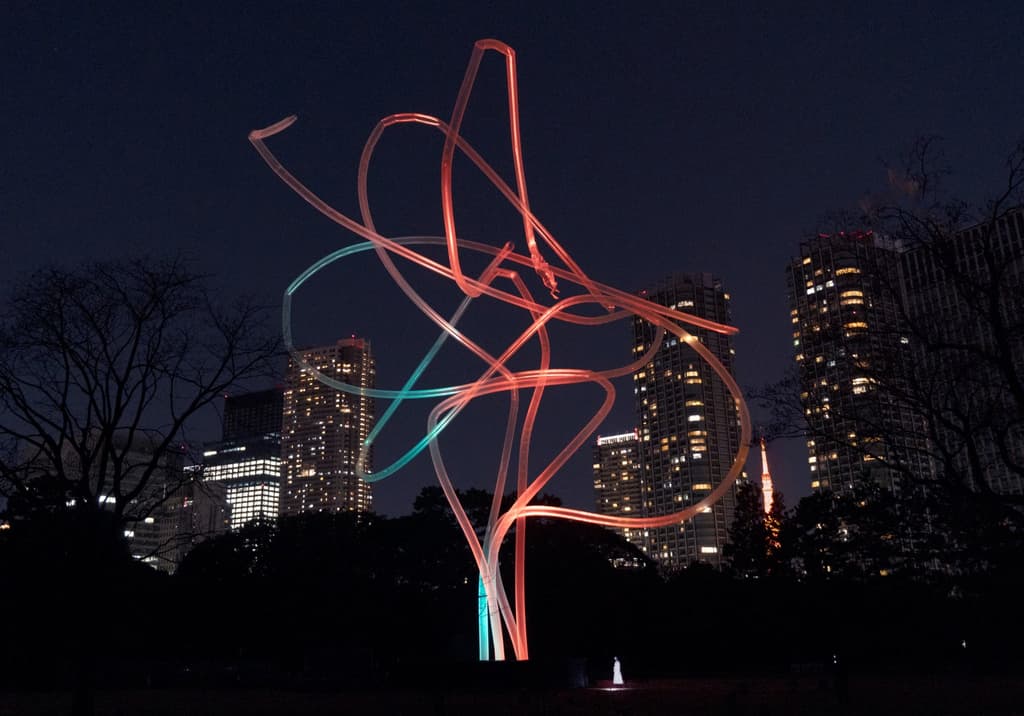
Spatial Calligraphy of Wind
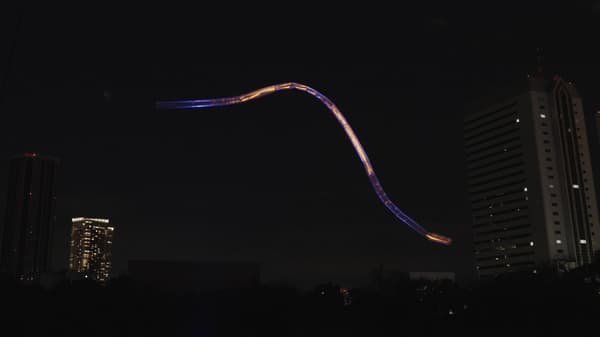
teamLab, Spatial Calligraphy of Wind, 2024 © teamLab. Shot in real space. No AI or CGI.
On a clear night, when the wind blows, this work appears in the sky. When the wind stops, the work disappears.
Humans cannot control when the wind blows or how strongly. The existence of the work rests not on human intention but on the environment.
This work is an attempt to extend sculpture from a fixed object to something whose structure keeps being generated by constant flow in an open environment.
Spherical Crystallized Light in the Onozoki
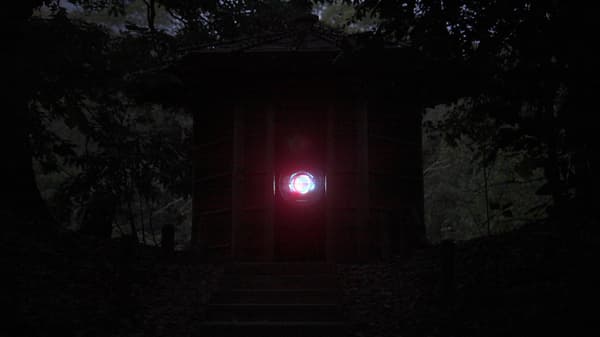
teamLab, Spherical Crystallized Light in the Onozoki, 2024–, from the series Bubble Universe: Spherical Crystallized Light, Wobbling Light, and Environmental Light - One Stroke, 2023 © teamLab. Shot in real space. No AI or CGI.
The duck hunting ground (鴨場) of Hama-rikyu was built in the late 18th century. The Onozoki (大覗き) is an observation post where people hid from the ducks to peek at the pond and the ducks without being noticed. The current structure has been handed down through repeated restoration.
What are you looking at? And is it an existence?
At the center of a transparent sphere is a sphere of light. On the surface of this sphere of light there is no glass or other material. The sphere is made of light alone. In this world, however, light does not solidify, and light cannot form a spherical mass. In other words, the form of this sphere does not physically exist.
It is a sculpture that appears only in the human cognitive world, a Cognitive Sculpture. The form of the sculpture is not determined by a material outline. The subject that shapes it is the viewer's own body and cognition.
The sphere cannot exist by itself. Only when a phenomenon produced by the environment is shaped by the viewer's dynamic body and cognition does it become a sculpture in that cognitive world.
300-Year Pine
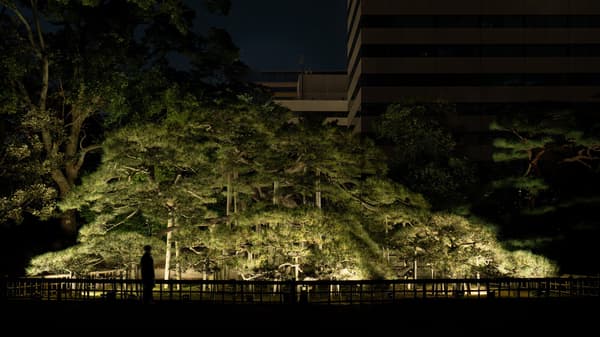
teamLab, 300-Year Pine, 2026 © teamLab. Shot in real space. No AI or CGI.
A black pine said to have been planted around 1709. The branches of this 300-year-old pine spread widely to the side, extending more than 17 meters.
Concept of teamLab: Hama-rikyu Gardens
Hama-rikyu Gardens is a leading daimyo garden of the Edo period (1603–1868), with a tidal pond that draws in seawater from Tokyo Bay and changes character with the rise and fall of the tide. It was originally a reed-filled coastal wetland by the sea where the Tokugawa shogun family released hawks to hunt waterfowl. From around 1654, the land was reclaimed, and the "Kofu Hama-yashiki" (甲府浜屋敷) was later built there. From the time of the sixth shogun (1709–1712), it was called "Ohama-goten" (御浜御殿) and was used for about 160 years. In the Meiji era it became an imperial detached palace, and although it lost many of its buildings to the earthquake and the war, it was opened to the public in 1946 as an onshi garden (恩賜庭園).
Over about 400 years, the site has been used while changing roles, from a falconry ground to a villa of the shogun's family, an imperial detached palace, and a garden for the people. In this exhibition, the garden, with its long history, becomes the artwork space as it is, and is transformed by the presence of the people living today, influenced by wind, rain, and the shifting forest.
As visitors wander through the garden's forest and walk where accumulated time and the present overlap, nature and people, and long spans of time and the present, continue on without boundaries.
Message From the Producer
The producer of the Hama-rikyu Art Project, 杉山央 of 新領域株式会社, shared the following message.
The garden has built up a long history as a Special Place of Scenic Beauty and Special Historic Site of Japan. The producer says it is a great honor to hold teamLab: Hama-rikyu Gardens in this irreplaceable place together with teamLab, which is active on the world stage.
While valuing above all the history of the garden inherited from the Edo period and respect for nature, the project aims to create, through art, an experience unique to Hama-rikyu at night, different from the daytime. The producer hopes to share scenery that can be found only in this place with many people in Japan and abroad.
Event Details
teamLab: Hama-rikyu Gardens
Dates: Wednesday, November 25, 2026 – Thursday, December 24, 2026
Venue: Hama-rikyu Gardens (1-1 Hamarikyu-teien, Chuo-ku, Tokyo)
Hours: 6:00 PM – 9:15 PM (last entry 8:30 PM)
- Opening times may shift earlier or later so that the artworks can be viewed in optimal conditions.
- Depending on weather and other conditions, the display of some artworks may be canceled and they may not be viewable.
Official website: https://www.teamlab.art/jp/e/hamarikyu/
Ticket Prices
Adult: ¥2,500
Junior/senior high school student: ¥1,500
Elementary school student: ¥900
Preschooler: Free
Persons with disabilities: ¥1,250
Advance date-and-time reservations are required.
Tickets are not sold on-site.
If tickets are not sold out, they can also be purchased on the day through the official ticket site.
Ticket purchase (official ticket site): https://hamarikyu.tickets.teamlab.art/