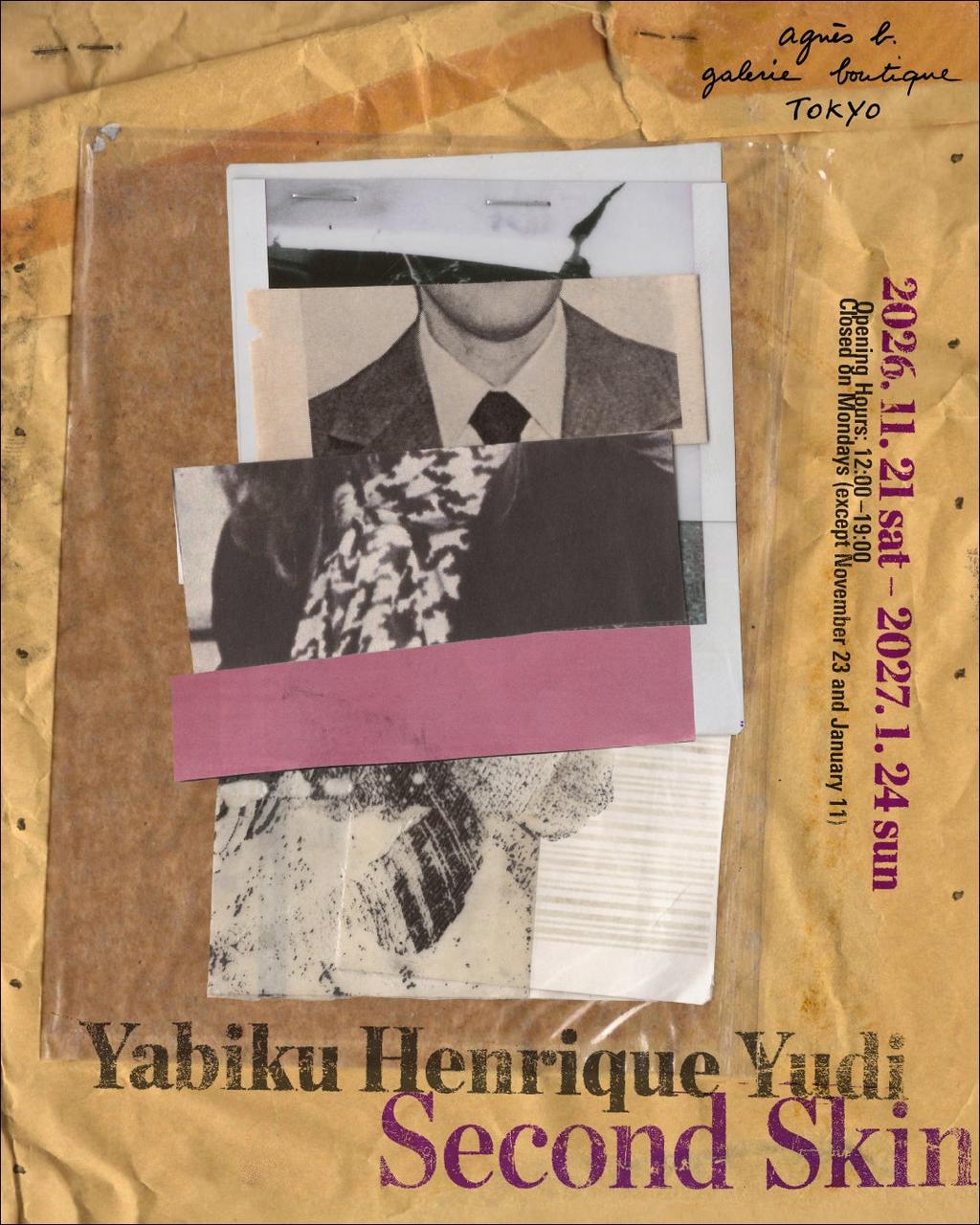
agnès b. Galerie Boutique in Minami-Aoyama, Minato-ku, Tokyo, will host a solo exhibition by Yabiku Henrique Yudi titled "Second Skin" from Saturday, November 21, 2026 to Sunday, January 24, 2027.
About the Exhibition
Yabiku was born in São Paulo in 1997 as a third-generation Japanese Brazilian and spent childhood moving between Brazil and Japan. Skateboarding, which Yabiku became absorbed in during adolescence, brought a strong influence from street culture. After studying fashion at fashion school, Yabiku's interest shifted to making collages from clippings of old magazines. Since then, the materials have expanded to wood, canvas, and prints made through three-dimensional printing, but collage has remained a consistent method, with an attitude of "DIY, reconstruction, and freedom" at its root.
This exhibition is a project in which Yabiku, who shifted from fashion to collage as a mode of expression, takes clothing as the theme once again. Clothing is seen as a "second skin" that exists between the body and society, and the exhibition considers how human identity is shaped and changes through its relationship with society and the environment.
Clothing is a means of expressing individuality, but it also helps people adapt to social norms and surroundings, and at times conceals part of the body or the self. However much the body is covered, traces such as sweat, stains, and wrinkles appear on the surface where the body meets the external environment.
Having grown up between two societies, Brazil and Japan, Yabiku sees this relationship as overlapping with human identity. When people place themselves in a different culture or society, they change their behavior and values to adapt to that environment, which is something like putting on another layer of skin. At the same time, aspects of oneself that never fully blend in may surface unconsciously, and a new self may emerge in the process of adapting. In other words, the "second skin" not only conceals part of the self but also changes the self through contact with the outside world.
All of the works in the exhibition are created on the principle of collage. Yabiku does not decide on a clear final image. Instead, the artist intuitively selects materials with different backgrounds and contexts and combines them on a single surface. In the process, the different elements sometimes blend with one another and sometimes clash and leave a sense of discord, taking on new meanings and expressions through their relationship with their surroundings while keeping their original qualities. The structure of collage itself, in which materials are layered, covered, and partially exposed, embodies the relationships of concealment and expression, and of adaptation and transformation, found in the "second skin."
How do we receive and face the traces and discord that arise in the course of adaptation? Through this exhibition, Yabiku poses that question.
Exhibition Information
Yabiku Henrique Yudi "Second Skin"
- Venue: agnès b. Galerie Boutique (5-7-25 Minami-Aoyama, Minato-ku, Tokyo, La Fleur Minami-Aoyama 2F)
- Dates: Saturday, November 21, 2026 to Sunday, January 24, 2027
- Hours: 12:00 PM to 7:00 PM
- Closed: Mondays (except November 23 and January 11)
- Winter break: December 28 (Mon) to January 8 (Fri)
- Design: Yabiku Henrique Yudi, Azone+Associates
- Exhibition setup: LIFE LIVE
For more details, see the exhibition page on the agnès b. website.
Artist Statement
I returned to my hometown of São Paulo again this year. Unable to sleep because of jet lag, I went up to the roof of a building in the early morning, when the city was still quiet, and looked out over the streets. Then a fine rain began to fall.
It was the drizzle known as "Garoa," a symbol of São Paulo. It felt less like rain falling than a mist drifting through the air. I did not get wet right away; it touched my body so slowly that I did not notice, and before I knew it my whole shirt was damp.
The city is usually full of life, but at that hour there were few cars or people, and it was wrapped in stillness. The drizzle, the smell of the city, and the faint presence of people mingled together, and an atmosphere that felt somehow lonely yet strangely special hung in the air.
Touching that air, I suddenly remembered the foggy roads I used to travel in my parents' car from early morning when I was a child. It should have been a nostalgic scene, yet I felt somehow unsettled. Even so, I could not take my eyes off that strange atmosphere.
That feeling stayed with me for a while even after I returned to Japan.
That rain did not change anything dramatically. But looking at my shirt, which had become damp without my knowing, I felt as though I had suddenly noticed that slow change. Perhaps that became an opportunity to look at myself and my past works from a slightly different perspective.
About the Artist
Yabiku Henrique Yudi
Born in 1997 in São Paulo, Brazil. Yabiku spent childhood moving between Brazil and Japan and is now based in Tokyo. After studying fashion at Bunka Fashion College, Yabiku began working in a collage-centered mode of expression. The work is grounded in the experience of moving between places, fragmented memories, and sensibilities formed in the gaps between multiple cultures. By quoting and reconstructing printed matter and mass-consumed images and combining them with everyday and industrial materials such as cardboard and staples, Yabiku blurs the boundary between artworks and consumable goods and questions binary oppositions such as order and chaos, beauty and distortion, and love and hatred. The structures in which connection and destruction coexist, and the transformable and reconfigurable forms of the works, express an attitude of resistance to fixed values and identities. The violence and noise that occasionally appear bring out the tension and beauty hidden in an imperfect world. In recent years, in addition to creating objects and spatial installations, Yabiku has also worked on providing artwork to fashion brands, visual production, and art direction, broadening the range of expression.