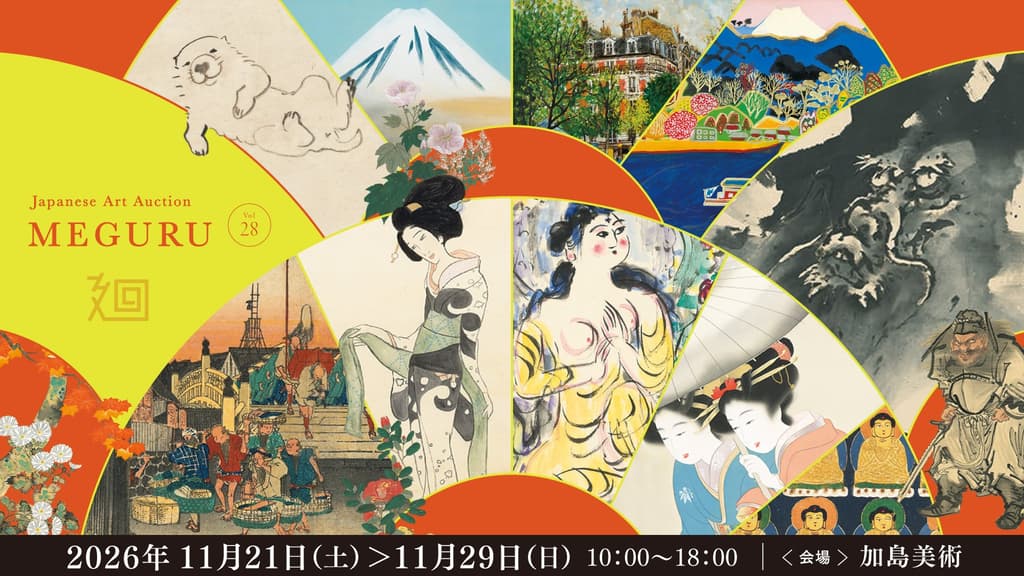
Kashima Arts (Kyobashi, Chuo City, Tokyo) is holding "Japanese Art Auction MEGURU Vol. 28" from Saturday, November 21 to Sunday, November 29, 2026. With the largest number of works offered in the auction's history, this edition has plenty to see. The main highlight is a selection of fine works from the Rinpa school, which developed its own decorative beauty in the Edo period. A large number of works that let visitors enjoy a modern, refined sense of beauty handed down across the ages are on offer.
"MEGURU" began in 2019 as an auction dealing in a wide range of art, centered on early modern and modern Japanese painting but also including Western-style painting, calligraphy, prints, and crafts. Since its founding, it has introduced carefully selected works entrusted by sellers across Japan to art lovers at home and abroad, and it has grown into one of Japan's leading Japanese art auctions.
Passing art on to the next generation also means connecting Japan's culture and art to the future. Art dealers support the continuation of that culture by recognizing the value and appeal of a work and bridging it to the people who need it. "MEGURU" is one of the places that plays this role: works meet new owners and are carefully handed down, and through that accumulation the history and appeal of art are carried into the next era.
For Vol. 28 in November, the focus is on the aesthetic of Rinpa, which flourished in the Edo period. Works by leading Rinpa painters including Ogata Kenzan, Sakai Hōitsu, Suzuki Kiitsu, and Sakai Dōitsu appear in large numbers, and the lineup of varied masterpieces lets visitors feel the appeal of Rinpa as it has been passed down across eras and genres.
What Is Rinpa? A Modern, Refined Sense of Beauty That Transcends Time
Rinpa began in Kyoto in the early Edo period. It is an artistic current that inherited the traditions of Japanese art while developing its own decorative beauty. Bold depictions of natural motifs such as flowers and grasses, birds, and flowing water, rendered with vivid colors, simple forms, and compositions that make use of empty space, produced refined pictures.
The approach goes beyond realistically reproducing nature: shapes and colors are boldly organized so that each picture works as a single design. This modern sensibility connects with today's posters, graphic design, and fashion patterns. The decorative quality and sense of design that spread from painting to crafts was born in the Edo period, yet it still has a fresh appeal today.
Featured Rinpa Works
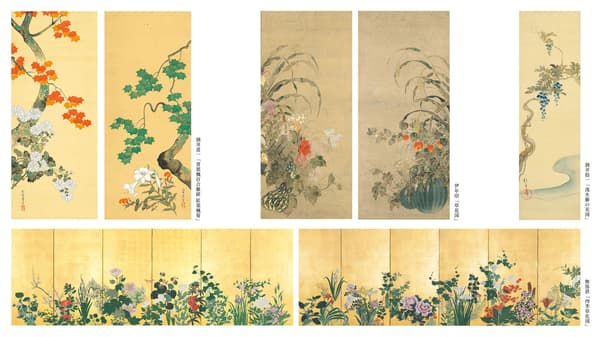
Unsigned "Flowers and Grasses of the Four Seasons" (「四季草花図」)
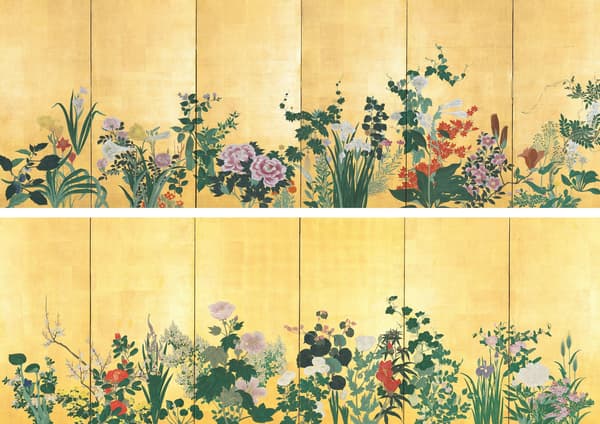
Set against the broad empty space of a gold ground, a wide variety of seasonal flowers and grasses is painted in a flowing sequence, making this a gorgeous pair of screens with a commanding presence.
Each flower and grass is painted large and with care, bringing out its individuality while creating a beautifully harmonious whole. The folding screen leaves an impression through the expansiveness that the empty gold space provides and its refined beauty of color.
Note: "Unsigned" (無落款) means that no signature or seal of the artist is found on the work.
"Flowers and Grasses" (「草花図」) With the Inen Seal (伊年印)
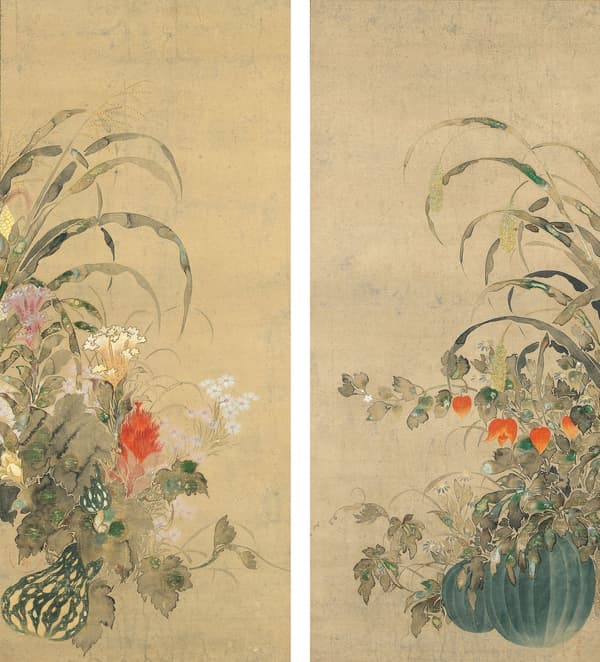
With flowers and grasses as its subject, this work is notable for understanding the painting style of the Rinpa lineage. Works stamped with a seal reading "Inen" (伊年) are thought to have been produced by the workshop of Tawaraya Sōtatsu or by painters in its lineage. The work conveys the Rinpa sense of beauty, which copies the appearance of nature while giving form and arrangement a sense of design.
Sakai Hōitsu, "Wisteria and Flowing Water" (「流水藤の花図」)
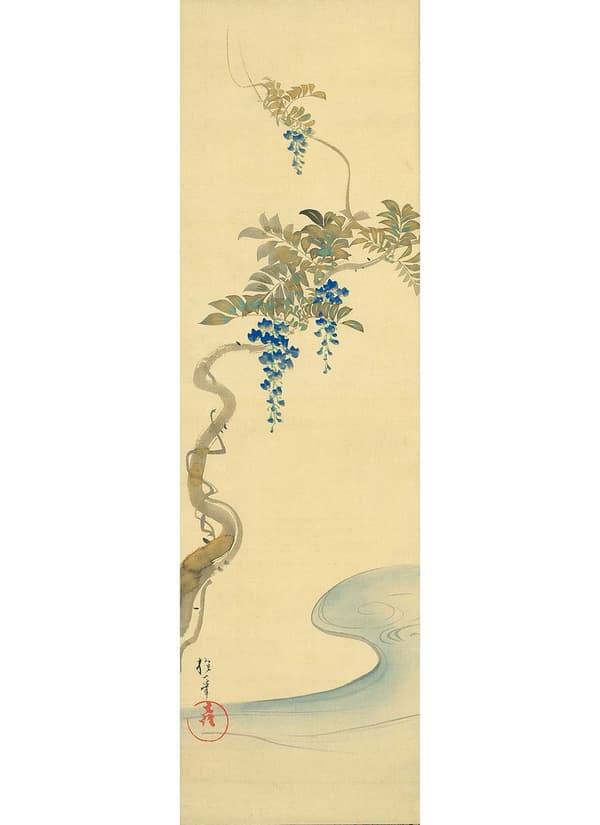
Sakai Hōitsu is the painter known as the "founder of Edo Rinpa." He studied the art of Ogata Kōrin and developed its sense of beauty within the sensibility of the Edo period. Through the natural motifs of flowing water and wisteria blossoms, this work lets viewers experience the graceful world Hōitsu painted. The mood created by the pairing of flowing water and flowers is another highlight.
Sakai Dōitsu, 「青葉楓百合雁緋 紅葉楓菊」
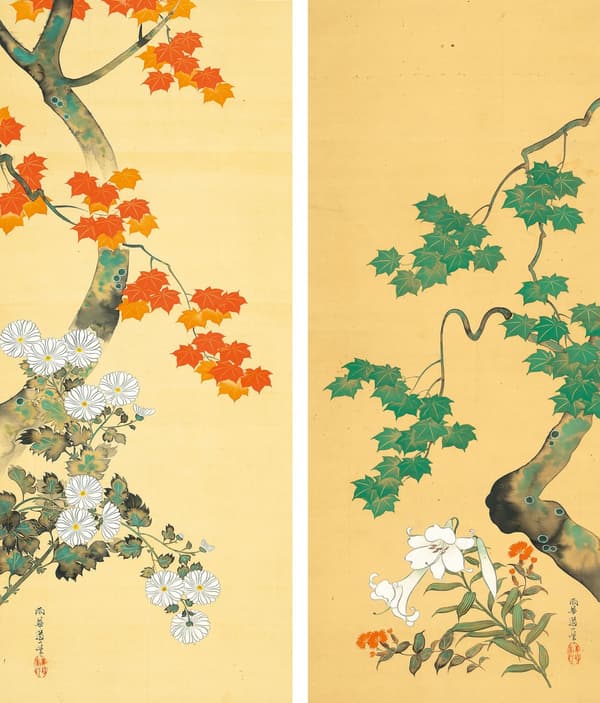
The work of Sakai Dōitsu, who belongs to the lineage of Sakai Hōitsu, is also a highlight of this feature. The subjects bring to mind plants that color the seasons, such as green leaves, autumn leaves, lilies, and chrysanthemums, conveying the many faces of nature and the appeal of decorative composition. Together with the group of works featuring seasonal flowers and grasses, they show how the Rinpa sense of beauty has been handed down to later generations.
Visitors can enjoy the varied expression and the individuality of each painter through the November auction.
A Record 710 Works Gather for "MEGURU"
"MEGURU" Vol. 28 brings together 710 works, the most in the auction's history, including ukiyo-e, old paintings, modern paintings, Western-style paintings, ink calligraphy, and crafts.
A preview viewing is held during the sale period. Anyone is welcome to visit freely and see the works up close. Because the works are displayed without glass cases, visitors can directly feel the texture, the details, and the presence of the pictures, one of the distinctive appeals of "MEGURU." Visitors can look at a wide range of works in person and search for one that catches their eye.
Those who find it difficult to visit the preview can view all of the works offered on the official website and place bids there as well.
Main Featured Artists
- Ukiyo-e: Utagawa Hiroshige
- Old paintings: Itō Jakuchū, Soga Shōhaku, Maruyama Ōkyo, Nagasawa Rosetsu, Mori Sosen, Uragami Gyokudō, Ogata Kenzan, Sakai Hōitsu, Suzuki Kiitsu, Utagawa Kuniyoshi, Kawanabe Kyōsai, Watanabe Seitei, Kobayashi Kiyochika
- Modern prints: Kawase Hasui, Yoshida Hiroshi
- Modern paintings: Yokoyama Taikan, Kawai Gyokudō, Fukuda Kodōjin (福田古道人), Kimura Buzan, Takeuchi Seihō, Itō Shōha, Yasuda Yukihiko, Maeda Seison, Kawabata Ryūshi, Hayami Gyoshū, Kaburaki Kiyokata, Kainoshō Tadaoto (甲斐庄楠音), Takehisa Yumeji, Tanaka Isson, Kataoka Tamako, Sugiyama Yasushi, Fukui Kōtarō, Saitō Kiyoshi
- Western-style paintings: Kumagai Morikazu, Kuniyoshi Yasuo, Kishida Ryūsei, Nakagawa Kazumasa, Tōgō Seiji, Matsumoto Shunsuke, Kodama Yukio (児玉幸雄), Saitō Shin'ichi, Kamoi Rei, Tsuguharu Foujita, Hamaguchi Yōzō, Yayoi Kusama
- Calligraphy: Toyotomi Hideyoshi, Tokugawa Ieyasu, Date Masamune, Hon'ami Kōetsu, Hakuin Ekaku, Sengai Gibon, Taigu Ryōkan, Saigō Nanshū, Tokugawa Yoshinobu, Katsu Kaishū, Yamaoka Tesshū, Takahashi Deishū, Itō Hirobumi, Fukuzawa Yukichi, Tōgō Heihachirō, Yosano Akiko, Wakayama Bokusui, Kawabata Yasunari, Hibino Gohō, Nishikawa Yasushi, Shinoda Tōkō
- Folk crafts (mingei): Shikō Munakata, Serizawa Keisuke, Kawai Kanjirō, Hamada Shōji, Domon Ken
- Crafts: Kawakita Handeishi, Kitaōji Rosanjin, Kayama Matazō, Kamoda Shōji (加守田章二), Fujita Kyōhei, Kotani Shinzō (小谷眞三), Kuriki Tatsusuke (栗木達介), Émile Gallé
Preview Viewing Details
- Event: "Japanese Art Auction MEGURU Vol. 28"
- Preview viewing: November 21 (Saturday) to November 29 (Sunday), 2026 - free admission, open every day during the run
- Location: Kashima Arts (Kyobashi, Chuo City, Tokyo)
- Hours: 10:00 AM to 6:00 PM
- Works offered: 710
- Bidding deadline: November 29 (Sunday), 2026, 6:00 PM
- Bid opening: December 1 (Tuesday), 2026, 3:00 PM
Preview Highlights
- No glass cases - view works up close: Works are displayed without glass cases, so visitors can see the texture, brushwork, and size of each piece up close. Some works are not always on display at the preview, so ask staff if there is a particular piece you would like to see.
- Guidance from specialist staff: Staff with knowledge of the works are on site throughout the preview. Visitors can ask on the spot about technique, highlights, an artist's background, or anything else they are curious about.
- On-site bidding for the work you want: Visitors who find a work they like can take part in the auction by filling in the required details on the designated bidding form and dropping it into the bidding box at the venue. The method is easy to understand even for first-time bidders. Condition reports on the works offered can also be sent to those who cannot visit, so feel free to ask.
See the Lineup and Bid on the Website
The official "MEGURU" website lets visitors view the lineup of works early and place bids.
- Website: https://meguru-auction.jp/
- Period: November 13 (Friday) to November 29 (Sunday), 2026, until 6:00 PM
Free Original Catalog
An original catalog featuring all of the works offered is being given out free of charge. To request a copy, apply through the form.
- Catalog request form: https://meguru-auction.jp/mem_inquiry
Printed catalogs are limited in number; once the supply is exhausted, only the web catalog will be available.
Web-Only Auction "MEGURU Online" Also Held
Separate from "Japanese Art Auction MEGURU Vol. 28", a web-only auction called "MEGURU Online" is also being held.
Unlike the format in which bidders view works at the venue before bidding, "MEGURU Online" is an online-only auction in which everything from bidding to winning takes place on the web. It uses an open bidding format in which the current price can be checked in real time, and most works have minimum bids starting from a few thousand yen, giving the lineup a more accessible price range.
- Japanese Art Auction MEGURU Vol. 28 [MEGURU Online]: https://meguru-auction.jp/mem_goodslist
- Bidding period: November 20 (Friday) to December 9 (Wednesday), 2026
- Bidding deadline: December 9 (Wednesday), 2026, 9:00 PM
"MEGURU Online" is a separate auction from "Japanese Art Auction MEGURU Vol. 28", with different works, a different bidding format, and different dates.