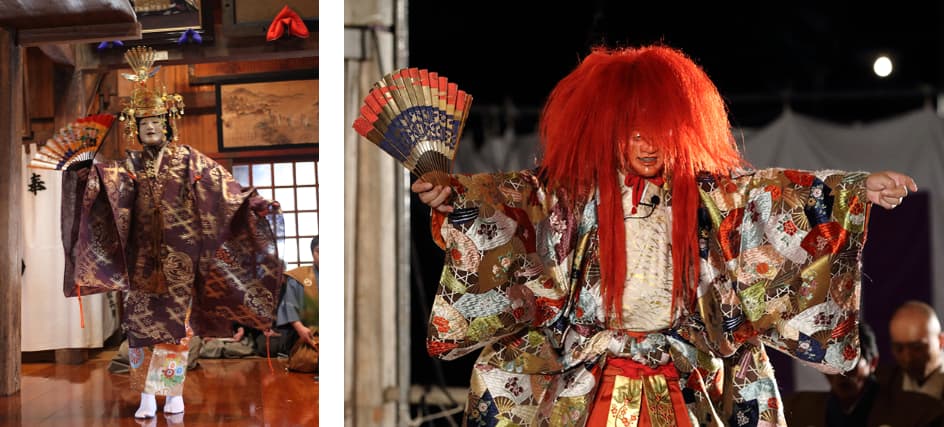
Kurokawa Noh, a form of sacred Noh passed down for over 500 years at Kasuga Shrine in Kurokawa, Tsuruoka City, Yamagata Prefecture, will take the stage in Singapore as part of "A Tapestry of Sacred Music" — a festival hosted by the Esplanade – Theatres on the Bay, Singapore's national performing arts venue. The performances are being co-organized by the Japan Foundation to mark the 60th anniversary of diplomatic relations between Japan and Singapore.
In addition to the stage performances, a lecture-demonstration will be held at the Japan Creative Centre (JCC). Lim Beng Choo, Head of the Department of Japanese Studies at the National University of Singapore (NUS) and a leading scholar of Japanese performing arts, will lead the session, using live demonstrations to explore the spirituality and aesthetic beauty of Kurokawa Noh as a "sacred Noh" rooted in local community tradition.
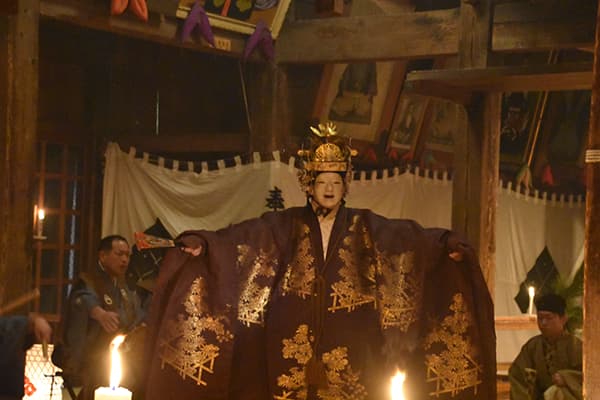
Kurokawa Noh Singapore Performances
April 30, 2026 (Thursday)
- Start time: 10:15 PM (local time)
- Venue: Esplanade Concourse
- Program: "Shōjō"
May 1, 2026 (Friday)
- Start time: 8:45 PM (local time)
- Venue: Esplanade Concert Hall
- Program: "Hagoromo"
A talk event is scheduled before each performance.
Tickets: Free admission (details will be announced on the official website of "A Tapestry of Sacred Music")
Organizer: Esplanade – Theatres on the Bay
Co-organizer: Japan Foundation
Supporter: Kurokawa Noh Preservation Society (Public Interest Foundation)
Patron: Embassy of Japan in Singapore
Lecture-Demonstration
Date: April 29, 2026 (Wednesday)
Venue: Japan Creative Centre (JCC)
Performers: Kurokawa Noh, Kamiza (Upper Group)
Program: Shimai "Naniwa"
Lecturer: Lim Beng Choo (Head, Department of Japanese Studies, National University of Singapore)
Organizer: Japan Creative Centre
Co-organizer: Japan Foundation
Supporter: Kurokawa Noh Preservation Society (Public Interest Foundation)
About Kurokawa Noh
Kurokawa Noh has been inherited by parishioners as "sacred Noh" (shinto noh) at Kasuga Shrine in Kurokawa, Tsuruoka City, Yamagata Prefecture. While it follows the lineage of sarugaku Noh as perfected by Zeami — sharing the same roots as the current five major schools (Kanze, Hōshō, Komparu, Kongō, and Kita) — it belongs to none of these schools and maintains its own independent tradition, said to preserve ancient performance forms and repertoire.
How Noh first came to Kurokawa remains unresolved, but records from the early Edo period already mention the presence of Noh masters and difficulties in sustaining the art. The existence of Noh costumes (three robes, designated as National Important Cultural Properties) woven during the Muromachi period suggests that Kurokawa Noh was already firmly established by at least the late Muromachi period, around 1500.
Approximately 240 parishioners of Kasuga Shrine are divided into two companies — the Upper Seat (Kamiza) and the Lower Seat (Shimoza) — each led by a Noh master who also serves as company head. Together, the companies include around 150 performers spanning all ages — from children to elders — performing roles in dance, music, and kyōgen. The tradition encompasses 250 Noh masks, over 500 Noh costumes, a repertoire of more than 500 Noh pieces, and 50 kyōgen pieces, making it an exceptionally large-scale folk performing art.

Over more than 500 years, Kurokawa Noh has been preserved and handed down through countless hardships, sustained by the faith and deep devotion of the local community. On May 4, 1976, it was officially designated as a National Important Intangible Folk Cultural Property. Today, in addition to performing at local religious festivals, Kurokawa Noh also accepts invitations for performances both within Japan and internationally through the Kurokawa Noh Preservation Society.
This project is part of the SJ60 commemorative certification program and is being implemented as a component of the Japan Foundation's comprehensive cultural exchange initiative, "Next Generation Co-Creation Partnership – Cultural WA2.0 –."