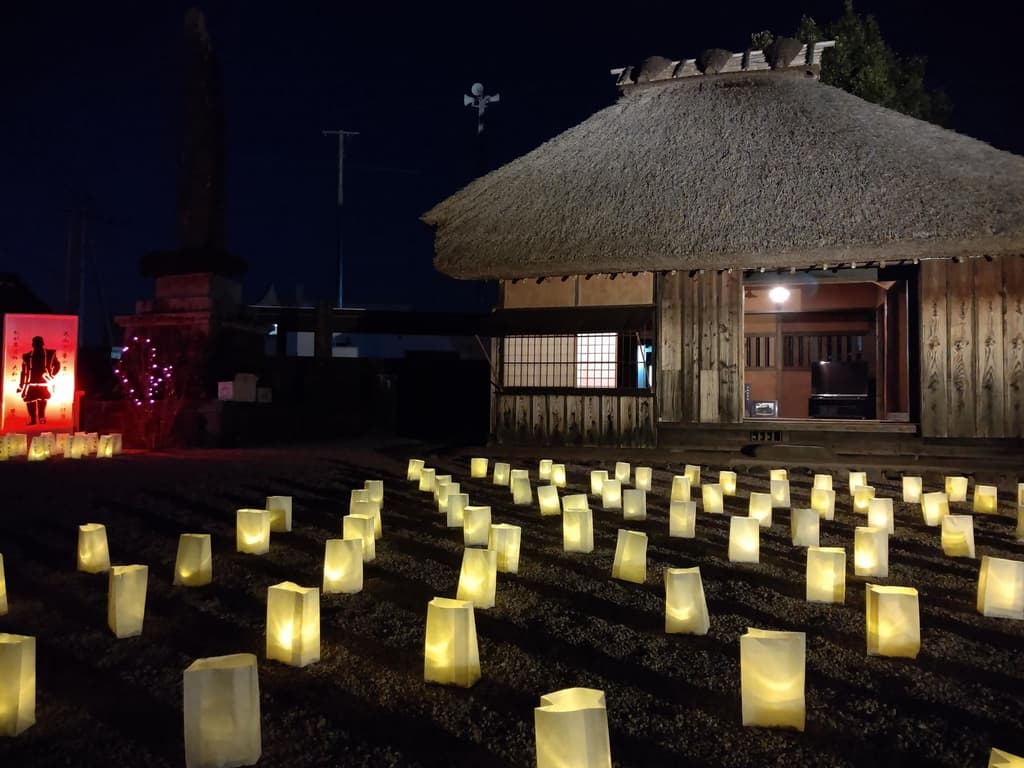
Sanshika (山梔窩), a historic house in Chikugo, Fukuoka Prefecture, will be lit up for the winter event "#Sanshika no Fuyu" (#サンシカの冬) on five evenings in December 2026.
Sanshika is the place where Maki Izumi-no-kami Yasuomi (真木和泉守保臣), a samurai activist of the late Edo period, spent about 10 years and taught his ideas and martial arts to young men. It stands about 100 meters west of Mizuta Tenmangu Shrine (水田天満宮), at the corner of the "Mizuta Nakamachi" (水田中町) intersection.
During the light-up, panels will introduce Izumi-no-kami's farewell poem, and paper lanterns bearing the names of his 50 comrades will be on display. Visitors can see the historic building wrapped in light on a winter evening.
Event Details
- Dates: Friday, December 4, Saturday, December 5, Sunday, December 6, Friday, December 11, and Saturday, December 12, 2026 (five days in total)
- Hours: 6:00 PM to 8:30 PM each day
- Venue: Sanshika (山梔窩), 242-12 Mizuta, Chikugo City, Fukuoka Prefecture
- Admission: Free
If the event is canceled because of weather, an announcement will be posted at https://chikugo.net/sanshika_winter/
Dago-jiru and Chikugo Black Tea
Warm refreshments will be served at the venue.
- December 4 and 5: Dago-jiru (a local dumpling soup) served by the local women's group "Koi no Sato Yui" (恋の里 結)
- December 6, 11, and 12: Warm Chikugo black tea
About Sanshika and Maki Izumi-no-kami
Sanshika is a simple thatched house made up of two rooms, one of three tatami mats and one of four and a half. It is also known as "Kuchinashi no Ie" (くちなしの家, the Gardenia House) and is designated as a Fukuoka Prefecture Cultural Property (Historic Site).
Maki Izumi-no-kami was a samurai of the Kurume Domain, born into a family that had served as priests of Suitengu Shrine (水天宮) for generations. After he spoke out on reform of the domain's government, he drew the domain's displeasure. In 1852, he was placed in the care of his younger brother, Otorii Rihei (大鳥居理兵衛), a priest at Mizuta Tenmangu Shrine.
Ordered into house confinement in Mizuta, Izumi-no-kami worried about the future of the country and advocated the ideology of sonno joi (revering the emperor and expelling foreigners). He named his residence "Sanshika," and it is said that he taught his ideas and martial arts to about 50 young men there.
In 1862, Izumi-no-kami left the domain. In 1864, he fought alongside Chōshū forces in the Kinmon Incident. After they were defeated, he took his own life on Mount Tennōzan in Kyoto.
After his death, the movement to overthrow the shogunate gained speed through events such as the formation of the Satsuma-Chōshū Alliance, and in 1867 the shogunate returned political power to the emperor. Sanshika has been carefully preserved to this day as a place that nurtured the ideas and people that led to the Meiji Restoration.