teamLab: Digitized Fukuoka Castle Ruins 2026-2027, a nighttime outdoor art exhibition, is being held at Fukuoka Castle Ruins, a nationally designated historic site in Maizuru Park, Fukuoka. It is the third edition and the first in seven years, running from Friday, October 30, 2026 through Monday, January 11, 2027 (a national holiday).
The full lineup of artworks has now been revealed. The exhibition turns the central area of the castle ruins, with its beautiful stone walls, into an art space that changes with nature and the presence of the people who visit.
Highlight Video: teamLab: Digitized Fukuoka Castle Ruins 2026-2027 © teamLab. Shot in real space. No AI or CGI.
Featured Artworks
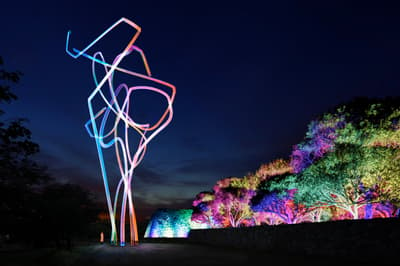
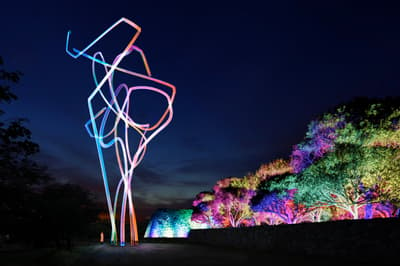
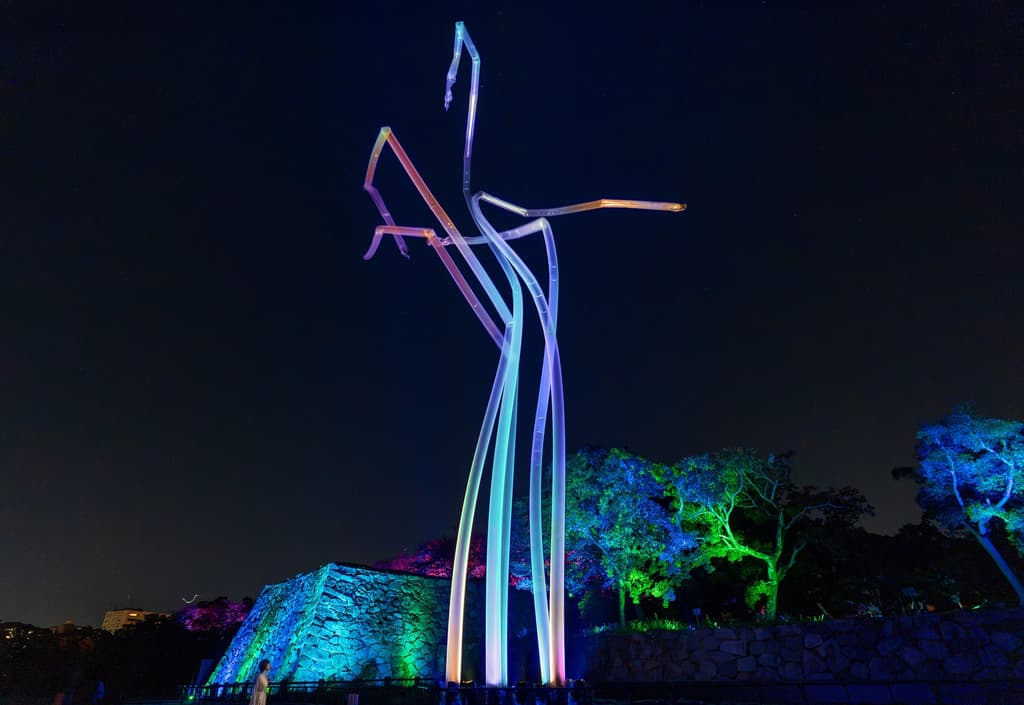
Pillars of Constant Flux
Pillars of Constant Flux (2026–) is part of the series Pillars that Dance with the Wind (2023–).
All life exists within flows of matter and energy, and the flow itself creates and sustains structure. This is fundamentally different from objects such as stones, iron, and the things humans have made, which have independent, static, and stable structures of their own.
The work does not stand because air is sealed inside it and pressure holds it up. Its entrance and exit are the same size, and air flows through the interior without interruption. The work stands, and keeps its structure and existence, through that flow itself. If the flow stops, the material remains, but the existence of the work disappears.
The work is strongly affected by the environment, including wind, rain, and humidity, and its movement and height change greatly. Even so, as long as the environment that gives rise to its existence is maintained and the flow continues, its existence is maintained while its form keeps changing. It keeps moving, supple, soft, and fragile.
Pillars of Constant Flux is an attempt to extend sculpture from a fixed object to something whose structure keeps emerging through constant flow in an open environment. Rather than the artist shaping the form directly, the artist creates the environment in which existence arises.
Autonomous Resonating Life
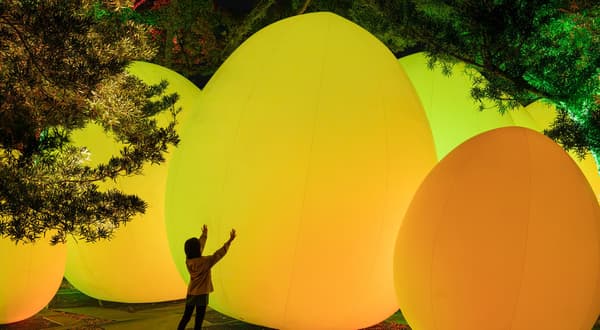
teamLab, Autonomous Resonating Life, 2017– © teamLab
Shot in real space. No AI or CGI.
When pushed by people or wild animals, or knocked over by strong rain or wind, each Ovoid rights itself, shining brightly and sounding a tone. The surrounding Ovoids respond one after another, carrying the light and tones onward.
The light and tones of the Ovoids also spread to the nearby work Resonating Trees and continue on. The artwork space is transformed by people's behavior, the environment, and the surrounding works, making people and the environment part of the work.
Resonating Trees
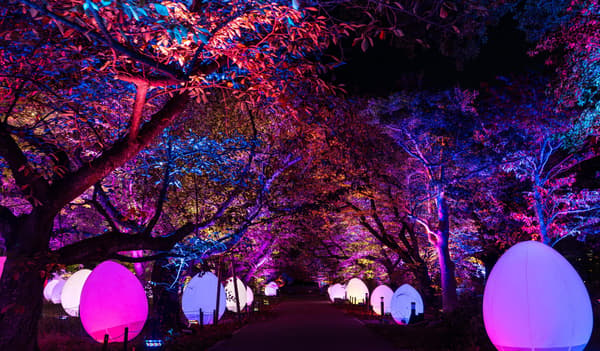
teamLab, Resonating Trees, 2014– © teamLab
Shot in real space. No AI or CGI.
The lights of the trees respond to the continuous light of Autonomous Resonating Life, shining and sounding tones. The surrounding trees respond one after another, shining and sounding in turn.
When light surges from deep among the trees, it means someone is there. Visitors are likely to become more aware than usual of the other people in the same space and of their surroundings.
This work is part of Digitized Nature, an attempt to let nature become art as nature, without destroying it.
The shapes, textures, and changes of the trees in a forest hold long spans of time, the continuity of life, and relationships with the ecosystem. A tree is part of an ecosystem, yet its surface and interior also host life and form an ecosystem of their own. Unlike human-made objects, the outline of its existence is ambiguous.
When immaterial materials such as sensing, networks, light, and sound are layered onto such trees, the trees respond to one another as trees and form a continuous field as a colony. Rather than humans carving nature as a material, it is an attempt to let trees shaped over a long time and within an ecosystem stand as a resonating colony sculpture.
Here, it is not only humans who change the work. Bodies, others, wild animals, the environment, trees, and the surrounding works are all connected to the same ecosystem-like field of response. Visitors do not simply look at the work. They enter the resonance of the trees and feel the presence of others, wild animals, and the environment through the continuity of light and sound.
Walk, Walk, Walk - Fukuoka Castle Ruins
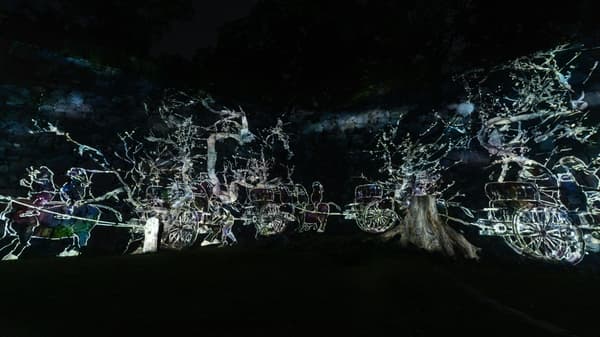
teamLab, Walk, Walk, Walk - Fukuoka Castle Ruins, 2021– © teamLab
Shot in real space. No AI or CGI.
An anonymous, diverse crowd of figures keeps walking along the stone walls of Fukuoka Castle Ruins. People choose something, discard something, and view the work while facing these figures.
A Zen saying goes 歩歩是道場 (hoho kore dojo). The figures in the work keep walking endlessly, facing various events. Visitors, too, will face them together by following the figures in the world of the work, or by facing each figure as they come walking in one after another.
The work is drawn continuously in real time by a computer program, not played back from pre-recorded video. The whole is never copied from a previous state and keeps changing forever. The picture of this very moment can never be seen again.
Enso on Ancient Stone Wall
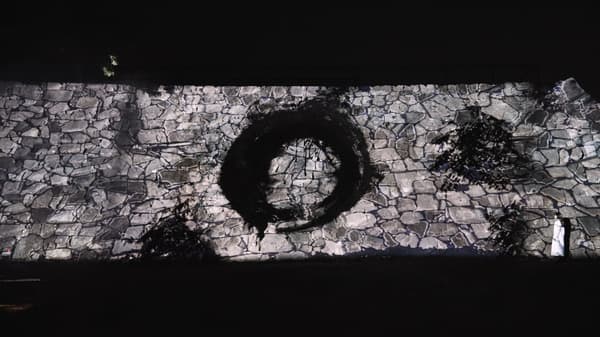
teamLab, Enso on Ancient Stone Wall, 2023– © teamLab
Shot in real space. No AI or CGI.
Among the stone walls of Fukuoka Castle Ruins, the wall of the tenshudai (keep base) uses the oldest technique, nozura-zumi (野面積み), in which natural stones are stacked as they are. An "ensō" is written continuously on this wall.
The black of the calligraphy drawn in light means the absence of light, and it is indistinguishable from the shadows formed by a stone wall weathered over hundreds of years. The black of the calligraphy and the black created by a long span of time become one, endlessly writing an ensō onto the wall. The ensō blurs the material boundary of the wall and creates a new space and time.
The ensō, a Zen calligraphic work in which a circle is drawn in a single stroke, is here drawn in one stroke as "spatial calligraphy." The stroke, drawn in three dimensions, appears as a circle at the moment it rotates into view. Spatial calligraphy is calligraphy written in space, which teamLab has pursued since its founding, reconstructing the depth, speed, and strength of ink traces in three dimensions through a new interpretation.
In Zen, the ensō has been expressed since ancient times by drawing a circle in the air with a staff or similar tool, and it is considered a symbolic expression of enlightenment, truth, the whole universe, and equality. It is also a circle that reflects the mind of the viewer, and its interpretation is left to the viewer.
Sketch Kuroda Kanbei
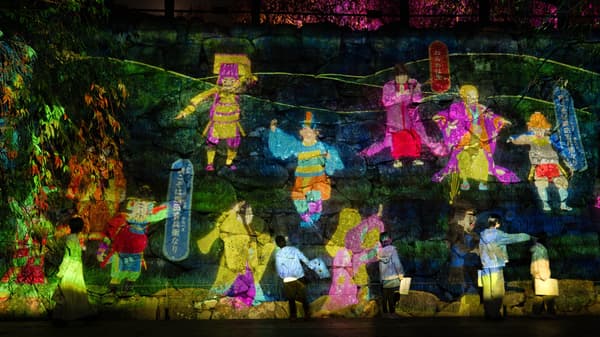
teamLab, Sketch Kuroda Kanbei, 2019– © teamLab
Shot in real space. No AI or CGI.
Kuroda Kanbei figures drawn by visitors walk around and dance. Visitors freely draw historical figures connected to Kuroda Kanbei on paper, and the figures they draw start to walk. When a visitor approaches a historical figure, it starts to speak.
Continuous Life and Death at the Now of an Ancient Tree
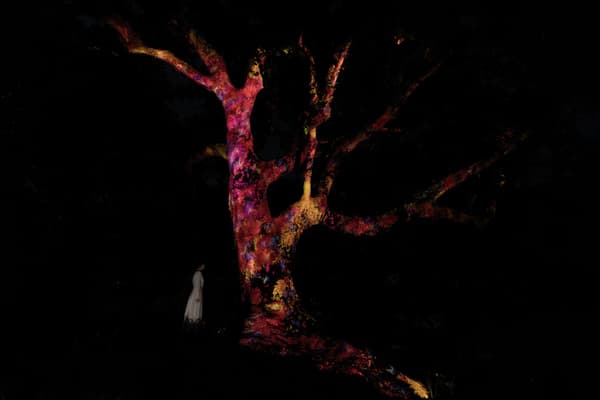
teamLab, Continuous Life and Death at the Now of an Ancient Tree, 2026, from the series Ever Blossoming Life Tree - Giant Taro Cedar, 2021– © teamLab
Shot in real space. No AI or CGI.
The giant trees in the forest of the castle ruins have put down roots in the earth, thickened their trunks, and spread their branches, forming their present shape over a long span of years.
People usually cannot perceive a span of time far longer than their own lives, or that this time is continuous with the present. But when facing a giant tree, they notice that an enormous accumulation of time is contained in its overwhelming shape and texture. teamLab calls this huge presence shaped by long time "Time-Sculpted Existence."
Within this presence, flowers repeat birth and death, the time of continuous life flows, and it is transformed by the presence of the people living now. As visitors enter the forest of the ruins, wander, and become one with this presence, it becomes clear that the accumulated time is continuous with the present moment.
Walking through the overlap of the tree's accumulated time and the continuous time of life, people feel with their whole bodies that their own existence rests on a long continuity of time without boundaries.
Spatial Calligraphy of Wind
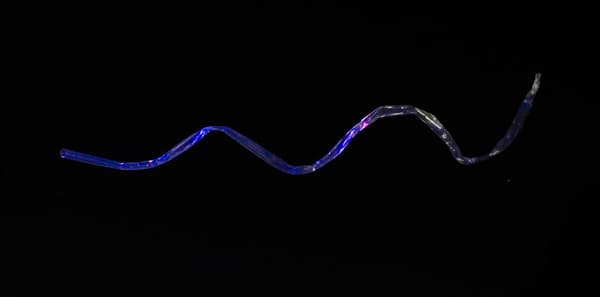
teamLab, Spatial Calligraphy of Wind, 2024 © teamLab
Shot in real space. No AI or CGI.
This work appears in the sky on a clear night when the wind blows. When the wind stops, it disappears.
Things humans have made, such as concrete, have stable structures of their own, like stones. A whirlpool, however, gets its structure from water that keeps flowing from the outside to the inside and from the inside to the outside, and its order is maintained as the water continues to flow. Life, too, maintains its order as energy and matter keep flowing in and out through food.
The work is not floating in the sky because air is sealed inside it and pressure holds it up. Its entrance and exit are the same size, and the wind flows through the interior without interruption. That flow itself creates the structure of the lines dancing in the sky and maintains their existence.
The wind that raises this work into the sky is natural wind. Humans cannot control when it blows or how strongly. The existence of the work rests on the environment, not on human intention. When the wind blows, lines are drawn in the sky, and when the wind stops, the lines disappear. The lines continuously drawn in the sky are the form of the wind itself.
Stone Steps of Oblivion - Fukuoka Castle Ruins
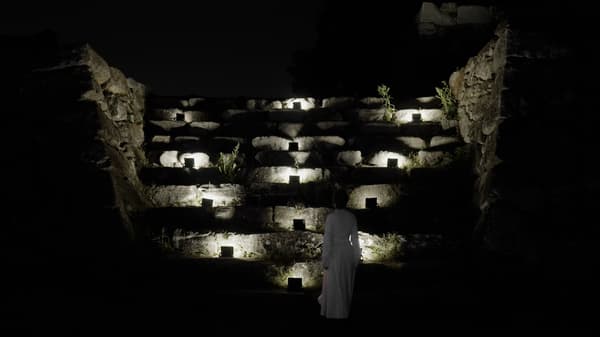
teamLab, Stone Steps of Oblivion - Fukuoka Castle Ruins, 2017 © teamLab
Shot in real space. No AI or CGI.
The stone steps of the small keep of Fukuoka Castle, also known as the Stone Castle (石城), which was built in 1607, glow with light.
The lights on the steps are each autonomous, flickering as if breathing slowly. When a person approaches, the lights shine brightly and sound a tone.
The Materialization of Time
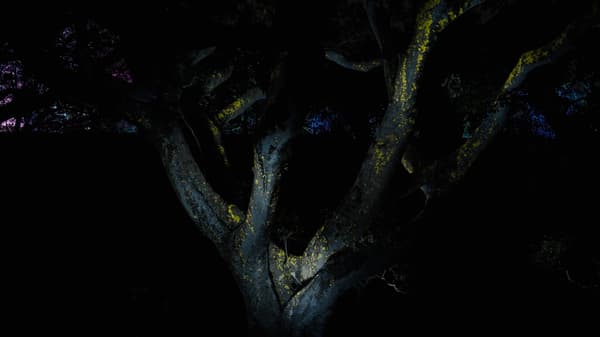
teamLab, The Materialization of Time, 2026 © teamLab
Shot in real space. No AI or CGI.
The scaly lichen ウメノキゴケ that spreads across the trunks of old trees is a living organism of the ultimate "open system," a symbiosis of fungi and algae. It lives on sun and rain alone, goes dormant without water, and can survive even in outer space. In an open system with sun and rain it keeps a lifespan close to eternal, yet it dies quickly if the air is even slightly polluted by exhaust fumes.
Growing at the slow pace of just 1 mm to 5 mm a year, it is, in the present day, a presence for which an internet search turns up only "how to remove it." In the Edo period, however, people called the distinctive texture this lichen wears "古色 (koshoku)" and prized it as the highest virtue, a presence of long time that they could never create themselves.
ウメノキゴケ may be the "materialization of time." Masters such as Kano Eitoku, Maruyama Okyo, and Ito Jakuchu once painted countless "blue-green dots" on the trunks of old trees. Those dots were proof that a tree had lived for a thousand years, and a sign that determined the stature of a painting.
Originally, some ウメノキゴケ emit yellow or blue light under ultraviolet rays, but this cannot be seen during the day because other light is stronger. In the darkness, the vivid colors flickering under ultraviolet light are a trace of life that a long span of years has continued to draw in the forest. The work is a "Time Painting," in which a glow of long time materialized rises into view.
Sketch Factory

teamLab, Sketch Factory, 2022– © teamLab
Composite image.
The pictures visitors draw can be taken home as gifts. The historical figures born from visitors' drawings in Sketch Kuroda Kanbei become can badges here.
Concept
Fukuoka Castle was built over seven years starting in 1601 and is, by scale, the largest castle in Kyushu. Its central area, including the Honmaru, Ninomaru, and Sannomaru, is built entirely of stone walls, which is why it is also known as the Stone Castle (石城). The still-beautiful stone walls are divided into four tiers, making it an extremely vast historic site.
teamLab runs an art project called Digitized Nature. Using immaterial digital technology, the project turns a place into an art space as it is, without physically altering nature or the place.
At this exhibition, Fukuoka Castle Ruins, a site with a long history, becomes the space for the artworks. The space changes interactively, influenced by the wind and rain in nature and by the behavior of the people there, making visitors part of the works and part of a long span of time together with nature. In this way, the works, people, and nature, the self and others, and the present and the past continue without boundaries.
Event Details
teamLab: Digitized Fukuoka Castle Ruins 2026-2027
Official website: https://www.teamlab.art/jp/e/fukuoka-castle/
Dates: Friday, October 30, 2026 – Monday, January 11, 2027 (national holiday)
Venue: Fukuoka Castle Ruins, Maizuru Park (Jonai, Chuo-ku, Fukuoka, Fukuoka Prefecture)
Hours:
- Monday, November 2 – Friday, November 6, 2026: 6:30 PM – 10:00 PM
- Saturday, November 7 – Thursday, December 31, 2026: 6:15 PM – 10:00 PM
- Friday, January 1 – Monday, January 11, 2027 (national holiday): 6:30 PM – 10:00 PM
- Last entry: 9:30 PM
- Opening times may shift earlier or later so the artworks can be viewed in optimal conditions.
- Depending on weather and other conditions, some artworks may not be displayed.
Ticket Prices
Weekdays (excluding Tuesday, December 29 – Thursday, December 31):
- Adult: ¥2,300
- Junior/senior high school student: ¥1,300
- Elementary school student: ¥700
- Preschooler: Free
Weekends, national holidays, and Tuesday, December 29 – Thursday, December 31:
Adult: ¥2,500
Junior/senior high school student: ¥1,500
Elementary school student: ¥900
Preschooler: Free
Weekends, national holidays, and December 29–31 require an advance date-and-time reservation. No advance date or time is needed on other weekdays.
Tickets purchased on-site cost an additional ¥200 for adults and ¥100 for junior/senior high school students and children.
If advance tickets sell out, same-day tickets will not be sold on-site.
Where to Buy Tickets
- ARTNE TICKET ONLINE: https://fukuoka-castle.ticket.artne.jp/#/
- Ticket Pia: https://w.pia.jp/t/teamlab-fukuokacastle/
- P-code for the weekday ticket: 996-303
- P-code for the weekend and national holiday timed-entry ticket: 662-414