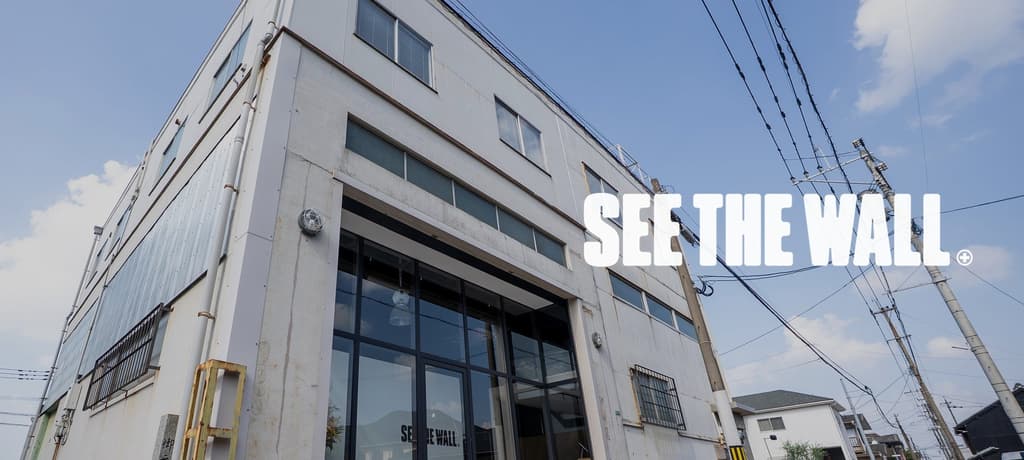
On November 1, 2026 (Sunday), "SEE THE WALL" opened in Moji Ward, Kitakyushu, Fukuoka Prefecture. It is a new base created by ZEN, an artist who is a pioneer of Japanese parkour and who works in Japan and abroad exploring the relationship between cities and the body. The building, formerly an ironworks, has been renovated to include a space for parkour on the first floor and an atelier and exhibition space on the second floor. It is a new base where physical practice, and the creation and presentation of artworks, all take place in one location.
Born and raised in Tokyo, ZEN has moved with the body in cities around the world, creating videos and artworks. The place ZEN chose is Moji in Kitakyushu, where ZEN's family has roots. In the "open space" of the Dairi (大里) district, surrounded by sea and mountains and steeped in industrial history, ZEN saw the potential for a new culture to emerge.
Local children come to learn parkour, visitors come to see the works, and people gather for events. People of different purposes and generations come and go in the same building, and the parts that cannot be called either culture or art meet on site. ZEN believes this overlap will bring a new flow to the area. Working with local companies and artists, ZEN plans to nurture what can only be born in this land.
SEE THE WALL
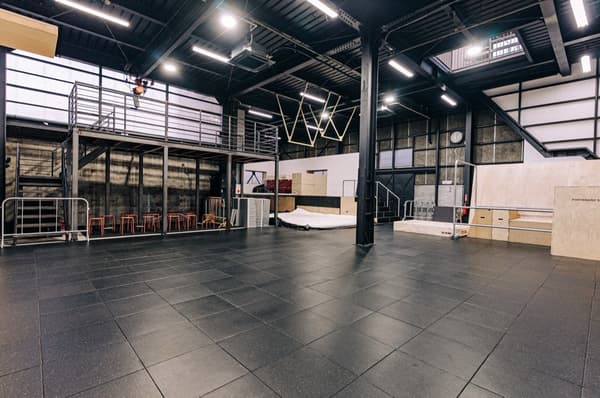
The first-floor parkour space
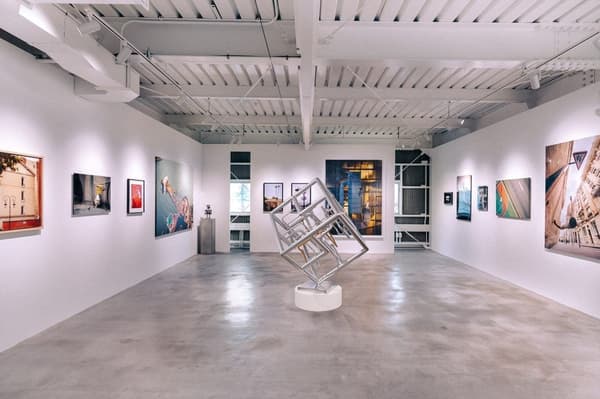
The second-floor exhibition space
The name "SEE THE WALL" comes from ZEN's philosophy of parkour. By continuing to ask how one sees a wall, one looks anew at one's own mind and body. That idea has been turned directly into a space.
"When I returned from my activities overseas, what I needed was time to calmly digest what I had gained, time to face my daily input and output, and a space that makes that possible. In everyday life, where information flows in constantly and is hard to control, I think such time and space are necessary not only for me but for everyone living today. Moving the body and looking at artworks can both become time spent facing yourself," says ZEN.
At the same time as the opening, the opening exhibition "SEE THE WALL" began in "SEE THE WALL GALLERY," the exhibition space on the second floor. It shows works, including previously unpublished pieces, centered on self-portraits that ZEN has created in cities around the world. Admission is free, and visits are by reservation only. Reservations can be made through the dedicated form on the official website: https://seethewall.jp
Facility Statement: About This Place
SEE THE WALL is a base for parkour and art. For me, the whole building, both the first and second floors, is my atelier.
I set up this place so that I can face the challenges and themes I give myself and overcome them. In that process, I grow, refine my thinking, polish my skills, and create new worlds.
For me, parkour is input for receiving something from the world, and at the same time output for expressing it with the body. Moving the body and making works are not separate activities.
I was born and raised in Tokyo, and in my teens I learned parkour in Los Angeles. One of the things that drew me there was the breadth of space in the city. Because there is room to spare, people gather, communities form, and places are made to receive them. I also liked the slightly distant feeling between people that comes from a city where you get around by car.
Dairi in Moji Ward, Kitakyushu, where SEE THE WALL stands, has a similar feeling. There are mountains behind and the sea in front. Palm trees line the coast, and from the second floor you can see the Kanmon Strait and Shimonoseki on the opposite shore, large in view.
Kitakyushu is also where my mother's side of the family has its roots. Finding in this place, to which I have ties, the same room to spare that drew me in LA was the deciding factor in choosing it as my base.
This area suits both trying things out and thinking alone. There is room in the space and in relationships between people, and room for a new culture to come in.
Here, I move my body, think, and create, and from here I will present my work. Rather than keeping it closed off as a place of my own, I want to create what can only be born in this place, while working with local companies and artists who share similar thoughts.
ZEN
SEE THE WALL Facility Overview
- Name: SEE THE WALL
- Overview: A base for parkour and art by parkour artist ZEN
- Opening date: Sunday, November 1, 2026
- Address: 2-3-12 Dairihonmachi, Moji Ward, Kitakyushu, Fukuoka Prefecture 800-0063
- Website: https://seethewall.jp
- Instagram: @see.the.wall (https://www.instagram.com/see.the.wall/)
1st Floor: Space for Parkour
Normally closed to the public, it is opened during classes and open gym sessions run by PARKOUR KYUSHU, and during parkour culture events. In the evening, it is used as PARKOUR KYUSHU's Moji Studio.
- Inquiries about classes and open gym: PARKOUR KYUSHU's Instagram, @parkour_kyushu (https://www.instagram.com/parkour_kyushu/)
- The studio is not available for rental to the general public.
2nd Floor: Atelier and Exhibition Space (SEE THE WALL GALLERY)
A space for ZEN's creation and exhibitions. Windows look out over the Kanmon Strait and Shimonoseki on the opposite shore. The exhibition space is free to enter and reservation-only, and anyone can make a reservation.
- Reservations: Accepted through the dedicated form on the official website (https://seethewall.jp). A reservation is confirmed once staff reply.
- Exhibition schedule: Each exhibition runs for about 3 months, with an exhibition changeover period of about 1 month between exhibitions.
Opening Exhibition Overview
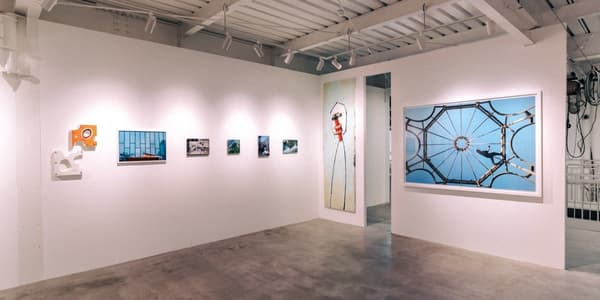
Installation view of the opening exhibition
SEE THE WALL
- Dates: Sunday, November 1, 2026 to Sunday, January 31, 2027
- Venue: SEE THE WALL GALLERY, 2nd floor
- Admission: Free, reservation required (reservations are accepted through the dedicated form on the official website)
The opening exhibition "SEE THE WALL" mainly shows self-portraits ZEN has created in cities around the world, along with paintings and sculptural works.
ZEN's photographs place ZEN's own body in city scenes in arrangements that can look like composites. No photo compositing is done, and nothing at the scene is moved at the time of shooting.
The works were previously presented city by city in series set in Bangkok, Paris, and Los Angeles. Here they are shown together under a single theme, outside those series. Works that have not been shown before are also on public view for the first time. The works on display are for sale (with some exceptions).
Exhibition Statement: Opening Exhibition "SEE THE WALL"
Ever since I encountered parkour at the age of 15, things in the city have started to look completely different from their original roles. A wall divides space, and stairs are for people to go up and down. But when I became deeply involved with that space, touching it, climbing it, and jumping, I found no end of other ways to use it. It was not that the walls or stairs had changed.
What I found was not only that something offered a foothold for a technique or that its height was perfect for practice. By getting involved, a new meaning is born there. Knowing the name and role of a thing is a separate matter from how I relate to it and what I find in it.
Rather than "I discovered a new possibility of the wall," I realized that "it was I myself who determined how the wall looked."
After that, instead of just trying to know the world, I wanted to engage with it from many angles, using my own body and experience. I think the accumulation of meanings I found along the way shapes the world as it is for me.
In my work today as well, I try to find different relationships in the familiar appearance of things in the city. To do that, I place my body in places where I would not normally stand.
What can be seen from that place?
ZEN
About the Dairi (大里) District
In 1903 (Meiji 36), Suzuki Shoten (鈴木商店), a Kobe trading company, established the Dairi Sugar Refinery (大里製糖所) here. The Dairi Flour Mill (大里製粉所, 1911), Teikoku Beer (帝国麦酒, 1912), and the Dairi Spirits Distillery (大里酒精製造所, 1914) followed one after another, and the area developed as an industrial zone.
The brick buildings of the sugar refinery are still in operation today as a Kanmon Seito (関門製糖) factory. The former Teikoku Beer factory was used as the Sapporo Beer Kyushu Brewery (サッポロビール九州工場) until 2000 and is now preserved and used as "Moji Red Brick Place" (門司赤煉瓦プレイス). Four buildings, including the factory facilities completed in 1913, were registered as Registered Tangible Cultural Properties of Japan in 2007.
SEE THE WALL was born in this historic Dairihonmachi neighborhood.
Access
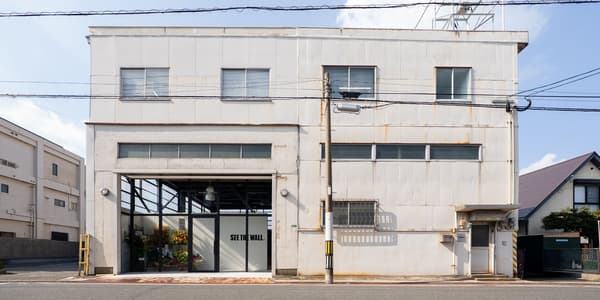
Front exterior
- Nearest station: About a 10-minute walk (about 3 minutes by car) from Moji Station on the JR Kagoshima Main Line
- From Kokura: One stop on the JR Kagoshima Main Line from Kokura Station to Moji Station (about 6 minutes)
- From Hakata: About 16 minutes by Sanyo Shinkansen from Hakata Station to Kokura Station, then transfer to the JR Kagoshima Main Line for about 6 minutes to Moji Station
- Parking: 2-2-26 Dairihonmachi, Moji Ward, Kitakyushu, Fukuoka Prefecture (across the road from the building)
- Only areas ③, ⑤, ⑥, ⑦, ⑧, and ⑩ may be used.
- Look for the "SEE THE WALL Dedicated Parking" (SEE THE WALL 専用駐車場) sticker.
Moji Station is a different station from Mojiko Station, the closest station to the tourist spot Mojiko Retro (門司港レトロ). Moji Station is two stations before Mojiko Station.
ZEN Profile
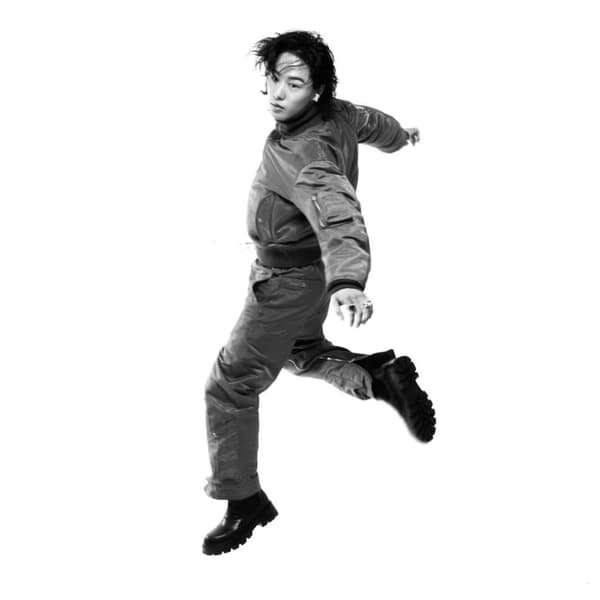
ZEN
ZEN was born in Tokyo in 1993.
ZEN encountered parkour at 15 and went to Los Angeles alone the following year. After returning to Japan, ZEN became Japan's first professional parkour athlete and has conveyed parkour as a culture. ZEN has also competed, winning the North American Championship in 2015 and an FIG world competition in 2020.
ZEN remains a top-level player and faces cities around the world with nothing but the body. This practice has expanded into video, lectures, and artwork.
Art is one part of that. Since 2020, ZEN has been creating photographs, sculptures, and drawings centered on self-portraits, starting from the relationship between urban space and the body. ZEN has worked in Bangkok, Paris, Los Angeles, and elsewhere, and has presented work in Japan and abroad, including at Photo London and in a solo exhibition on the Champs-Élysées in Paris.