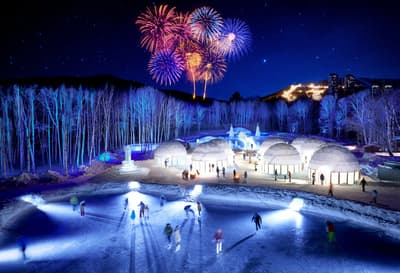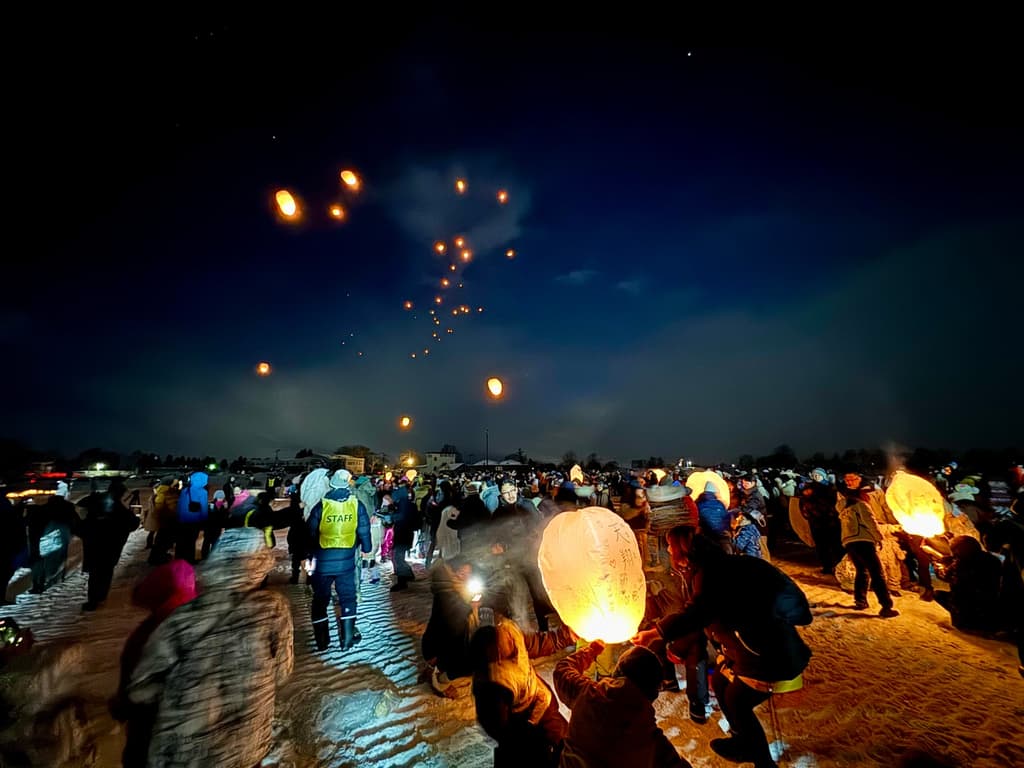
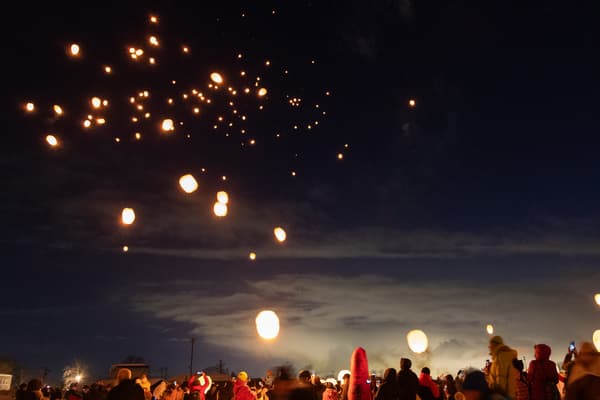
Shinshinotsu Village in Hokkaido, about 45 minutes by car from Sapporo, will hold the 7th Shinshinotsu Tento (Lantern) Festival (第7回新篠津天灯(ランタン)祭り) on Saturdays and Sundays in February 2027. Visitors can send a fire-lit lantern carrying their wishes into the winter sky above a wide snowfield. The lanterns are launched in the traditional way, lit with a flame and without a string, and the sight of many of them rising together resembles the Milky Way in winter.
In past years the festival was a one-day event with long stays. To let more people take part safely and enjoyably, and to keep the event sustainable to run, the format has changed significantly this time. It is now a reservation-based, long-run format with short experiences, and lanterns can be launched in four time slots, from midday to night, on every Saturday and Sunday in February.
Putting Hokkaido's Flattest Terrain and an Enveloping Sky to Use
Shinshinotsu Village is said to be "the flattest village in Hokkaido," with no mountains, slopes or tall buildings and a vast expanse of farmland. With nothing to block the view, the village has pursued a town-building approach that makes use of the sky, including the "Shinshinotsu Observatory" (しんしのつ天文台), the first fully open-style observatory in Hokkaido, and the "Shinshinotsu Glider Airfield" (新篠津グライダー滑空場).
That effort was recognized in October 2025 at the "Hoshizora no Machi, Aozora no Machi" National Convention (星空の街・あおぞらの街全国大会), hosted by the Ministry of the Environment and others, where the village received an award that was the first in Japan given to a single municipality. The Tento (lantern) festival was also one of the points evaluated in winning it, as a good example of using as a local resource the enveloping sky made possible by a very flat snowfield with no mountains, slopes or tall buildings, a result of the village's long focus on agriculture.
Under an enveloping sky and a snowfield stretching as far as the eye can see, lanterns float up into the winter sky of Shinshinotsu Village, 45 minutes by car from Sapporo, every year.
What Makes the Shinshinotsu Tento Festival Distinctive

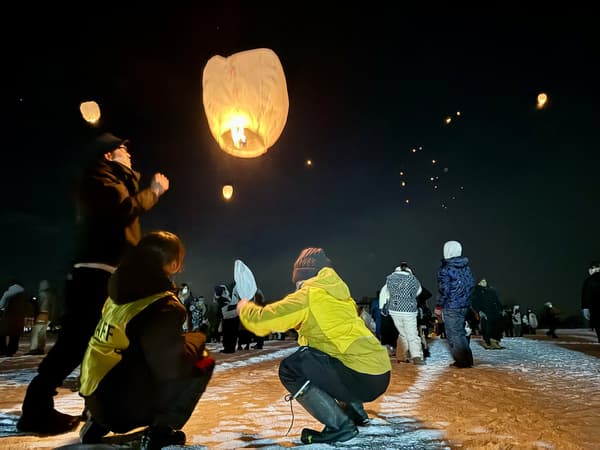
The highlight of the festival is the experience of actually lighting a lantern that carries a wish and sending it into the vast sky. The lantern here is, in effect, "a large paper balloon with fuel attached." When the fuel is lit and warm air collects inside, the lantern flies far up into the sky. In Taiwan, Vietnam and other places, lantern launches are held as traditional events. They are said to ward off evil spirits and pray for a good harvest, and it is also said that a wish written on a lantern and released will come true. Shinshinotsu Village releases fire-lit lanterns using the same traditional method as authentic lantern launches such as the Komloi (コムローイ) in Taiwan.
A Staple Nature Activity for a Winter Trip to Hokkaido
Hokkaido offers a variety of nature experiences in summer. In winter, however, nature activities center on skiing and snowboarding, and there are surprisingly few others. The lantern experience in Shinshinotsu is well suited as a winter nature activity near Sapporo.
1. A Hands-Free Experience
Anyone can try the lantern launch empty-handed, and the staff light the lantern. A lantern is about the right size for two or three people to hold and release together, and staff assist solo participants as well. As long as visitors dress warmly against the cold, no expensive equipment is needed, and people of a wide range of ages can take part.
2. Close to Sapporo
The village is 45 minutes by car from Sapporo along flat roads, and the launch experience takes roughly 45 minutes to 1 hour in each time slot, so it is easy to fit into a schedule, whether on a tour or an independent trip.
3. A Wide Range of Dates
The festival runs on the Saturdays and Sundays of February, for 8 days in total, with four time slots each day.
- 11:00 AM to 12:00 PM
- 3:00 PM to 4:00 PM
- 4:00 PM to 5:00 PM
- 5:00 PM to 6:00 PM
The experience is divided into four time slots from midday to night. By using a reservation system with multiple sessions and four staggered launches a day, the festival can reduce the risk of cancellation due to traffic congestion around the venue or strong winds, and can avoid crowding for safety.
Holding multiple sessions also makes it possible to adjust plans that were hard to fit into the former format of a single launch a day, and in bad weather visitors can reserve for the next available date. This makes the festival much easier to join for visitors and for the travel agencies that organize tours.
Collecting the Lanterns After the Experience

The lanterns that fly off and fall are made of materials that decompose naturally, without iron wire or similar parts. Staff walk out onto the snowfield and collect them directly, in two rounds, on the day of the event and on the following day.
How the Festival Began With a University Student's Idea
The festival began with an idea from a university student.
In 2020, during a joint project among Hokkai-Gakuen University, the Ishikari Subprefectural Bureau and Shinshinotsu Village, students of Hokkai-Gakuen University visited the village many times to consider local issues. They came up with the idea of "flying lanterns in Shinshinotsu Village, where agriculture is the main industry and a snowfield spreads out in winter," and the festival started from there. The first festival was held during the COVID-19 pandemic, so participation was limited to villagers, but it was a great success thanks to the efforts of the staff, including the students who gathered.
After the joint project ended and the organizer changed to the Shinshinotsu Village Tourism Association, Hokkai-Gakuen University students have continued to take part as staff every year as part of their regional learning. The number of visitors has grown with each edition, and at the 5th festival 1,200 lanterns were launched, making it one of the largest lantern events in Hokkaido. It has now become a winter tradition of Shinshinotsu Village that draws many participants from outside Hokkaido.
A Nature Activity Rare Even by World Standards
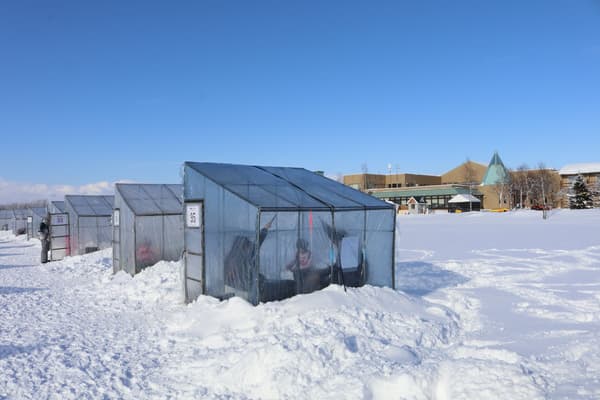
Only a few places in Japan offer lantern launches with fire-lit lanterns. Shinshinotsu's experience is also available in the daytime, and during the festival period it can be combined on the same day with wakasagi (Japanese smelt) fishing on Lake Shinotsu, which adjoins the venue. Wakasagi fishing can also be tried empty-handed. This allows "fishing on a frozen lake and a lantern experience," a combination of nature activities that is rare even worldwide. (Wakasagi fishing requires a separate reservation. For details, see the Shinshinotsu Onsen Tappu-no-Yu website.)
From evening into night, visitors may be able to see a fantastical sunset, a misty lake, and the starry sky together with the lanterns.
The lantern launch, a highly popular attraction on trips to Taiwan, can be experienced in Shinshinotsu Village without leaving Japan. The fantastical scenery is expected to make a lifelong memory.
Event Details
| Event name | 7th Shinshinotsu Tento (Lantern) Festival (第7回新篠津天灯(ランタン)祭り) |
| Dates | February 6, 7, 13, 14, 20, 21, 27 and 28, 2027 (Saturdays and Sundays) |
| Time slots | (1) 11:00 AM to 12:00 PM (2) 3:00 PM to 4:00 PM (3) 4:00 PM to 5:00 PM (4) 5:00 PM to 6:00 PM |
| Fee | ¥1,500 per lantern (reservation required, payable on site) |
| Venue | Shinotsu Park (しのつ公園), Dai 46-sen Minami 3, Shinshinotsu Village, Ishikari District, Hokkaido |
| Reservations and other details | Shinshinotsu Village tourism information page |