Tokyo Yomiuri Aquarium (東京よみうり水族館), an aquarium under construction in Tokyo Giants Town (東京ジャイアンツタウン) in Inagi, Tokyo, has been given its name and is scheduled to open in summer 2027. Tokyo Giants Town is being developed jointly by The Yomiuri Shimbun Tokyo Headquarters, the Yomiuri Giants, and Yomiuriland on a site adjacent to the Yomiuriland amusement park. A dining facility will open at the same time. Centered on Giants Town Stadium (ジャイアンツタウンスタジアム), which opened ahead of the rest in March 2025, Tokyo Giants Town will then hold its grand opening.
What Is Tokyo Yomiuri Aquarium?
Tokyo Yomiuri Aquarium is a full-scale inland aquarium that uses artificial seawater. The building has one basement level and three floors above ground, with a facility area of 9,874 m² including the outdoor exhibits. About 350 species and 40,000 exhibits are planned.
The concept is "visitors enter the world of living creatures and spend time together with them." The aquarium tells a story of water, the source of life, flowing from the Tama River, a symbol of the local area, to the sea, and from the shallows to the deep sea.
Exploring the World of Marine Life
Visitors are greeted by small-clawed otters just inside the entrance. The aquarium is divided into 10 areas, including "Penguins" and "Jellyfish," and highlights include:
- Water Garden (ウォーターガーデン): a planted tank about 30 m long, which is long for an aquatic plant display
- Sea Lion Paradise (アシカの楽園): a spacious exhibit area of about 300 m² where sea lions that have moved from the Yomiuriland amusement park live at a relaxed pace alongside seals
- Deep sea and ancient creatures area: a coelacanth specimen that was donated by the French government in 1967 and was shown to the public for the first time in Japan
An Undersea Tunnel into a Coral Sea
One of the main attractions is a transparent undersea tunnel that runs through a large tank themed on a coral sea (about 7 m high, about 13 m wide, and about 1,300 tons of water). Visitors can walk through it with a 360-degree view. The tank includes a "drop-off" (a place where the shallows suddenly become deep) to recreate a rich sea where many kinds of creatures gather. An acrylic dome at the start of the tunnel fills the field of view with underwater scenery, giving the feeling of being in the sea.
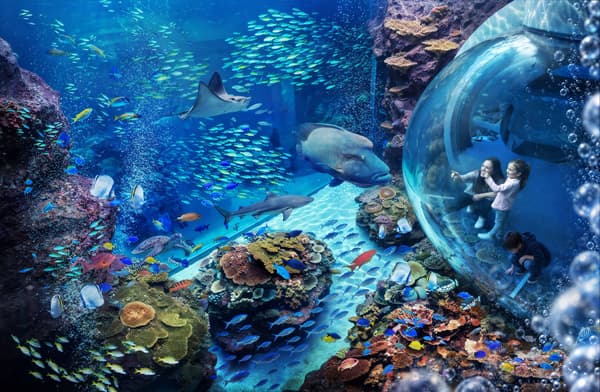
The acrylic dome offers an immersive feeling of being in the sea (image).
Protecting the "Cradle of the Sea"
Coral reefs nurture a wide variety of living creatures and are also called the "cradle of the sea." In recent years, large-scale bleaching caused by global warming has led to the loss of coral reefs. Yomiuriland has signed a comprehensive partnership agreement aimed at coral reef conservation with Kunigami Village in Okinawa Prefecture and the Kunigami Fisheries Cooperative Association (国頭漁業協同組合). In a tank next to the large tank, corals farmed in the village will be exhibited, and awareness-raising activities will also be held.
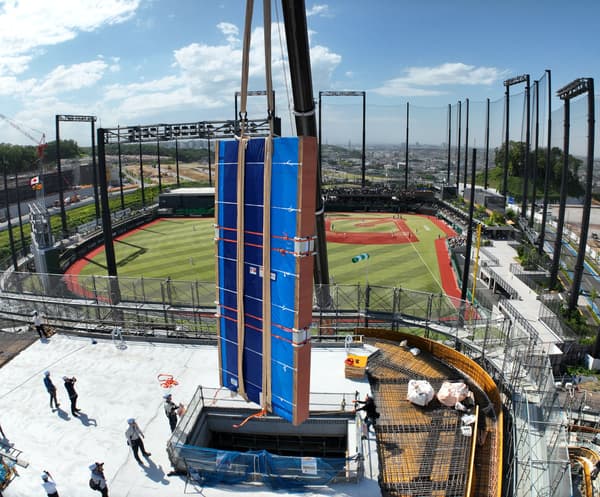
The giant acrylic panel being delivered (photographed May 29, 2026).
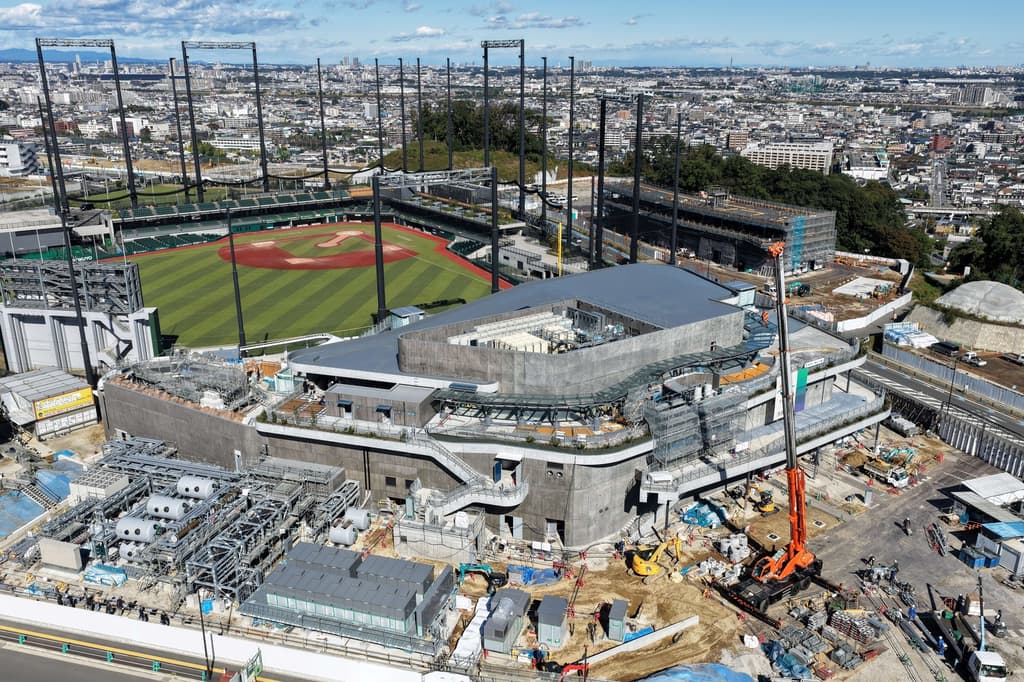
In May and June 2026, a giant acrylic panel for the large tank (about 8 m high, about 3 m wide, and over 16 tons) was delivered. It was lifted into the air by a large crane, carefully lowered into the building, and moved and installed over several days. Construction is currently about 60% complete, with the exterior now visible and interior work in full swing. To create a water environment in which the animals can live healthily, the aquarium will carry out careful adjustments during trial operation and then decide the opening date and time.
An Aquarium Connected to the Stadium Through the Tama River
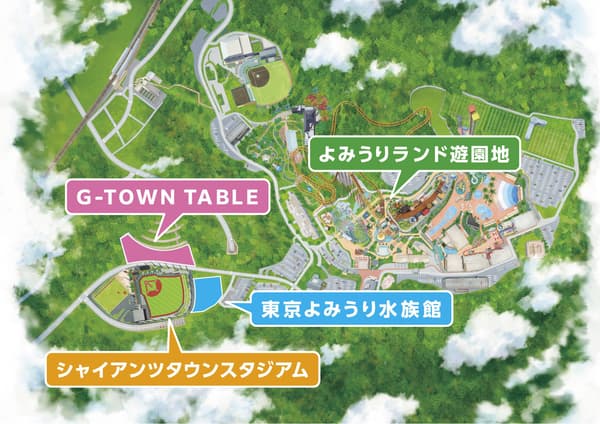
Tokyo Yomiuri Aquarium is a stadium-integrated aquarium that is unlike any other in Japan. It is located behind the left-field stands of Giants Town Stadium, and visitors can move freely between the two when no paid event is being held at the stadium.
The keyword linking the two facilities is "Tama River." The stadium is inspired by Tamagawa Ground (多摩川グラウンド) in Ota Ward, Tokyo, which was the Yomiuri Giants' exclusive ground from 1955 to 1998. At Tamagawa Ground in those days, fans casually called out to the future star players. To recreate that friendly atmosphere, the stadium limits the seating on the second and third floors to four rows, bringing spectators closer to the field.
The second floor of the stadium also has a 527 m concourse styled as an embankment of the Tama River, recreating the scene of fans strolling while looking at the players and the river. The concourse continues to the entrance on the second floor of the aquarium.
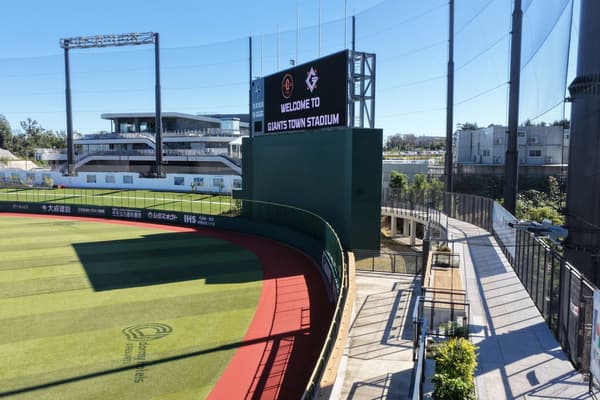
The concourse leads to the aquarium (photographed October 28, 2026).
Searching for Creatures in a Stream
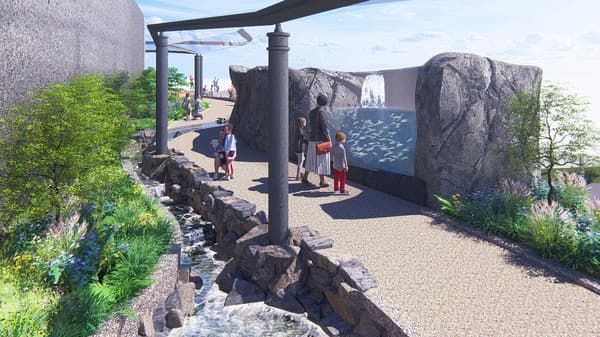
A recreation of the Tama River waterside (image).
The third floor of the aquarium will have the Tamagawa Area (多摩川エリア). Outdoors, creatures that live in the Tama River, such as sweetfish (ayu), will be on display, along with a stream modeled on a tributary where visitors can look for aquatic creatures. A café will be built indoors. From the café, visitors can see the whole stadium, a view unique to a stadium-integrated aquarium.
A Sea Lion Object as the Symbol
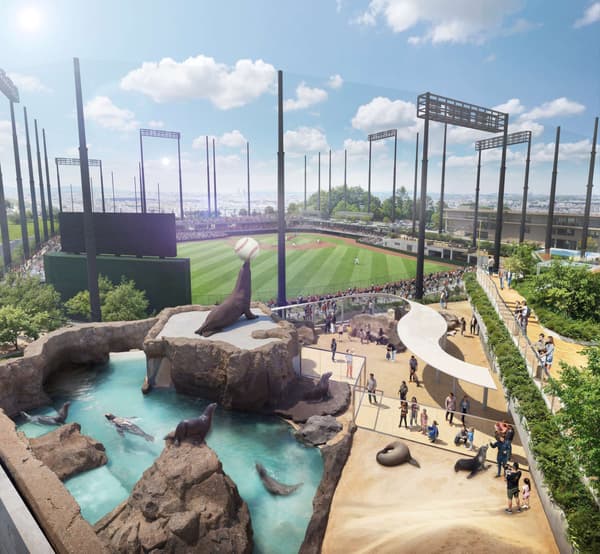
A sea lion object with a baseball on its nose (image).
The symbol of the unity between the stadium and the aquarium is a sea lion object about 5 m high with a baseball balanced on its nose. It will be installed in the outdoor Sea Lion Paradise so that it can be seen from various places in the stadium.
Information about the two facilities will also be shared in ways that make use of their integration, such as live broadcasts of the aquarium's animals on the stadium's large video screen. Visitors can tour the aquarium and then enjoy a baseball game or a walk around the stadium, or visit the aquarium after a game, offering a variety of ways to spend time at Tokyo Giants Town.
The Dining Facility "G-TOWN TABLE"
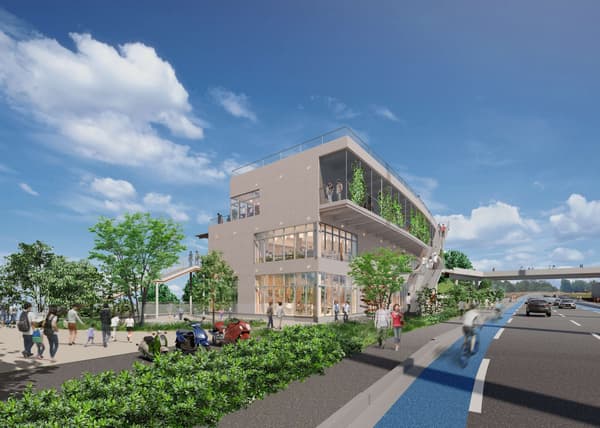
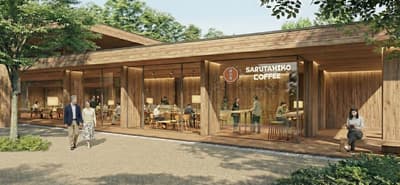
The dining facility, opening at the same time as the aquarium, is directly connected to it by a pedestrian bridge (image).
A three-story dining facility called G-TOWN TABLE (total floor area of 3,249 m²) will open at the same time as Tokyo Yomiuri Aquarium.
The facility is directly connected to the aquarium by a pedestrian bridge over a metropolitan road, so visitors can move between the stadium, the aquarium, and the dining facility without crossing a road. The ease of moving among the three facilities is a major feature of Tokyo Giants Town. The concept of G-TOWN TABLE is "Outstand" (アウトスタンド). A pleasant breeze passes through, the stadium can be seen from the building, and on the other side the cityscape stretches into the distance.
With the addition of the dining facility, visitors will be able to spend a relaxed time at Tokyo Giants Town while enjoying sports, aquarium experiences, and meals.
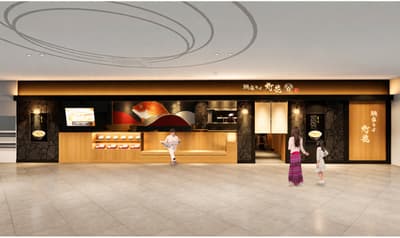
G-TOWN TABLE will be open not only to visitors of the stadium and the aquarium but also to local residents. The first floor will have a bakery café and other shops, the second floor a food hall and more, and the third floor specialty stores. The rooftop will also be open to the public.
About Tokyo Giants Town
Tokyo Giants Town is a town development project by The Yomiuri Shimbun Tokyo Headquarters, the Yomiuri Giants, and Yomiuriland on a site of about 76,000 m² adjacent to the Yomiuriland amusement park in Inagi, Tokyo. Its concept is "GROWINGOOD!", combining "GROWING," meaning growth, with "GOOD." Nearby are the Yomiuriland amusement park, Poké Park Kanto, the flower park HANA-BIYORI, the hot spring facility Kakeinoyu (花景の湯), and Tokyo Yomiuri Country Club, making it a leisure area that combines sports and entertainment, developed by the Yomiuri Group.