The Izu Peninsula juts out into the Pacific about 100 km southwest of Tokyo, and it packs a surprising amount of variety into a compact area. On the east coast you get rugged sea cliffs and surf beaches; on the west, quiet fishing villages and sea caves. Inland, volcanic peaks and bamboo-lined onsen towns fill the valleys. You can reach the northern gateway towns of Atami and Mishima from Tokyo in under an hour by Shinkansen, making Izu one of the easiest overnight or weekend trips from the capital.
This guide covers 15 of the strongest things to do across the peninsula, with real prices, hours, and train details so you can plan without guesswork.
Soak in Shuzenji Onsen
Shuzenji is the classic Izu onsen town. A narrow river runs through the center, lined by ryokan and crossed by small red bridges. The main draw is the atmosphere — old wooden buildings, steam rising from the river, and a bamboo-grove path lit up at night.
Shuzenji Temple (the temple that gave the town its name) sits at the heart of things. The grounds are open from 5:00 to 17:00, and the temple office sells goshuin (stamps) from 8:30 to 16:30 in summer, closing half an hour earlier in winter. The Bamboo Grove Path (Chikurin-no-Komichi) behind the temple is open from 6:00 to midnight, with a shadow-light illumination running from 20:00 to 22:00 most evenings.
One thing that trips people up: the temple is written 修禅寺 while the town and station use 修善寺. Both read "Shuzenji," but GPS apps sometimes get confused, so double-check when searching.
How to get there: Take the Tokaido Shinkansen from Tokyo to Mishima (about 55 minutes), then transfer to the Izu-Hakone Railway Sunzu Line to Shuzenji Station (about 32 minutes). From the station, a local bus reaches the onsen town in about 10 minutes. Alternatively, the direct Limited Express Odoriko runs from Tokyo Station to Shuzenji, taking roughly 2 hours and 10 minutes without any transfers.
Walk the Jogasaki Coast
The Jogasaki Coast on the eastern shore near Ito is where Izu shows off its volcanic geology. Lava flows hit the ocean here thousands of years ago, and what remains is a jagged wall of dark rock with the sea crashing below. The signature photo spot is the Kadowaki Suspension Bridge, a 48-meter-long span hanging 23 meters above a gorge.
A network of walking trails follows the clifftops. You can do the short loop around the bridge area in about 30 minutes, or extend your walk along the coast for an hour or more. The trails and suspension bridge are free to visit, and there are no fixed operating hours since it is an open-air coastal path, though you will want to go in daylight and avoid days with rough seas.
How to get there: From Ito Station, take the Izukyu Line one stop to Jogasaki-Kaigan Station, then walk about 25 minutes to the bridge area. From Izu-Kogen Station, local buses also run toward the coast.
Ride the Chairlift up Mount Omuro
Mount Omuro is a nearly perfectly round volcanic cone covered in green grass, standing 580 meters above sea level near the east coast. You ride a two-person chairlift to the top (no hiking trail exists — the lift is the only way up), and at the summit you can walk around the crater rim in about 20 to 30 minutes. On a clear day you get views of the Pacific, the Izu coastline, and Mount Fuji to the north.
The chairlift costs 1,000 yen for adults and 500 yen for children (round trip only). Hours run from 9:00 to 17:00 between March and September, and 9:00 to 16:00 from October through February, with the last downhill ride 15 minutes after closing.
How to get there: From Ito Station, take a Tokai Bus bound for Shaboten Koen (Cactus Park) and get off at the final stop. The ride takes about 40 minutes and costs 880 yen one way. The chairlift base is right across from the bus stop.
See Kawazu's Early Cherry Blossoms
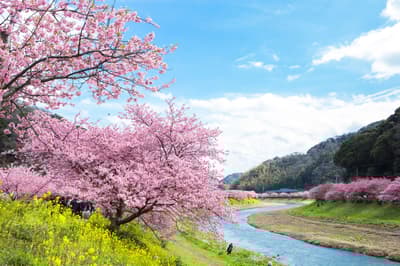
If you are visiting Izu between early February and early March, Kawazu should be at the top of your list. The town is famous for the Kawazu-zakura, a variety of cherry blossom that blooms about a month earlier than the Somei Yoshino trees that color the rest of Japan in late March and April. About 8,000 Kawazu-zakura trees line the river through town, and at peak bloom the combination of deep pink blossoms and bright yellow canola flowers along the riverbanks is genuinely striking.
The annual Kawazu Cherry Blossom Festival typically runs from early February to early March. In 2026, the festival dates are February 7 to March 8, and peak bloom was declared around February 13. The festival area is a three-minute walk from Kawazu Station, so you do not need a car.
How to get there: The Limited Express Odoriko from Tokyo Station reaches Kawazu in about 2 hours and 40 minutes. On weekends during the festival, extra trains run and the station area gets packed, so go on a weekday morning if you can.
Explore Shimoda's Beaches and Perry Road
Shimoda sits at the southern tip of the east coast and has two distinct draws: some of Izu's best beaches and an unusually rich bit of international history. This is where Commodore Perry's ships anchored in 1854, and where the Treaty of Peace and Amity was signed at Ryosenji Temple, effectively opening Japan to the world.
Perry Road is the main historic walk — a canal-side lane with old stone warehouses converted into cafes and antique shops, leading to Ryosenji Temple. Beyond the history, Shimoda Park offers bay views and is covered in hydrangeas every June.
For beaches, the main options are Shirahama, a long white-sand stretch with surf; Tatadohama, a quieter cove popular with surfers; Kisami Ohama, a broad sandy beach with space even on busy days; and Irita, a smaller bay with clear blue water that feels almost tropical. Beach season runs from mid-July through late August, though the sand and scenery are worth visiting year-round.
Shimoda is also the place to eat kinmedai (golden eye snapper), a local specialty served grilled, simmered, or as sashimi at restaurants around the station.
How to get there: The Izukyu Line from Ito reaches Izukyu-Shimoda Station in about an hour. From Tokyo, the direct Odoriko takes about 2 hours and 49 minutes.
Cruise through Dogashima's Sea Caves
On the quieter west coast, Dogashima is known for its eroded volcanic coastline and sea cave boat tours. The sightseeing boat takes you into a cave where sunlight pours through a hole in the ceiling, creating a natural spotlight on the water — it is called Tensodo (Cave of Heaven's Window) and the visual effect on a sunny day is genuinely dramatic.
The boat tour runs about 20 minutes and costs 1,500 yen for adults, 750 yen for children. Boats depart roughly every 15 to 20 minutes, with the last departure at 16:00. Operations depend on sea conditions, so check with the operator on rough-weather days.
Near Dogashima, a tidal tombolo (sandbar) connects to Sanshiro-jima island at low tide. The crossing is usually possible when the tide drops below 30 cm — roughly one hour before and after low tide. From March through September, daytime crossings are often possible, but between October and February the timing rarely lines up with daylight. The Nishiizu tourism association publishes a tide table each year showing exact crossing windows.
Hike the Kawazu Nanadaru (Seven Waterfalls)
The Kawazu Nanadaru trail follows the Kawazu River upstream through dense forest, passing seven waterfalls of varying sizes. The trail is paved and well-maintained, taking about 60 to 90 minutes to walk at a relaxed pace. Each waterfall has a viewing platform, and the largest — Odaru (Great Waterfall) — drops about 30 meters. The approach from the trailhead passes through a corridor of life-size statues from the short story "The Izu Dancer" by Nobel Prize-winning author Yasunari Kawabata, which is set along this very route.
The area also has a few small onsen bath houses near the trailhead, so you can soak after your walk. The trail itself is free to walk.
How to get there: From Kawazu Station, take a Tokai Bus toward Shuzenji and get off at Nanadaru (about 25 minutes). The trailhead starts from the bus stop area.
Take a Day Trip to Atami
Atami is the closest Izu town to Tokyo and works well as either a day trip or a first stop before heading deeper into the peninsula. The town wraps around a bay, with a hillside of ryokan and hotels stacked above the waterfront. Main draws include MOA Museum of Art, which houses National Treasure-level artworks in a dramatically designed cliffside building, and Atami Plum Garden (Atami Baien), which blooms from late January through early March with about 470 plum trees.
For onsen, Atami has both public baths and ryokan day-use options. The town also has a solid fireworks tradition — Atami hosts seaside fireworks shows multiple times throughout the year, visible from the beach and many hotel balconies.
How to get there: The Tokaido Shinkansen reaches Atami from Tokyo in about 45 minutes. Local JR trains from Tokyo also reach Atami in about 1 hour 40 minutes and cost less.
Cross the Amagi Pass
The Amagi area in central Izu is where the peninsula gets mountainous. The Amagi Pass (Amagi-goe) is famous in Japanese literature — it features in Kawabata's "The Izu Dancer" — and the hiking trails through beech and cedar forests here are some of the most peaceful walks on the peninsula. The old Amagi Tunnel (Joren Falls entrance side) and the surrounding trails offer good half-day hikes, especially in autumn when the leaves turn.
Joren Falls, near the western approach to the Amagi area, drops 25 meters in a curtain-like sheet. The basalt columns behind the falls are a designated natural monument. There is a short walking path from the parking area to the falls viewpoint.
Sample Local Seafood Across the Peninsula
Izu is surrounded by ocean on three sides, and fishing towns dot the entire coast. Rather than one single food destination, seafood is something you can eat well almost anywhere. Some highlights worth knowing about:
- Kinmedai (golden eye snapper) in Shimoda and Inatori — often served simmered in a sweet soy glaze (nitsuke) or as sashimi
- Aji (horse mackerel) in Numazu — the Numazu Port fish market at the northern base of the peninsula is a popular lunch stop
- Ise-ebi (spiny lobster) along the south coast, in season from about October through March
- Wasabi — Izu grows some of Japan's best wasabi in its mountain streams. You can try freshly grated wasabi at restaurants in the Amagi and Shuzenji areas, and the Amagi Wasabi-no-Sato offers wasabi-themed dishes and products
Book a Private Photoshoot in the Izu Area
If you want professional photos against the Izu coastline, onsen towns, or mountain scenery, a private photoshoot with a local photographer is a solid option. Sessions cover locations like the dramatic shoreline near Atami and Shimoda, hot spring town streets, historic Perry Road, or the volcanic crater views from Mount Omuro. Having a photographer who knows the area means you will find angles and timing (especially for light) that most visitors miss.
Relax at Izu-Nagaoka Onsen
Izu-Nagaoka is a mid-peninsula onsen town that does not get the same attention as Atami or Shuzenji but has its own appeal — it is quieter, the ryokan tend to be more affordable, and the hot spring water here is said to be excellent for skin. The town is also close to Nirayama Reverberatory Furnaces, a UNESCO World Heritage-affiliated site (part of the Sites of Japan's Meiji Industrial Revolution) that you can visit in about 30 minutes.
How to get there: From Mishima, take the Izu-Hakone Railway to Izu-Nagaoka Station (about 20 minutes).
Go Bar Hopping with a Local Guide
Exploring Izu's nightlife on your own can be tricky — many izakayas in smaller towns have no English menus and may feel hesitant about walk-in visitors who do not speak Japanese. A guided bar-hopping tour solves this by taking you to 2 to 3 local spots with a guide who handles the ordering and introductions. You get to eat regional dishes and drink local sake or craft beer without the language barrier.
Visit Izu Oshima Island
Izu Oshima is the largest of the Izu Islands, lying about 25 km off the coast. The island is dominated by Mount Mihara, an active volcano with a stark crater you can hike to. The landscape is surprisingly raw — lava fields, dense camellia forests, and black sand beaches give the island a very different feel from the mainland peninsula. Camellia season (late January through March) covers the hillsides in red and pink.
High-speed jet ferries from Atami reach Izu Oshima in about 45 minutes. From Tokyo's Takeshiba Terminal, the large ferry takes about 6 hours overnight or 1 hour 45 minutes by jet foil.
Plan Your Izu Trip by Season
Izu works year-round, but different seasons highlight different strengths:
- February to March: Kawazu cherry blossoms, Atami plum blossoms, and Minami-Izu canola flowers. This is the most popular season for flower-viewing day trips from Tokyo.
- April to June: Comfortable hiking weather along the Jogasaki coast and Amagi trails. June brings hydrangeas to Shimoda Park.
- July to August: Beach season at Shimoda's beaches. Atami fireworks shows light up the bay on multiple summer evenings.
- October to November: Autumn color in the Shuzenji bamboo grove and Amagi mountain forests. Cooler weather makes for better coastal walks.
- December to January: Quieter travel period with fewer crowds at onsen towns. Spiny lobster season is in full swing along the south coast.
Getting to the Izu Peninsula from Tokyo
Several train routes connect Tokyo to different parts of Izu:
- Tokaido Shinkansen to Atami (about 45 minutes) — best if you are starting with Atami or transferring to the Ito/Izukyu Line for the east coast
- Tokaido Shinkansen to Mishima (about 55 minutes) — best for Shuzenji, Izu-Nagaoka, and western Izu
- Limited Express Odoriko from Tokyo Station — runs direct to Ito (about 1 hour 40 minutes), Izu-Kogen, Kawazu (about 2 hours 40 minutes), and Izukyu-Shimoda (about 2 hours 49 minutes). A separate Odoriko route goes to Shuzenji (about 2 hours 10 minutes). Reserved seats are required.
- JR Tokaido Line (local) — the budget option to Atami at about 1 hour 40 minutes, then transfer to the Ito Line or Izukyu Line
Once on the peninsula, the Izukyu Line covers the east coast from Ito down to Shimoda. For Shuzenji and the west coast, buses from Shuzenji Station or Mishima Station are the main option. Renting a car at Mishima or Ito opens up the west coast and mountain areas, where bus service can be infrequent.