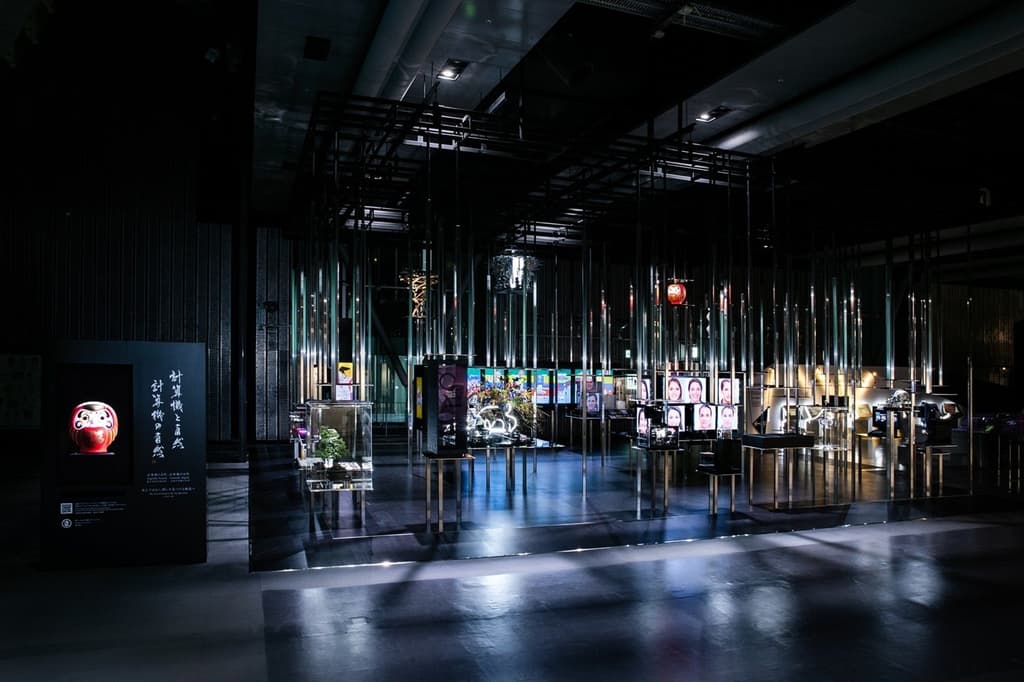
The National Museum of Emerging Science and Innovation (Miraikan, Director: Chieko Asakawa) is partially renewing its permanent exhibition "Digitally Natural - Naturally Digital," with comprehensive supervision by media artist Yoichi Ochiai — who also designed the signature pavilion "null²" at the Osaka-Kansai Expo. The renewed exhibition opens to the public on April 1, 2026 (Wednesday), as the second installment in a series of Osaka-Kansai Expo-themed exhibitions.
The renewal introduces updates to the two core symbol exhibits, "Computers and Nature" and "Nature of Computers," along with two entirely new exhibits: one featuring generative AI powered by a large language model (LLM), and another applying glasses-free 3D stereoscopic viewing technology.
Originally opened in November 2019, the permanent exhibition "Digitally Natural - Naturally Digital" explores how our sense of nature and understanding of the world may change as computers and artificial intelligence (AI) continue to advance. As digital devices and software evolve, the worlds they create are approaching a resolution that surpasses human perception. This state — where the boundary between nature and artificial objects dissolves, and digital and analog mutually enhance one another — is envisioned as the "new nature" of humanity's future, presented through numerous exhibits that challenge everyday assumptions.
Opening Details
| Opening Date | April 1, 2026 (Wednesday) |
| Exhibition Area | 3rd Floor, Permanent Exhibition Zone "Digitally Natural - Naturally Digital," Miraikan |
| Closed Days | Tuesdays (may be open on public holidays, during summer vacation, etc.) *Closed for facility maintenance from October 1, 2026 to April 22, 2027 |
| Opening Hours | 10:00 AM to 5:00 PM (ticket purchase and reception until 4:30 PM) |
| Admission | Adults (age 19 and over): ¥630; Ages 18 and under (elementary school age and above): ¥210 *Free for preschool children and for visitors age 18 and under on Saturdays |
| URL | https://www.miraikan.jst.go.jp/exhibitions/future/digitallynatural/ |
Exhibition Highlights
"Computers and Nature" (Renewed)
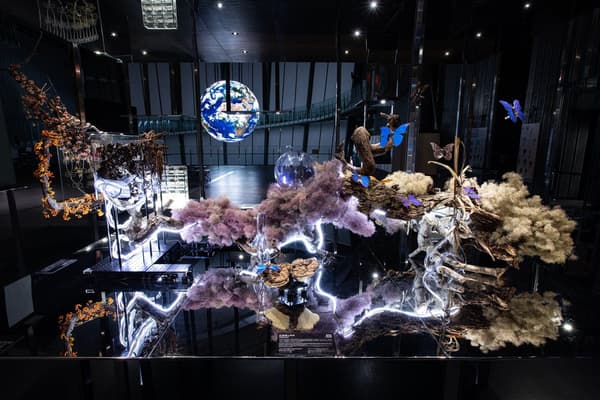
This exhibit lets visitors experience a world where printed butterflies hide among trees and flowers, blurring the line between natural forms and computer-generated artificial objects. A newly added video artwork uses generative AI to depict cracked LCD imagery that continuously shifts and transforms. The cracks undulate like liquid and change shape without end, visually embodying the "Computers and Nature" worldview in which the boundary between matter and information dissolves to give rise to something new.
Credits
Ikebana: Yuki Tsuji (Kadō artist, Yuki Tsuji Space Laboratory Co., Ltd.)
Video/Installation: Yoichi Ochiai (media artist)
Structural Color Printing: Fujifilm Imaging Systems Co., Ltd.
Butterfly Mechanism: Kokusai Display Kogyo Co., Ltd.
"Nature of Computers" (Renewed)
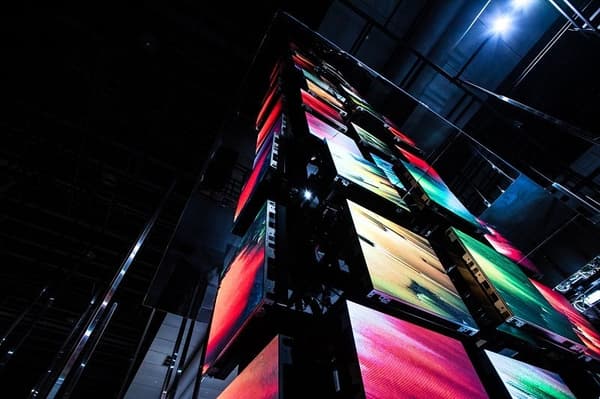
Image generation is one of the most prominent fields where AI excels. AI learns common features from vast numbers of images and creates entirely new images that exist nowhere in the world. This exhibit applies new AI-based expression from the "null²" exhibit at the Osaka-Kansai Expo. Using a generative AI technology called a "diffusion model" — which learns to restore clear images from noise — the installation displays footage generated in real time from video captured by on-site cameras.
Credits
Created by: Yoichi Ochiai (media artist)
Technical Assistant: Tatsuya Minagawa
"Does it matter whether you're talking to a human or a machine?" (New)
When a visitor speaks into a telephone receiver, a voice recognition AI converts the words to text, and a text generation AI produces a response. A voice synthesis AI then reads that response aloud in the voice of media artist Yoichi Ochiai. At the heart of this sequence is a generative AI technology called a "large language model (LLM)," which learns the structure of language from vast amounts of text. The black rotary phone once connected only to humans, but the distinction between human and machine is becoming increasingly blurred.
Credits
Created by: Yoichi Ochiai (media artist)
Technical Assistant: Yuga Tsukuda

"Is this inside or outside the computer?" (New)
This exhibit applies glasses-free 3D stereoscopic viewing, so visitors can experience three-dimensional imagery without special glasses. A camera tracks the position of both eyes of the nearest visitor and continuously updates the monitor display to match their line of sight, creating a convincing sense of depth. In this work, a physical sculpture and three-dimensional data are united as one, offering a new experience that probes the boundary between the real and the virtual.
Credits
Original concept and production: Takumi Yokoyama (University of Tsukuba), University of Tsukuba Digital Nature Research and Development Center
Data courtesy: Stanford Computer Graphics Laboratory
Note: Discontinued exhibits
As part of the renewal, the following exhibits have ended:
- Were colors the same in the past?
- Is this inside or outside the computer? (previous version)