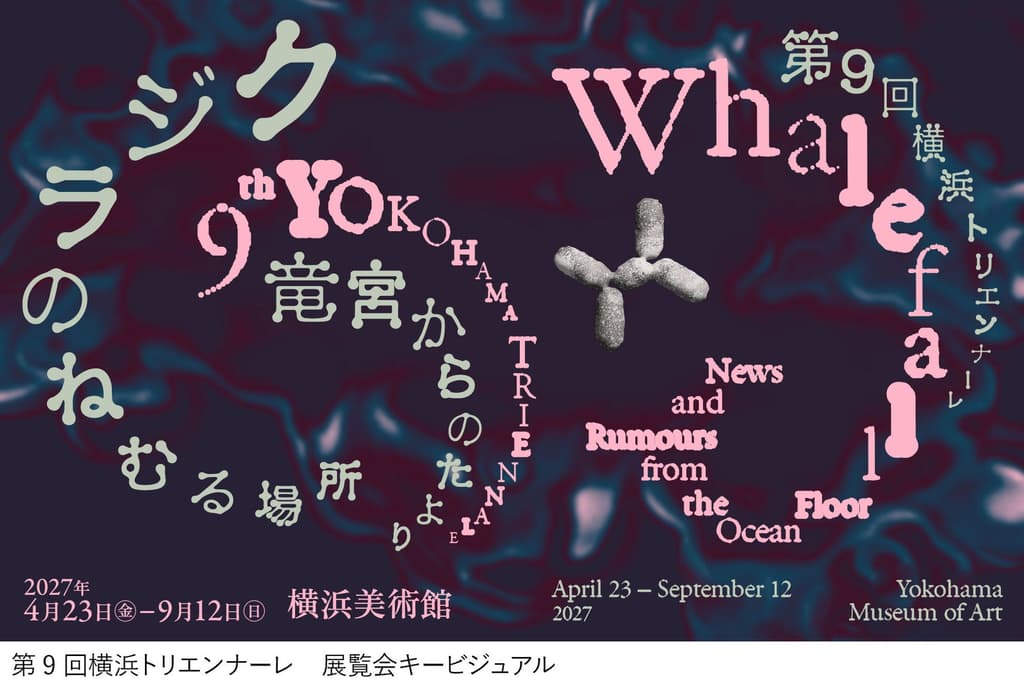
The 9th Yokohama Triennale will be held from April 23 (Friday) to September 12 (Sunday), 2027, at the Yokohama Museum of Art, and its exhibition title, concept, and key visual have now been revealed.
Exhibition Title: "Whalefall: News and Rumours from the Ocean Floor"
The exhibition's Japanese title is クジラのねむる場所、竜宮からのたより. It takes two motifs from the deep sea. One is the oarfish, a deep-sea fish said to announce the coming of disaster. The other is "whale fall" (whale-bone communities), in which the huge body of a whale that has sunk to the seafloor nurtures a new circulation of ecosystems over generations. Using these two motifs as clues, the exhibition looks at today's world, which seems to be sinking under the weight of various crises, and presents works that search for signs of hope for the future sprouting in its depths.
Thinking About Global Connections From the Port
Today's information and communication networks are supported by submarine cables laid across the deep sea. This global network inherits the telegraph network built when Yokohama's port opened, as well as the history of international exchange that had been woven even earlier. Against this background of changing and evolving means of communication, Artistic Directors Cosmin Costinaș and Inti Guerrero conceived the exhibition with inspiration from the "port," a place where people and cultures come and go and where various intentions and stories intersect.
The Museum Imagined as a Whale
The Yokohama Triennale is an international exhibition of contemporary art held once every three years. For the 9th edition, the venue, the Yokohama Museum of Art, is imagined as the body of a large whale, inviting visitors into the unknown that lies deep inside. The exhibition aims to give everyone, from people unfamiliar with contemporary art to the children who will shape the future, a chance to experience the diversity of the world.
Exhibition Concept
"Whalefall: News and Rumours from the Ocean Floor"
The oarfish, which lives in the deep sea, is known in Japan as a messenger from the "Dragon Palace" (Ryugu-jo) of the fairy tale, and its appearance at the sea surface has long been regarded as an omen of disaster. In the phenomenon known as whale fall (whale-bone communities), however, both the direction of movement and the meaning it carries are reversed. The body of a dead whale sinks to the seafloor and becomes the source of an ecosystem that nurtures life for decades or even longer. This sinking movement, which finds a beginning in death and richness in an ending, is the central metaphor of "Whalefall: News and Rumours from the Ocean Floor."
Much of today's anxiety has been seen as a kind of "monster" that devours humanity and its world. But what if humanity could eat this monster and overcome the fear? To reverse the story of calamity, we look downward, in order to find hope in the depths of the darkness where life stirs and in the collective act of digestion.
The 9th Yokohama Triennale follows the news and rumours of the oarfish. This is deepened through a series of episodes in the history of information transmission, which could also be called a kind of deceptive testing ground. The Manila galleon trade, which connected Asia and the Americas from the late 16th century, played an important role in a worldwide information network maintained by Catholic religious orders and supported an early form of cybernetic globalization. Information about the persecution of Christians in places such as Nagasaki spread through this network, embellished by missionaries. The telegraph systems and panorama halls that developed in the 19th century as media supporting nationalism and empire turned false reports and spectacles displaying imperial prestige into collective reality. And today's internet and social media, as well as AI, the ultimate illusion that digests the past and closes off new possibilities, are in fact supported by undersea cables covered with marine life.
Yokohama, which opened to the world at the dawn of Japan's modernization, is the starting point of the story this triennale traces. Through architectural interventions in the Triennale, the Yokohama Museum of Art becomes the body of a whale, and its Grand Gallery turns into the inside of that body, or the hull of a giant ship. Expressions rooted in different lineages gather there, and a new world rises from the seabed.
Cosmin Costinaș and Inti Guerrero, Artistic Directors, 9th Yokohama Triennale
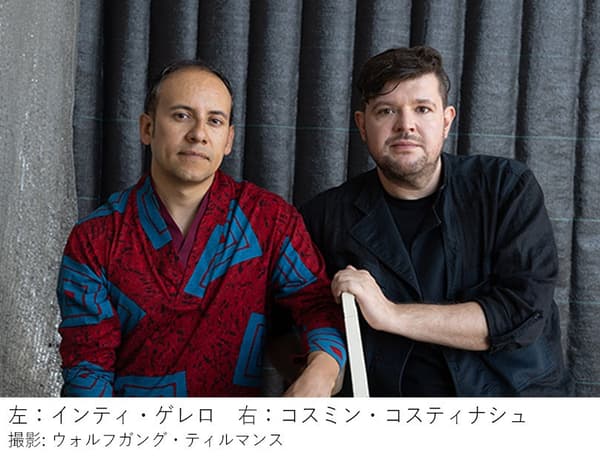
Left: Inti Guerrero, right: Cosmin Costinaș. Photo: Wolfgang Tillmans
About the Key Visual
The key visual for the 9th Yokohama Triennale was designed by Studio YUKIKO, a Berlin-based creative agency.
"Whale Fall" Expressed Through Spiral Swells
The sea exists together with everything that passes through it, and the ideas, images, and information circulating there change along with the sea's constant motion. A signal sent from one place drifts in a spiral between clarity and obscurity on the seabed and surfaces again in another place. The spiraling letters visualize this rising and sinking movement in the sea. They also express the circulation and distortion of information, and the duality of "whale fall" (whale-bone communities), in which an ending leads to a beginning.
The Yokohama Triennale Logo, Turned Into a Fossil
The "Y" of the Yokohama Triennale logo is rendered like a fossil, showing the present form as a trace that will remain into the future. It suggests that even when old systems collapse, a new ecosystem is born.
Organically Changing Letters
By adopting a variable typeface based on a dot matrix, the letters gradually grow larger as they rise and change into organic shapes. Each dot represents a new possibility or ecosystem.
Colors That Represent the Sea
Against a background of blue and deep red representing the deep sea, bright coral red and soft green are combined to express the hope, possibilities, and new life that emerge from the dark deep sea.
About Studio YUKIKO
Founded in 2012, Studio YUKIKO is a Berlin-based creative agency. It has won numerous awards for communication design based on its own concepts in a wide range of fields, including fashion, technology, culture, and art. By unearthing stories buried around the world, it conveys the voices and activities of local communities, while looking at the internet and contemporary culture to present new perspectives. Through ongoing research, it explores the possibilities of new visual expression and aims to deepen understanding of culture, society, and technology. Its major works include the visual identity plans for the 36th São Paulo Bienal (2025) and Haus der Kulturen der Welt (HKW) (2023).
- Website: https://y-u-k-i-k-o.com/
- Instagram: @studio_yukiko
Exhibition Information
9th Yokohama Triennale "Whalefall: News and Rumours from the Ocean Floor"
- Artistic Directors: Cosmin Costinaș and Inti Guerrero
- Dates: April 23 (Friday) to September 12 (Sunday), 2027 (124 days)
- Closed: Every Thursday (except April 29 and September 9) and April 28 (Wednesday)
- Venue: Yokohama Museum of Art (3-4-1 Minatomirai, Nishi-ku, Yokohama)
- Organizers: City of Yokohama, Yokohama Arts Foundation, NHK, The Asahi Shimbun Company, Yokohama Triennale Organizing Committee
- Official website: https://www.yokohamatriennale.jp
About the Yokohama Triennale
The Yokohama Triennale is an international exhibition of contemporary art held every three years in the city of Yokohama. Besides showing works by internationally active artists, it has widely introduced emerging artists and presented the latest trends in contemporary art around the world. Since the first exhibition in 2001, it has been held repeatedly, and in an era when world circumstances change rapidly, it has looked at the relationship between the world and Japan and between society and the individual, re-examining the social significance of art from a wider range of perspectives.
From the 1st edition (2001) to the 3rd edition (2008), the Japan Foundation served as one of the organizers and ran the secretariat, with the goal of promoting cultural exchange between Japan and other countries through contemporary art. Since the 4th edition (2011), operation has been led by the City of Yokohama, and the event has continued as a project symbolizing Yokohama as a creative city of culture and the arts, welcoming many visitors.