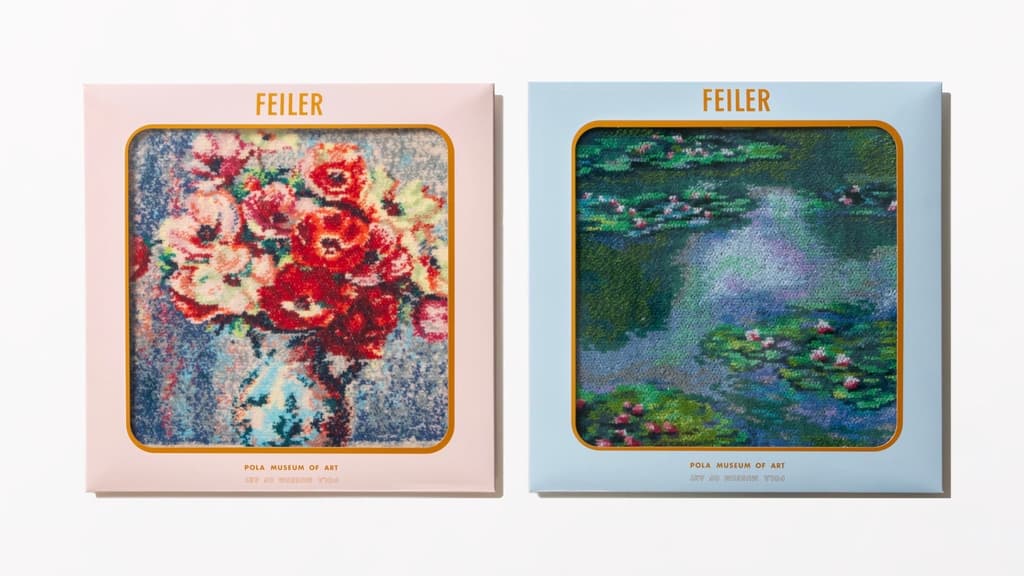
Pola Museum of Art (Hakone, Kanagawa Prefecture) has collaborated with FEILER for the first time, releasing two original handkerchiefs featuring paintings from the museum's collection — Claude Monet's "Water Lilies" and Pierre-Auguste Renoir's "Anemones." The handkerchiefs went on sale from June 17 (Wednesday) at the Pola Museum of Art Museum Shop and online shop, coinciding with the exhibition "The New Vision: Monet and 21st-Century Art," held to mark the 100th anniversary of Claude Monet's death and the museum's 25th anniversary.
FEILER, founded in Germany in 1948, wove these Pola Museum of Art original handkerchiefs using its traditional chenille technique. Colors were selected from a palette of 130 threads to capture the world of each artwork with delicate weaving, while gold and silver threads beautifully reflect the shimmering light on the water's surface and the sparkle of the flowers.
Product Details: Pola Museum of Art × FEILER Original Handkerchiefs
Works featured: Claude Monet, "Water Lilies"; Pierre-Auguste Renoir, "Anemones"
Size: Approximately 25 × 25 cm
Price: ¥3,520 each (tax included)
Sales start: June 17, 2026 (Wednesday) at 9:00 AM
Available at:
- Pola Museum of Art Museum Shop
- Online Shop: https://shop.polamuseum.or.jp/
Note: These handkerchiefs are not available at FEILER stores or the official FEILER online shop.
About the Works
Claude Monet, "Water Lilies"
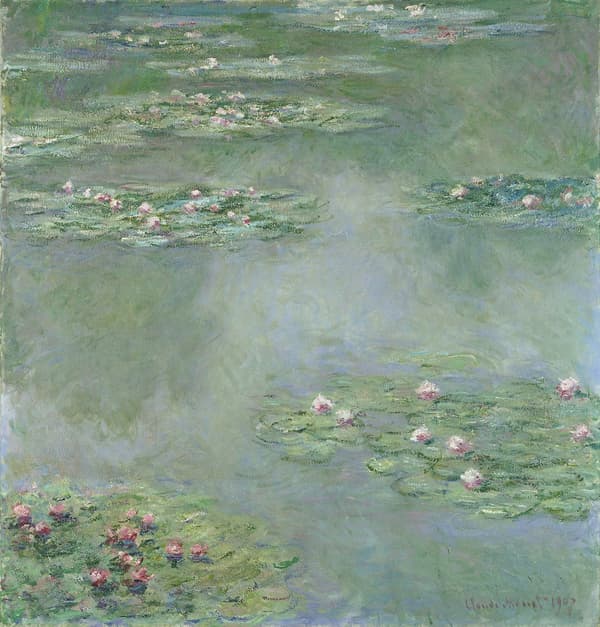
Claude Monet (1840–1926), a master of Impressionism who spent his life capturing the changing qualities of light and atmosphere, created the "Water Lilies" series as the culmination of his career, focused on the garden he cultivated at Giverny, his final home. The series has had a profound influence on painting from the 20th century onward.
This work belongs to the second series (unveiled in 1909), which garnered widespread acclaim for its concentrated focus entirely on the surface of the water dotted with water lilies. By capturing the varied effects of light on the water's surface, Monet conveys the color of the sky, the movement of clouds, the presence of surrounding trees, and the world beneath the water's surface — hinting at a world that extends beyond the canvas itself.
Pierre-Auguste Renoir, "Anemones"
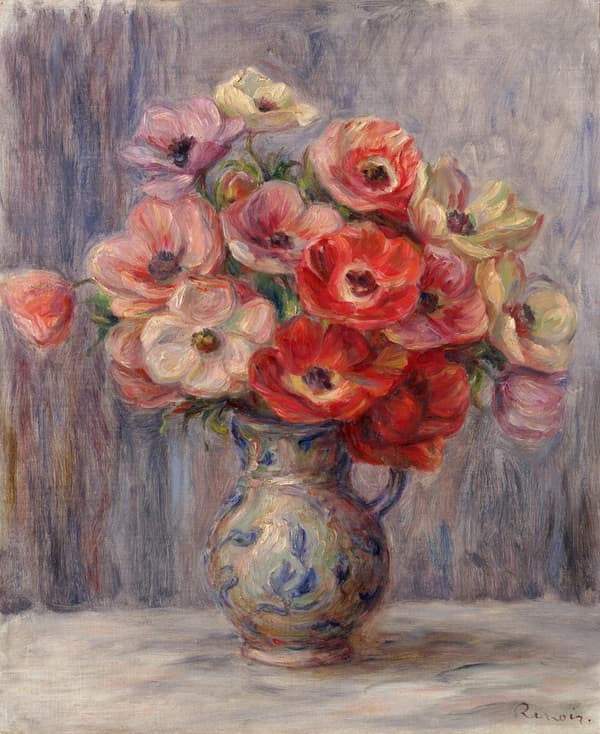
Pierre-Auguste Renoir (1841–1919) established a distinctive style characterized by soft brushwork and vibrant colors, and alongside Monet, was a leading figure of Impressionism.
Anemones were one of Renoir's most beloved flowers to paint, alongside roses and dahlias. The painter may have been drawn to their form — the sepal parts, which resemble curling petals, arrayed to create a rounded shape, in a variety of colors. In this work, the blue background unifies the composition, while the cobalt blue of the vase's decorative pattern further accentuates the brilliant reds and mauves of the flowers.
Exhibition Information
"The New Vision: Monet and 21st-Century Art" (Commemorating the 100th Anniversary of Monet's Death and the Museum's 25th Anniversary)
https://www.polamuseum.or.jp/sp/the-new-vision/
"Cézanne Legend" (concurrent exhibition)
https://www.polamuseum.or.jp/exhibition/20260617c02/
Dates: June 17, 2026 (Wednesday) to April 7, 2027 (Wednesday), open daily during the exhibition period (closed December 1 [Tuesday])