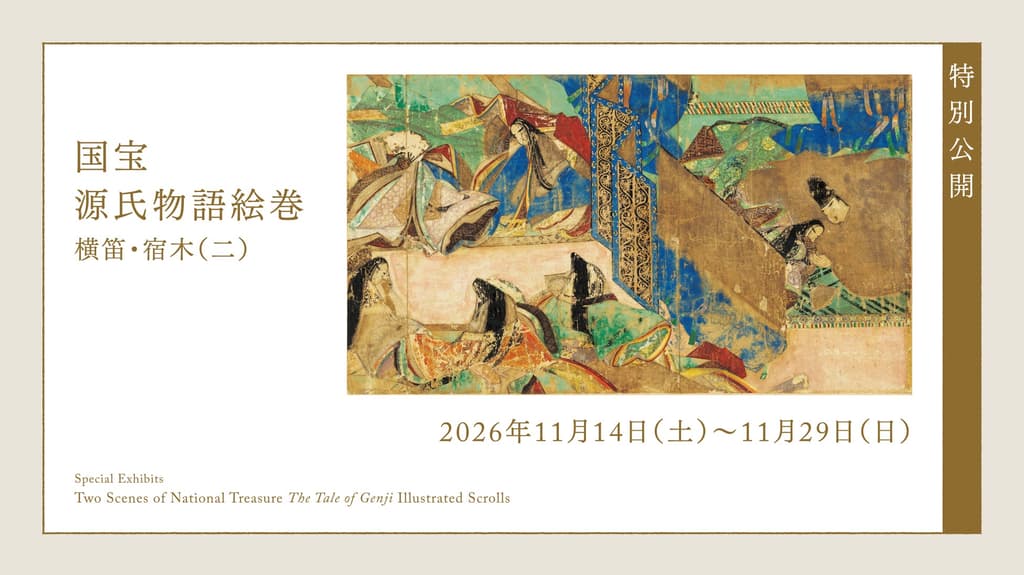
The Tokugawa Art Museum in Higashi Ward, Nagoya, will put "Yokobue (The Flute)" and "Yadorigi (The Ivy) II" from the national treasure The Tale of Genji Illustrated Scrolls on special display from Saturday, November 14 to Sunday, November 29, 2026.
The Tale of Genji Illustrated Scrolls is the oldest surviving narrative picture scroll, depicting the court culture of the Heian period with delicate brushwork and rich colors. This display features two chapters: "Yokobue (The Flute)," which portrays one night in the life of a married couple set off by the flute of a late close friend, and "Yadorigi (The Ivy) II," which portrays a splendid wedding of Heian aristocrats.
It is a rare chance to see up close a work made about 900 years ago and described as the "greatest masterpiece of yamato-e" (Japanese-style painting).
Chapter 37: Yokobue (The Flute)
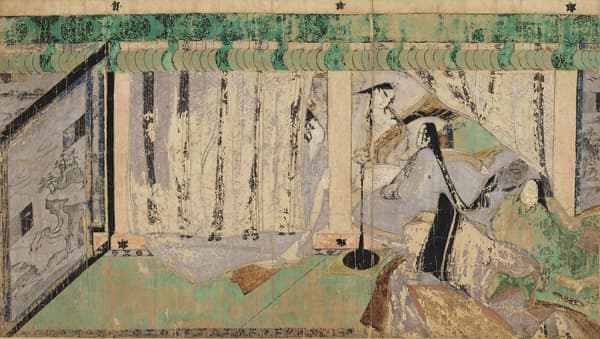
National Treasure, The Tale of Genji Illustrated Scrolls, Yokobue (The Flute) (painting section), Heian period, 12th century, Tokugawa Art Museum collection.
Yugiri (夕霧) is given the flute of his late close friend Kashiwagi (柏木). That night, Kashiwagi appears in his dream and tells him he would like the flute to be passed on to his descendants.
The painting depicts the moment when Yugiri's wife, Kumoi no Kari (雲居雁), is woken by the voice of a baby who has burst into tears, frightened by the presence of Kashiwagi. She tucks her long hair behind her ear and nurses the child. The wet nurse scatters rice to drive off an evil spirit (mono no ke), while her husband Yugiri peers in at the scene.
The everyday life of child-rearing and married life within elegant aristocratic society is vividly depicted.
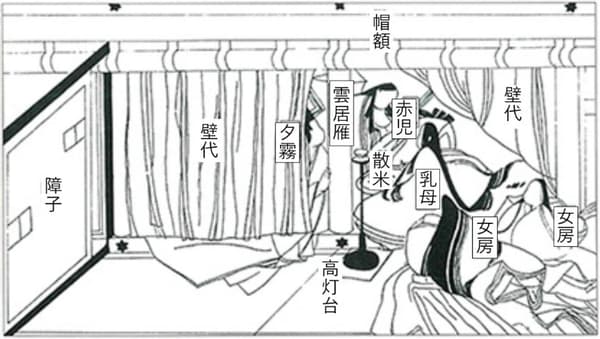
Yokobue (The Flute), figure placement diagram
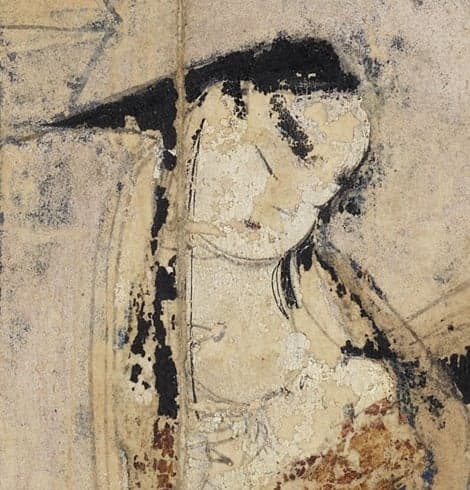
Kumoi no Kari tucks her long hair behind her ear and, with a hand at her breast, nurses the baby. The figure of a mother busy with child-rearing comes across vividly.
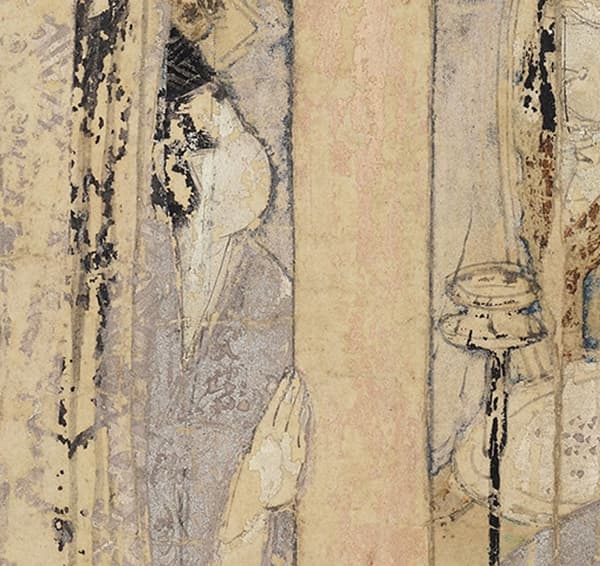
Yugiri peers in at his wife and child from behind the kabeshiro (壁代), a cloth partition. The area is lit by a tall lamp stand (高灯台).
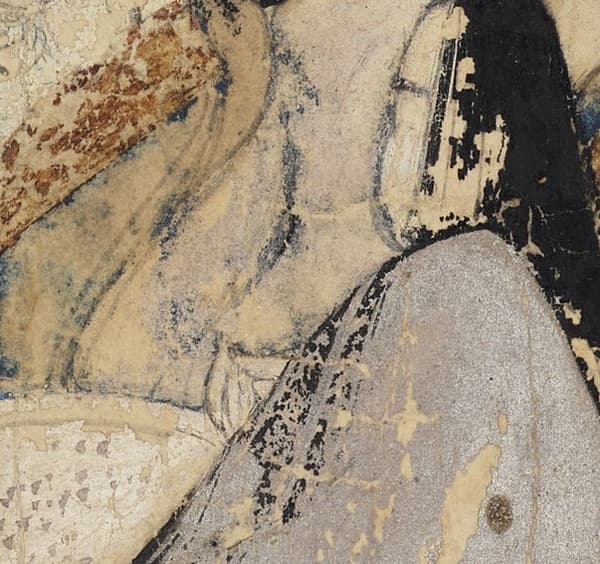
The wet nurse scatters rice to drive off an evil spirit. She is shown picking rice from a vessel and about to scatter it.
Chapter 49: Yadorigi (The Ivy) II
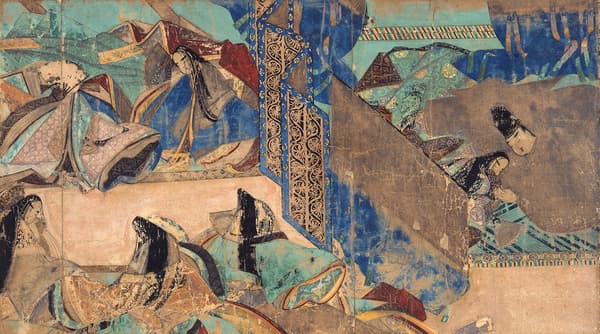
National Treasure, The Tale of Genji Illustrated Scrolls, Yadorigi (The Ivy) II (painting section), Heian period, 12th century, Tokugawa Art Museum collection.
Niou no Miya (匂宮), the third prince of the reigning emperor, reluctantly goes through with his wedding to Yugiri's daughter, Roku no Kimi (六の君). But on the morning after the ceremony on the third day of the marriage, when he sees Roku no Kimi for the first time in the light of day, he finds her flawlessly beautiful and intelligent, and is completely captivated.
The painting depicts a scene in which Roku no Kimi, drawn close by Niou no Miya, is shy. Beside them, hand-picked court ladies (nyobo, 女房) line up, dressed in gorgeous costumes elaborated beyond the bounds of convention in an effort to astonish Niou no Miya.
A solemn, magnificent scene fitting a wedding in the flourishing house of the Minister of the Left, along with the stirrings of the young couple's hearts, is painted with striking use of vivid ultramarine.
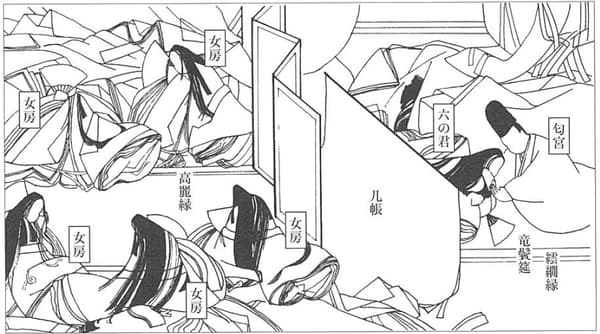
Yadorigi (The Ivy) II, figure placement diagram
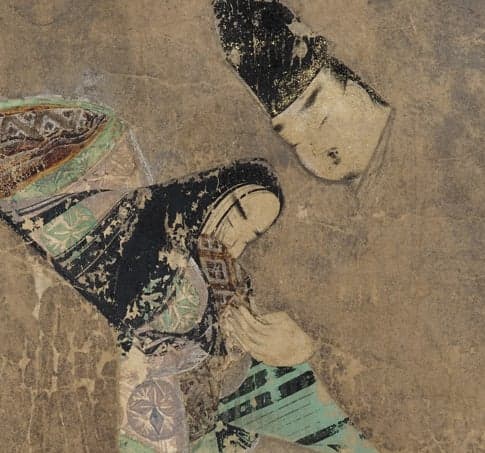
Roku no Kimi lowers her face, shy in Niou no Miya's embrace. The freshness of the newlyweds comes across.
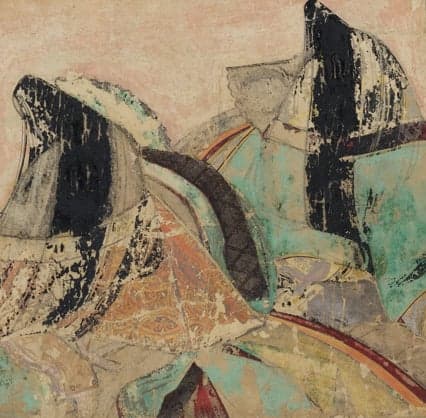
Court ladies lined up in dazzling costumes. The text of the tale states that 30 court ladies and 6 young girl attendants (女童) were waiting.
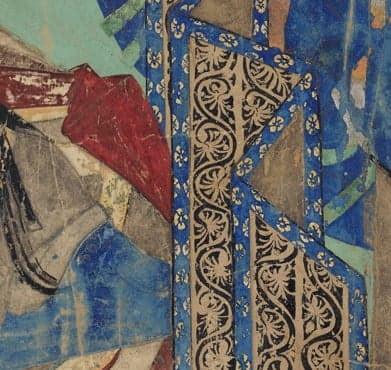
The ultramarine that remains vivid and the yusoku patterns (有職文様) leave an even deeper impression of the splendid wedding scene.
Special Display Details
Special display: National Treasure The Tale of Genji Illustrated Scrolls, "Yokobue (The Flute)" and "Yadorigi (The Ivy) II"
Dates: Saturday, November 14 to Sunday, November 29, 2026
Venue: Tokugawa Art Museum, Masterpiece Collection Exhibition Room 5 (名品コレクション展示室5)
Hours: 10:00 AM to 5:00 PM (last admission at 4:30 PM)
Closed: Mondays (the museum is open on Monday, November 23, a national holiday, and closed on the following day, Tuesday, November 24)
Admission:
- General: ¥2,000
- High school and university students: ¥1,200
- Junior high school students and younger: Free
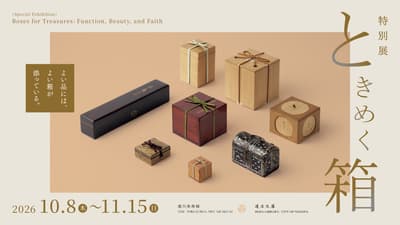
The same admission also covers the special exhibition "Tokimeku Hako" (ときめく箱, through November 15) and the feature exhibition 旅する侯爵 徳川義親 (through December 13), both currently under way.
Organizer: Tokugawa Art Museum
Tokugawa Art Museum Information
Address: 1017 Tokugawa-cho, Higashi-ku, Nagoya 461-0023
Phone: 052-935-6262 (10:00 AM to 5:00 PM, except Mondays)
Hours: 10:00 AM to 5:00 PM (last admission at 4:30 PM). Closed on Mondays (the following weekday if Monday is a national holiday).
Access:
- 8-minute walk from the south exit of Ozone Station on the JR Chuo Main Line
- 3-minute walk from the "Tokugawaen Shindeki" stop on Nagoya City Bus and Meitetsu Bus Kikan Route 2
- Right by the "Tokugawaen, Tokugawa Art Museum, Hosa Bunko" stop on the Nagoya Sightseeing Route Bus Meguru
- Free parking for 17 cars on the south side of the museum
Official website: https://www.tokugawa-art-museum.jp/
Facebook: https://www.facebook.com/tokugawa.art.museum